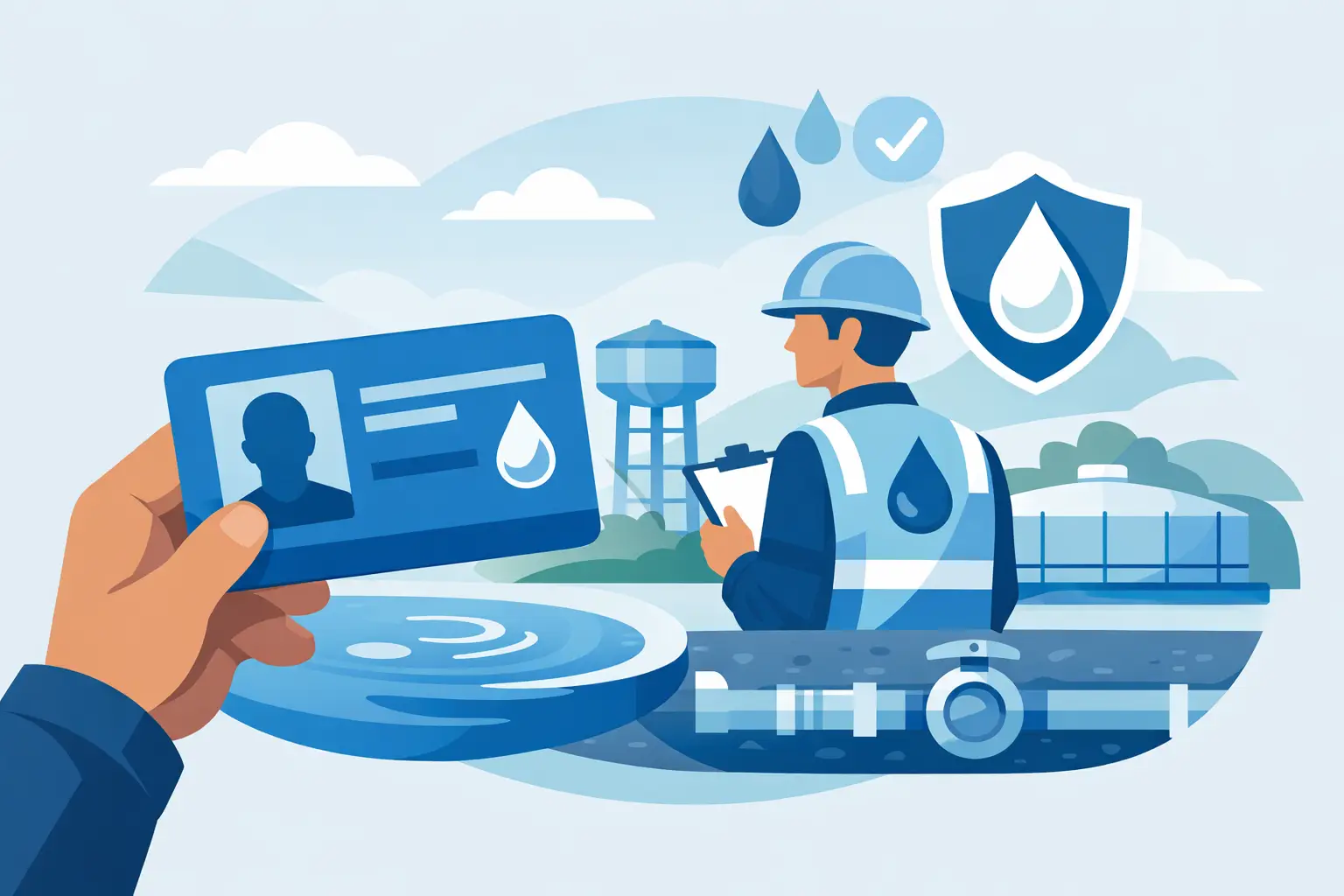
A contractor may have an excellent RAMS pack, current plant certification and a competent supervisor, yet still be turned away at the gate of a clean-water site. Where work could affect potable water assets, the EUSR National Water Hygiene (Blue Card) is commonly a site-access requirement and a key part of demonstrating workforce competence.
For principal contractors, utilities providers and supply-chain businesses, the card is not simply an administrative requirement. It provides evidence that an individual understands the consequences of poor hygiene controls around drinking-water infrastructure. That matters wherever work takes place at treatment works, service reservoirs, pumping stations, distribution assets or other controlled areas where contamination could affect customers.
What is the EUSR National Water Hygiene Blue Card?
The EUSR National Water Hygiene scheme is an industry-recognised registration for people who work on, or may enter, environments associated with the drinking-water supply. The resulting registration is widely known as the Blue Card. Its purpose is to establish a consistent baseline of hygiene awareness across the water-industry workforce, including direct employees, agency labour, subcontractors and specialist visitors.
It focuses on protecting public health and maintaining water quality. A relatively minor lapse in personal hygiene, tool control, material storage or access discipline can introduce a contamination risk. The operational consequences may include water-quality investigations, service disruption, regulatory scrutiny, customer impact and substantial remedial cost.
The Blue Card should not be confused with a general construction card, a water-industry site induction or a technical competence qualification. It does not authorise an operative to carry out every task on a water site. A confined-space entry, lifting operation, electrical isolation, chlorination activity or excavation near buried services will still require the relevant training, permits, supervision, RAMS and task-specific controls.
Who needs National Water Hygiene registration?
The requirement depends on the asset owner, the work location and the scope of activity. In practice, National Water Hygiene registration is frequently required for personnel entering clean-water operational sites or working where their actions could affect potable-water quality.
This can include civil engineering operatives, pipefitters, mechanical and electrical contractors, commissioning teams, surveyors, drainage specialists, cleaners, security staff, delivery personnel and project managers. It may also be required for specialist suppliers undertaking inspections, maintenance or temporary works.
A useful planning rule is to check the client specification before mobilisation, not after a team has been allocated. Water companies and tier-one contractors can apply local access arrangements in addition to EUSR requirements. The presence of a current Blue Card does not remove the need for a local induction, medical declaration, security clearance, plant competence evidence or a review of site-specific risks.
Clean water and wastewater work are not the same
Not every utilities project carries the same hygiene controls. Wastewater, drainage and pumping-station work may present significant biological, chemical and confined-space hazards, but the National Water Hygiene scheme is principally associated with protecting drinking-water supplies. A project team should therefore identify the asset type, client standards and interfaces between clean-water and wastewater systems at tender stage.
This distinction matters on complex capital works. A contractor may work across treatment, distribution, sewerage and environmental infrastructure under one framework, while each location has different access, PPE, decontamination and competence requirements.
What the training is designed to cover
National Water Hygiene training establishes practical awareness of behaviours that can protect or compromise water quality. Learners are expected to understand why hygiene controls apply, rather than merely memorising site rules.
Training typically addresses the importance of safe drinking water, routes by which contamination can be introduced, personal hygiene expectations, welfare arrangements, illness reporting, protection of work areas, and the care of tools, materials and equipment. It also reinforces the need to follow the asset owner’s procedures where there is a suspected contamination event or an activity that could affect water quality.
The operational value is straightforward. A worker who understands the consequences of placing unclean equipment near an open chamber, bypassing a controlled access point, or failing to report illness is better placed to stop and escalate an issue. This supports the wider control framework of permits, method statements, work packs, quality plans and site supervision.
For employers, the course should form part of a broader competence matrix. It works best when records are linked to named roles, planned work locations and renewal dates. Treating it as a one-off booking exercise creates predictable problems when a framework call-off starts at short notice and key operatives cannot obtain access.
Blue Card validity and renewal planning
EUSR registrations are time limited, and National Water Hygiene registration is generally valid for three years. Employers should nevertheless confirm current scheme rules, card status and client requirements before deployment, particularly where an operative has changed employer, name or role.
A central training matrix should record the registration expiry date alongside other critical evidence such as EUSR SHEA, CSCS or CPCS cards, confined-space competence, first aid, asbestos awareness, lifting qualifications and medical fitness. The objective is not to collect certificates. It is to ensure the person assigned to the task is demonstrably competent and able to gain access when work begins.
Renewal should be planned early enough to avoid gaps. This is especially important for shutdowns, emergency response arrangements and major programmes involving a high proportion of subcontract labour. A lapsed registration can delay a work package, increase labour replacement costs and place pressure on supervisors to make poor decisions about access control.
How to manage compliance across contractors
For a principal contractor or utilities framework supplier, the Blue Card requirement needs to be controlled through procurement and mobilisation as well as training. Prequalification questions can identify whether a subcontractor has sufficient registered personnel. Tender returns should distinguish between operatives who already hold the required registration and those who require training before their start date.
At mobilisation, competence evidence should be checked against the workforce list, the programme and the anticipated work zones. A generic statement that a subcontractor is ‘EUSR compliant’ is not enough. Project teams need to know who is registered, when that registration expires and whether the individual is being allocated to a clean-water environment.
Site managers should also maintain a clear escalation route for hygiene concerns. If an operative reports illness, discovers damaged asset protection, identifies unsecured materials or suspects contamination, the response should be defined before the event occurs. This may involve stopping work, protecting the area, notifying the client representative and following the site incident procedure. The correct action will depend on the asset, the stage of work and the water company’s emergency arrangements.
Training does not replace supervision
Even with current EUSR registration, workers require appropriate briefings and supervision for the actual task. A Blue Card supports baseline awareness, while the RAMS, permit conditions, isolation plan and site rules determine how work is carried out safely on that project.
This is particularly relevant where hygiene requirements interact with other high-risk activities. Excavation near water mains must reflect HSG47 principles and service information. Work in wet wells or chambers requires confined-space controls. Chemical dosing areas may require COSHH and DSEAR assessment. The right competence profile is determined by the risk assessment, not by a single card.
Choosing the right training arrangement
Businesses with regular water-sector activity benefit from planned training aligned to project demand, workforce turnover and renewal cycles. Smaller contractors may require targeted places for specific operatives before a new contract starts. In either case, confirm that the course and registration route meet the relevant EUSR and client requirements.
Evolution Safety Solutions can support organisations that need National Water Hygiene training as part of a wider utilities competence programme, alongside EUSR SHEA, confined-space training, first aid, NVQ pathways and practical compliance support. Combining training records with mobilisation checks gives managers a clearer view of readiness before people arrive on site.
The most effective approach is to make water hygiene a normal part of operational planning: check competence early, brief the real site risks, and give workers the confidence to report anything that could compromise the drinking-water supply.