This plan is perfect for anyone in the industry who wants to tackle environmental challenges head-on while staying on the right side of the law.
We can create one for you.
Call 03333 399 037
Availability:In Stock
Has your local planning authority requested a Demolition and Construction Environmental Management Plan before your project can begin?
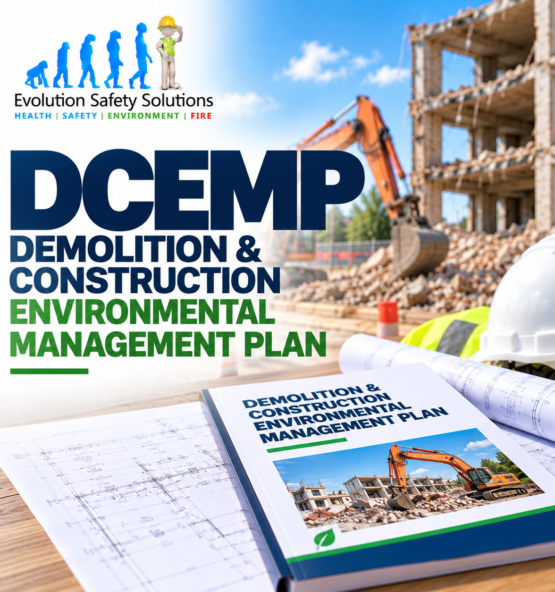
Evolution Safety Solutions Ltd provides professional Demolition and Construction Environmental Management Plans (DCEMP) and Construction Environmental Management Plans (CEMP) for developments throughout the UK.
We help developers, principal contractors, architects and planning consultants identify environmental risks and establish practical controls for demolition and construction activities.
Whether your project involves a residential development, commercial construction, refurbishment or demolition, we can prepare a structured environmental management plan tailored to the proposed works.
Our assessments consider dust, noise, vibration, waste, pollution prevention, drainage, traffic-related environmental impacts and other relevant environmental risks.
Furthermore, we review applicable planning conditions and environmental requirements to ensure the plan addresses the matters relevant to your project.
Need a DCEMP or CEMP to satisfy a planning condition?
Send us the planning condition, development drawings and project details. We can review the requirements and provide a quotation.
REQUEST YOUR DCEMP OR CEMP QUOTATION
Call our consultancy team: 03333 399 037
A Demolition and Construction Environmental Management Plan (DCEMP) is a project-specific document that establishes how environmental risks will be managed during demolition and construction activities.
Local planning authorities often request these plans to protect neighbouring properties, residents, businesses and the surrounding environment.
For example, demolition and construction works can generate dust, noise, vibration, waste and surface water pollution.
Without appropriate controls, these activities may affect nearby receptors or create environmental compliance issues.
A DCEMP identifies relevant risks and explains the measures the project team intends to implement.
Typically, the document considers:
However, each development presents different risks.
Therefore, we tailor the assessment to the proposed activities, site constraints and applicable requirements.
Local planning authorities may impose conditions requiring a Demolition and Construction Environmental Management Plan before development or specified construction activities begin.
These conditions help establish how the contractor will control environmental impacts.
For example, a planning condition may require details of dust suppression, working hours, waste management and pollution prevention.
Additionally, the authority may request information about vehicle movements, construction noise and environmental monitoring.
A suitable DCEMP provides a structured response to these requirements.
It also helps the contractor establish environmental responsibilities before work begins.
Many enquiries arise because a planning permission contains a condition requiring a DCEMP or CEMP.
The condition may require the developer to submit the plan for written approval before commencing the relevant works.
Consequently, delays in preparing the documentation can affect the construction programme.
Evolution Safety Solutions can review the condition wording and prepare the environmental management document required within our agreed scope.
Have you received a planning condition requesting a DCEMP?
SEND US YOUR PLANNING CONDITION FOR REVIEW
We support a range of developments and construction activities.
New housing schemes can create environmental impacts through excavation, groundworks, deliveries and construction activities.
Therefore, a DCEMP may need to address dust, noise, waste, drainage protection and the effect of works on neighbouring properties.
Commercial developments may involve substantial groundworks, heavy machinery and construction vehicle movements.
Our consultants review the proposed activities and identify appropriate environmental management measures.
Demolition can generate dust, noise, vibration and significant quantities of waste.
As a result, demolition projects may require more detailed environmental controls.
The plan can establish management arrangements for these activities, while identifying specialist assessments or permits that may be necessary.
Conversions and refurbishments can affect neighbouring properties, particularly in built-up areas.
For example, works may involve structural alterations, material removal, temporary storage and frequent deliveries.
A CEMP can explain how the contractor intends to manage these impacts.
Sites close to residential properties, schools, healthcare facilities or busy public areas may require additional environmental consideration.
Consequently, the management plan may need to establish more specific controls for dust, noise, deliveries and community liaison.
Construction close to watercourses, protected habitats or other sensitive receptors can create additional risks.
We identify relevant environmental considerations and establish the controls appropriate to the agreed assessment.
Where necessary, we also highlight the requirement for specialist ecological or other technical advice.
We prepare each plan around the development, proposed activities and relevant planning conditions.
First, we review the development and proposed programme.
This may include:
This information establishes the context for the environmental assessment.
Construction and demolition can generate airborne dust.
For example, excavation, cutting, breaking, stockpiling and vehicle movements may release particulate matter.
Our plan can establish measures such as:
Furthermore, we consider the proximity of neighbouring properties and other sensitive receptors.
Where a detailed construction dust assessment is required, we identify the need for additional technical work.
Construction machinery, deliveries and demolition activities can create noise.
Consequently, the project may need controls to reduce disturbance.
Our assessment may consider:
Where appropriate, we refer to relevant good-practice principles, including BS 5228.
However, a DCEMP does not automatically include a detailed noise prediction assessment or acoustic survey.
Certain activities can create vibration that affects neighbouring properties or structures.
For example, demolition, piling, compaction and breaking operations may require additional consideration.
The plan can establish appropriate management principles and identify the need for monitoring.
Where a specialist vibration assessment is required, this would form a separate technical scope.
Construction and demolition projects can generate substantial waste.
Therefore, suitable waste management arrangements are important.
Our DCEMP may address:
Additionally, the plan can establish responsibilities for waste management.
A separate detailed waste management document may be required where specified by the planning authority or project requirements.
Construction sites may store fuels, oils, chemicals and other potentially polluting materials.
Consequently, the plan should establish appropriate storage and handling controls.
We may consider:
These measures help reduce the risk of contamination.
Construction activities can affect surface water quality.
For example, sediment, concrete washout and uncontrolled runoff may enter drainage systems.
Therefore, the plan may address:
However, the DCEMP does not replace a detailed drainage strategy or engineering design.
Construction vehicle movements can create environmental and community impacts.
Our assessment may consider:
Where the planning authority requires a detailed Construction Traffic Management Plan or Construction Logistics Plan, we can discuss the additional scope.
Some developments are located near trees, habitats or other ecological features.
Therefore, construction activities may need specific environmental safeguards.
The DCEMP can reference existing ecological reports and relevant mitigation measures.
However, it does not replace ecological surveys, protected species assessments or a specialist Construction Environmental Management Plan for biodiversity where such work is required.
Effective environmental management requires clear responsibilities.
Therefore, the plan identifies suitable management arrangements for implementing the proposed controls.
These may include:
The principal contractor remains responsible for implementing and maintaining the agreed controls during construction.
Both documents address environmental risks associated with construction activities.
However, their scope can differ.
A DCEMP specifically covers both demolition and construction activities.
It may therefore include additional controls for demolition dust, vibration, material removal and demolition waste.
A CEMP focuses on environmental management during construction.
It typically addresses dust, noise, waste, pollution prevention, drainage and environmental responsibilities.
The answer depends on the proposed activities and planning requirements.
If the planning condition specifically requests a DCEMP, the document should address demolition and construction where applicable.
Alternatively, a CEMP may be sufficient for projects without demolition works.
We recommend sending us the exact planning condition before commissioning the report.
No. These documents serve different purposes.
A Construction Phase Plan (CPP) addresses health and safety arrangements under the Construction (Design and Management) Regulations 2015.
By contrast, a DCEMP focuses on environmental risks and controls associated with the works.
For example, a CPP considers risks to workers and others arising from construction activities.
A DCEMP addresses matters such as dust emissions, noise, pollution and environmental protection.
Some management arrangements may overlap. Nevertheless, one document does not automatically replace the other.
Evolution Safety Solutions provides both environmental and health and safety consultancy services.
Therefore, we can discuss your wider project documentation requirements where appropriate.
Our service follows a structured approach.
We review the relevant planning condition and supporting information.
This helps establish the matters the plan must address.
Next, we examine the proposed works, site layout and surrounding environment.
Where necessary, we request additional information about construction activities.
We identify relevant environmental risks arising from the proposed activities.
For example, these may include dust, noise, waste, pollution and drainage impacts.
We then establish practical management measures appropriate to the available project information.
Our consultants prepare a structured environmental management plan.
The document explains the proposed controls, responsibilities and monitoring arrangements.
Finally, we issue the completed document electronically for the project team to review and submit as appropriate.
The planning authority remains responsible for determining whether the submission satisfies the relevant planning condition.
Your DCEMP report will typically include:
The final content depends on the agreed scope and project information.
Please note: The standard service does not automatically include specialist acoustic modelling, air quality dispersion modelling, ecological surveys, contaminated land investigations, detailed drainage design, asbestos surveys, demolition engineering design or permit applications.
Where additional technical work is required, we will identify this during the assessment.
We provide project-specific quotations for DCEMP and CEMP services.
The fee depends on the development and the information required.
For example, a straightforward residential development may require a relatively simple environmental management plan.
However, a complex demolition project in a sensitive urban location may need additional assessment.
We consider:
Consequently, we recommend providing the planning condition and project drawings when requesting a quotation.
This allows us to establish the appropriate scope.
REQUEST YOUR DCEMP OR CEMP QUOTATION
Alternatively, call 03333 399 037.
To help us review your project, please provide the following information where available.
The full site address and postcode.
The planning decision notice and the condition requiring a DCEMP or CEMP.
Existing and proposed site plans, layout drawings and relevant development information.
Details of demolition, groundworks, construction and refurbishment activities.
The anticipated start date, project duration and proposed working hours.
Where appointed, provide the principal contractor’s contact information.
Details of the proposed plant, equipment, access arrangements and construction methods.
Any available noise, air quality, ecology, drainage or other relevant technical reports.
Any additional comments or requests from the local planning authority.
Please advise us of any planning condition discharge or construction deadlines.
If some information remains unavailable, we can identify what is necessary before the report progresses.
Evolution Safety Solutions provides environmental, health and safety consultancy services for construction and development projects.
Our experience allows us to consider environmental risks alongside practical construction activities.
We review the wording of the relevant planning condition and establish the appropriate scope.
Consequently, our reports focus on the environmental information requested for the project.
Our approach focuses on measures that contractors can understand and implement.
Furthermore, we identify where additional information or specialist assessment is necessary.
We prepare structured reports suitable for review by developers, planning consultants and project teams.
Based in South Wales, Evolution Safety Solutions supports projects throughout the UK.
We work with residential, commercial, industrial and mixed-use developments.
Where necessary, we can discuss related services, including:
Each additional service is subject to its own agreed scope.
DCEMP stands for Demolition and Construction Environmental Management Plan.
It establishes how environmental risks will be managed during demolition and construction activities.
CEMP stands for Construction Environmental Management Plan.
It addresses environmental controls during construction works.
Some developments require a DCEMP or CEMP as part of their planning conditions.
However, the requirement depends on the planning permission and proposed works.
Yes. A properly scoped DCEMP can provide the information requested by the relevant planning condition.
However, the local planning authority determines whether the submission is acceptable.
Not always.
Some projects can be assessed using suitable drawings, planning documents and construction information.
However, more complex developments may require site attendance.
A DCEMP can include construction dust management measures.
However, a separate detailed dust or air quality assessment may be necessary for certain developments.
Yes. The plan can establish practical noise management measures.
Nevertheless, detailed acoustic calculations or monitoring may require additional technical work.
Yes. Where demolition forms part of the project, the DCEMP can address relevant waste management arrangements.
However, specialist waste assessments or surveys may be required separately.
No. A Construction Phase Plan addresses health and safety under CDM 2015.
A DCEMP focuses on environmental management.
Yes. We can prepare environmental management plans for residential developments, subject to the agreed scope.
Yes. We support commercial, industrial and mixed-use developments.
Yes. We can assess the environmental management requirements associated with demolition activities.
However, demolition engineering, asbestos surveys and other specialist demolition assessments are separate services.
Yes. We can review subsequent planning officer comments and establish whether amendments or additional technical work are necessary.
No. The planning authority determines whether the submitted documentation satisfies the condition.
However, our assessment aims to address the relevant requirements within the agreed scope.
Need a DCEMP or CEMP before your construction project can begin?
Evolution Safety Solutions can help you establish the environmental management requirements and prepare the necessary documentation.
Whether your project involves residential construction, commercial development, refurbishment or demolition, our consultants can review the proposed works and relevant planning conditions.
Furthermore, we can identify where additional environmental investigations or specialist assessments may be required.
Send us your planning condition, project drawings and development details for a quotation.
REQUEST YOUR DEMOLITION AND CONSTRUCTION ENVIRONMENTAL MANAGEMENT PLAN
Call Evolution Safety Solutions: 03333 399 037
Evolution Safety Solutions Ltd – Professional DCEMP, CEMP and Environmental Consultancy Services Across the UK.