Schedule Meeting

Sustainability Statement Services

Sustainability Statement for Planning Applications Sustainable Construction & Environmental Reports – Evolution Safety Solutions

Sustainability Statement Services

From £850.00 Excl Vat

Elevate your organization’s commitment to sustainability with our expert Sustainability Statement services, tailored to showcase your environmental responsibility and guide your eco-friendly practices.

Sustainability Statement for Planning Applications – Sustainability Assessments & Reports

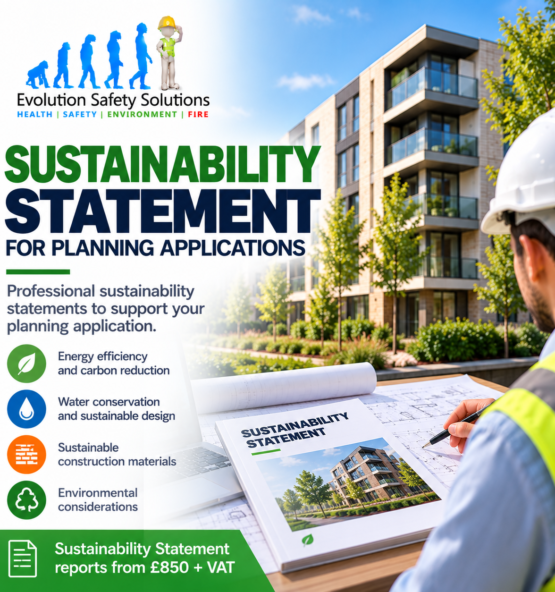
Professional Sustainability Statements from £850 + VAT

Has your planning officer requested a Sustainability Statement, Sustainable Construction Statement or evidence that your development meets local sustainability policies?

Evolution Safety Solutions Ltd provides professional Sustainability Statements for Planning Applications throughout the UK.

Our consultants help property developers, architects, planning consultants and building owners address sustainability requirements during the planning process.

Whether you are developing new homes, converting an existing property or preparing a commercial development, we can help identify the relevant planning requirements.

Furthermore, we can review planning officer comments, assess the proposed sustainability measures and prepare a professional report to support your application.

Our assessments consider energy efficiency, water conservation, sustainable materials, waste management, climate resilience and other relevant environmental considerations.

Sustainability Statement reports from £850 + VAT.

REQUEST YOUR SUSTAINABILITY STATEMENT QUOTATION

What Is a Sustainability Statement?

A Sustainability Statement is a planning document that explains how a proposed development addresses relevant environmental and sustainability policies.

Local planning authorities may request this information when assessing residential, commercial or mixed-use developments.

For example, a Sustainability Statement may explain how the design reduces energy demand, conserves water and promotes responsible material selection.

Additionally, the report can identify opportunities to reduce construction waste and improve the development’s environmental performance.

Depending on the project, a Sustainability Statement may consider:

  • Energy efficiency and carbon reduction.
  • Renewable and low-carbon energy technologies.
  • Water conservation and efficiency.
  • Sustainable construction materials.
  • Construction and operational waste management.
  • Climate change adaptation.
  • Sustainable drainage principles.
  • Biodiversity and green infrastructure.
  • Sustainable transport considerations.
  • Relevant local planning policies.
  • Long-term building sustainability.

However, not every development requires assessment of every topic.

Therefore, we review the proposed development and applicable planning requirements before confirming the scope.

Why Do You Need a Sustainability Statement for Planning Permission?

Planning authorities consider environmental sustainability when assessing many development proposals.

Consequently, some applications must demonstrate how the proposed development addresses relevant local planning policies.

A Sustainability Statement provides a structured explanation of the proposed measures.

Furthermore, it helps the project team identify opportunities to improve environmental performance before construction begins.

New Residential Developments

New housing developments may need to demonstrate how the proposed homes address sustainability.

For example, the planning authority may expect information about energy efficiency, water consumption, materials and waste management.

Our consultants review the relevant requirements and explain the proposed sustainability approach.

Residential Conversions and Changes of Use

Converting existing buildings into residential accommodation can introduce additional sustainability considerations.

For instance, the proposed works may involve upgrading insulation, replacing heating systems or improving water efficiency.

A Sustainability Statement can explain these measures and their relationship to the applicable planning policies.

Commercial Developments

Commercial buildings may need to demonstrate how their design addresses environmental performance.

Depending on the development, this may include energy demand, water conservation, waste management and sustainable construction.

We assess the relevant matters and prepare a report appropriate to the agreed scope.

Extensions and Refurbishments

Extensions and refurbishment projects provide opportunities to improve the sustainability of existing buildings.

For example, the proposed works may introduce improved building fabric, efficient services or sustainable materials.

Our assessment considers the relevant measures and identifies any additional information required.

Mixed-Use Developments

Mixed-use developments may combine residential, commercial and other building uses.

As a result, the sustainability requirements can vary across different parts of the development.

We review the proposed uses and establish an appropriate reporting approach.

Planning Conditions and Council Requests

Sometimes, a planning officer requests further sustainability information during an application.

Alternatively, a planning condition may require supporting documentation before development progresses.

In either situation, we can review the specific wording and identify the appropriate technical response.

Has your council requested a Sustainability Statement?

Send us the planning officer’s comments, development drawings and planning reference. We can then review the requirements and provide a quotation.

CONTACT OUR SUSTAINABILITY CONSULTANTS

What Does Our Sustainability Statement Assess?

We tailor each assessment to the development, its location and the relevant planning requirements.

The report may consider the following sustainability topics.

1. Energy Efficiency and Carbon Reduction

First, we consider how the proposed development aims to reduce energy consumption.

This may include reviewing:

  • Building insulation and thermal performance.
  • Proposed windows and glazing.
  • Energy-efficient heating systems.
  • Hot water arrangements.
  • Ventilation and cooling considerations.
  • Low-carbon technologies.
  • Opportunities for renewable energy.
  • Relevant carbon reduction measures.

Improving building efficiency can reduce operational energy demand.

Consequently, these measures often form an important part of the sustainability approach.

Where planning policy requires quantified energy performance, additional SAP, SBEM or other calculations may be necessary.

2. Water Efficiency and Conservation

Next, we consider opportunities to reduce water consumption.

Depending on the development, this may include:

  • Water-efficient taps and showers.
  • Dual-flush toilets.
  • Efficient appliances.
  • Water consumption targets.
  • Rainwater harvesting opportunities.
  • Greywater reuse considerations.
  • Appropriate water management measures.

Furthermore, we consider whether the relevant planning policies establish specific water efficiency requirements.

3. Sustainable Construction Materials

Material selection can influence a development’s environmental impact.

Therefore, we consider the proposed approach to responsible material selection.

Relevant matters may include:

  • Responsibly sourced construction materials.
  • Recycled and recyclable materials.
  • Reuse of existing building elements.
  • Material durability.
  • Opportunities to reduce construction waste.
  • Lower-impact material alternatives.

However, a standard Sustainability Statement does not automatically include a detailed embodied carbon assessment or whole-life carbon calculation.

Where necessary, we can identify these additional requirements.

4. Construction Waste and Resource Management

Construction activities can generate significant waste.

As a result, planning authorities may expect developers to demonstrate how they intend to manage resources responsibly.

Our assessment may consider:

  • Waste prevention.
  • Material reuse.
  • Recycling opportunities.
  • Waste segregation.
  • Responsible waste disposal.
  • Construction resource efficiency.
  • Relevant waste management commitments.

Where the planning authority requires a detailed Site Waste Management Plan or Construction Environmental Management Plan, we can discuss these as separate services.

5. Climate Change Adaptation

Climate resilience is another important sustainability consideration.

For example, developments may need to consider overheating, extreme rainfall or other environmental pressures.

Our assessment may review:

  • Passive cooling opportunities.
  • Solar shading.
  • Ventilation principles.
  • Overheating considerations.
  • Flood resilience measures.
  • Climate-related design constraints.

Furthermore, we identify where the project may require a separate technical assessment.

6. Sustainable Drainage and Water Management

Surface water management can influence the sustainability of a development.

Therefore, we consider the proposed drainage approach where relevant to the planning requirements.

This may include reviewing opportunities for:

  • Sustainable Drainage Systems (SuDS).
  • Rainwater attenuation.
  • Permeable surfaces.
  • Rainwater harvesting.
  • Appropriate surface water management.

However, a Sustainability Statement does not replace a detailed drainage design, Flood Risk Assessment or BRE 365 infiltration test.

Where necessary, these services require a separate technical scope.

7. Biodiversity and Green Infrastructure

Some developments must address biodiversity and ecological considerations.

For example, planning policies may encourage green infrastructure, habitat enhancement and landscaping measures.

Our Sustainability Statement can reference the proposed ecological measures and relevant supporting documentation.

Additionally, we can identify where separate ecological surveys or Biodiversity Net Gain assessments are necessary.

A Sustainability Statement does not replace a statutory Biodiversity Gain Plan or ecological assessment.

8. Sustainable Transport

Transport choices can influence a development’s environmental impact.

Depending on the planning requirements, we may consider:

  • Pedestrian access.
  • Cycling facilities.
  • Public transport accessibility.
  • Electric vehicle charging proposals.
  • Opportunities to reduce car dependency.
  • Relevant sustainable travel measures.

However, detailed transport assessments, parking surveys and travel plans fall outside the standard Sustainability Statement scope.

9. Planning Policy Compliance

Finally, we review the relevant sustainability planning policies.

These may include local requirements relating to:

  • Sustainable construction.
  • Energy efficiency.
  • Carbon reduction.
  • Water conservation.
  • Waste management.
  • Climate adaptation.
  • Environmental protection.
  • Sustainable development.

We then explain how the proposed measures address the applicable requirements.

Where the available information does not demonstrate compliance, we identify the relevant gaps.

Sustainability Statements and Local Planning Policies

Supporting Sustainable Development Requirements

Local planning authorities may establish specific sustainability requirements through their adopted planning policies.

Consequently, the information required for one development may differ from another.

For example, one authority may focus on energy efficiency and water conservation.

Another may require a wider sustainability assessment covering construction materials, climate resilience and waste management.

Our consultants review the relevant policy requirements before preparing the report.

Furthermore, we consider the planning officer’s comments where these are available.

This approach helps ensure that the assessment addresses the matters relevant to the application.

Sustainability Statements in Wales

Developments in Wales may need to address sustainability considerations arising from Planning Policy Wales and the relevant Local Development Plan.

Depending on the project, these may include sustainable development, climate change, resource efficiency and environmental protection.

We review the applicable requirements and establish an appropriate assessment scope.

Sustainability Statements in England

In England, relevant sustainability requirements may arise from the National Planning Policy Framework and adopted local planning policies.

For example, local policies may address energy efficiency, water consumption, climate resilience and sustainable construction.

The precise requirements depend on the development and planning authority.

Sustainability Assessments for London Developments

London developments may need to address additional sustainability requirements under the London Plan.

For example, relevant policies may concern energy efficiency, carbon reduction, water management and sustainable construction.

However, major developments may require separate technical assessments, including detailed Energy Statements or other specialist reports.

Therefore, we review the applicable requirements before confirming the scope.

REQUEST A SUSTAINABILITY PLANNING REVIEW

Sustainability Statement vs Energy Statement – What’s the Difference?

Although these documents overlap, they serve different purposes.

Sustainability Statement

A Sustainability Statement considers the broader environmental performance of a proposed development.

For example, it may address energy, water, materials, waste, climate resilience and sustainable transport.

Energy Statement

An Energy Statement focuses more specifically on energy efficiency, energy demand and carbon emissions.

Depending on the project, it may require supporting SAP or SBEM calculations.

Sustainability Assessment

A Sustainability Assessment may involve a more detailed review of environmental performance.

For example, the planning authority may require additional calculations, technical evidence or specific assessment methodologies.

Sustainable Construction Statement

Some planning authorities use the term Sustainable Construction Statement.

The required content depends on the relevant planning policy and development.

Therefore, we review the exact requirements rather than assuming that every document has the same scope.

Which Document Do You Need?

The appropriate report depends on the planning authority’s requirements.

If your planning officer has requested a particular document, send us the relevant correspondence.

We can then establish the appropriate assessment scope.

What Does Our Sustainability Statement Service Include?

Our service follows a structured assessment and reporting process.

Initial Development Review

First, we review the proposed development and available architectural drawings.

We also consider any relevant planning correspondence.

Planning Policy Assessment

Next, we identify the sustainability policies that apply to the development.

This helps establish the information needed for the report.

Review of Proposed Sustainability Measures

We examine the proposed energy, water, materials and environmental measures.

Furthermore, we consider whether the design team needs to provide additional information.

Identification of Further Assessment Requirements

Some developments require separate technical reports or calculations.

For example, the planning authority may request SAP calculations, a drainage assessment or detailed energy modelling.

Where necessary, we identify these requirements and explain the potential next steps.

Preparation of the Sustainability Statement

We then prepare the report, explaining the proposed sustainability measures and their relationship to the relevant planning policies.

Final Report Issue

Finally, we issue the completed report electronically for use by your architect, planning consultant or project team.

What Will You Receive?

Our Sustainability Statement report will typically include:

  • Development details and project description.
  • Purpose and scope of the assessment.
  • Relevant planning policy context.
  • Review of proposed energy efficiency measures.
  • Water conservation considerations.
  • Sustainable material selection.
  • Waste management considerations.
  • Climate resilience measures.
  • Relevant drainage and biodiversity considerations.
  • Sustainable transport considerations.
  • Identified assumptions and information gaps.
  • Recommendations and conclusions.

The precise content depends on the agreed scope.

Furthermore, we identify where additional technical evidence may be necessary.

Important: The standard service does not automatically include SAP calculations, SBEM modelling, BREEAM assessments, embodied carbon calculations, detailed drainage design, ecological surveys, Biodiversity Net Gain calculations or architectural drawings.

Where the planning authority requires additional technical assessments, we can discuss these separately.

How Much Does a Sustainability Statement Cost?

Sustainability Statement Reports from £850 + VAT

Our standard desktop Sustainability Statement for Planning Applications service starts from £850 + VAT.

This starting price applies to relatively straightforward developments where the client provides sufficient drawings and supporting information.

However, more complex projects may require additional technical assessment.

The final fee depends on:

  • Development size and complexity.
  • Proposed building use.
  • Number of dwellings or commercial units.
  • Relevant planning policies.
  • Available architectural drawings.
  • Existing sustainability information.
  • Required energy calculations.
  • Water efficiency requirements.
  • Need for additional technical assessments.
  • Extent of consultation or design changes.

We therefore review the project before confirming the fee.

Complex Sustainability Assessments

Larger developments may require detailed technical evidence or several supporting reports.

For example, a major residential development may need separate energy modelling, drainage assessments and ecological information.

In these circumstances, we can provide a tailored quotation based on the required scope.

REQUEST YOUR SUSTAINABILITY STATEMENT QUOTATION

What Information Do We Need from You?

To provide an accurate quotation, please send us the following information where available.

Development Address

Provide the full site address and postcode.

Description of the Proposed Development

Explain the intended use and nature of the proposed works.

For example, you may be constructing new homes, converting a commercial property or extending an existing building.

Architectural Drawings

Please provide existing and proposed floor plans, elevations and site plans.

Planning Application Details

If you have already submitted an application, please provide the planning reference number.

Planning Officer Comments

Forward any correspondence requesting a Sustainability Statement or Sustainable Construction Statement.

Proposed Energy Measures

Where available, provide details of insulation, heating systems and renewable energy technologies.

Proposed Sustainability Measures

Please include any available information about water efficiency, materials, waste management or other environmental measures.

Existing Technical Reports

Where available, provide Energy Statements, SAP calculations, drainage reports or other relevant assessments.

Required Completion Date

Finally, advise us of any planning submission or consultation deadlines.

If your project remains at an early design stage, we can explain what information you need before proceeding.

Our Sustainability Statement Process

Step 1 – Submit Your Enquiry

Contact Evolution Safety Solutions with your development details and available drawings.

Step 2 – Initial Review

We review the proposed development and identify the relevant sustainability planning requirements.

Step 3 – Confirm the Scope and Fee

Next, we provide a quotation based on the assessment requirements.

Step 4 – Undertake the Assessment

Our consultants review the proposed sustainability measures and applicable planning policies.

Step 5 – Prepare the Report

We then compile the Sustainability Statement and document the relevant environmental considerations.

Step 6 – Issue Your Completed Statement

Finally, we issue the report electronically for your planning submission.

Where the planning authority subsequently requests further information, we can discuss the additional work.

START YOUR SUSTAINABILITY STATEMENT ENQUIRY

Why Choose Evolution Safety Solutions?

Professional Environmental and Planning Consultancy

Evolution Safety Solutions provides environmental, sustainability and development-related consultancy services.

We understand the importance of preparing planning documentation that reflects the proposed development and relevant policy requirements.

Practical Advice for Developers

Our consultants focus on the information your project needs.

Consequently, we can identify where a straightforward Sustainability Statement is appropriate and where additional technical assessments may be necessary.

Clear Technical Reporting

We prepare structured reports that explain the proposed sustainability approach.

Furthermore, we identify relevant assumptions, limitations and outstanding requirements.

Support for Architects and Planning Consultants

We work with design teams and planning professionals to provide supporting technical information.

Additionally, we can review planning officer comments and identify further assessment requirements.

Transparent Quotations

We establish the scope before confirming the fee.

Therefore, clients can understand what the agreed service includes.

UK-Wide Consultancy

Based in South Wales, Evolution Safety Solutions supports development projects throughout the UK.

Our consultants can assist with residential, commercial and mixed-use developments, subject to the applicable planning requirements.

Frequently Asked Questions About Sustainability Statements

What is a Sustainability Statement for planning?

A Sustainability Statement explains how a proposed development addresses relevant environmental and sustainability policies.

It may consider energy efficiency, water conservation, materials, waste management and other sustainability measures.

Do I need a Sustainability Statement for planning permission?

Not every development requires one.

However, some planning authorities request sustainability information depending on the development and applicable policies.

How much does a Sustainability Statement cost?

Our standard desktop service starts from £850 + VAT.

More complex developments may require additional assessment and a tailored quotation.

Is a Sustainability Statement the same as an Energy Statement?

No. An Energy Statement focuses primarily on energy efficiency and carbon emissions.

By contrast, a Sustainability Statement generally considers a wider range of environmental matters.

What is a Sustainable Construction Statement?

A Sustainable Construction Statement explains how a proposed development addresses relevant sustainable construction requirements.

However, the required content depends on the planning authority and applicable policies.

Can you prepare a Sustainability Statement for a residential conversion?

Yes. We can review residential conversions and changes of use where planning-stage sustainability information is required.

Can you prepare Sustainability Statements for commercial buildings?

Yes. We can assess commercial and mixed-use developments within an agreed scope.

Do I need SAP calculations?

Not always.

However, some developments require supporting energy performance calculations.

We review the planning requirements before confirming whether additional calculations are necessary.

Does a Sustainability Statement include BREEAM?

Not automatically.

A formal BREEAM assessment is a separate process with specific assessment and certification requirements.

Does the report include Biodiversity Net Gain?

The report can reference relevant biodiversity measures and supporting documents.

However, it does not replace a statutory Biodiversity Gain Plan or detailed ecological assessment.

Can a Sustainability Statement help discharge a planning condition?

Yes, where the agreed report addresses the relevant condition requirements.

We recommend providing the exact condition wording before commissioning the assessment.

Do you need architectural drawings?

Yes. Suitable drawings and project information are normally necessary.

Additionally, we may require details of the proposed building fabric, heating systems and sustainability measures.

Do you provide architectural or CAD drawings?

No. We review drawings supplied by the client or design team.

We do not provide architectural or CAD drawing services as part of the Sustainability Statement.

Will a Sustainability Statement guarantee planning permission?

No. The planning authority determines the outcome of the application.

Nevertheless, an appropriate Sustainability Statement can provide relevant supporting evidence.

Can you respond to planning officer comments?

Yes. We can review subsequent comments and identify further technical information requirements.

However, additional work beyond the agreed scope may incur further charges.

Request Your Sustainability Statement Today

Professional Sustainability Reports to Support Your Planning Application

Whether you are developing new homes, converting an existing building or responding to a planning officer’s request, Evolution Safety Solutions can help.

Our Sustainability Statement service provides professional reporting on environmental sustainability and relevant planning requirements.

Furthermore, we can help identify whether your development requires supporting energy calculations, drainage assessments or other specialist technical information.

Sustainability Statement reports from £850 + VAT.

Send us your development details, architectural drawings and relevant planning correspondence.

We will then review the requirements and provide an appropriate quotation.

CONTACT EVOLUTION SAFETY SOLUTIONS – REQUEST YOUR SUSTAINABILITY STATEMENT QUOTATION

Evolution Safety Solutions Ltd – Professional Sustainability Statements, Environmental Assessments and Planning Consultancy Across the UK.