Schedule Meeting

Surface Water Drainage Assessment (SUDs)

Surface Water Drainage Assessment (SuDS) Sustainable Drainage & Planning Reports – Evolution Safety Solutions

Surface Water Drainage Assessment (SUDs)

From £1,250.00 Excl Vat

Enhance environmental sustainability and manage flood risks effectively with our comprehensive Surface Water Drainage (SUDs) Assessment services.
Or call for a chat on 0333 339 9037

SKU:surface-water-drainage-suds-assessmentCategory: Tag:

Surface Water Drainage Assessment (SuDS) – Drainage Reports for Planning Applications

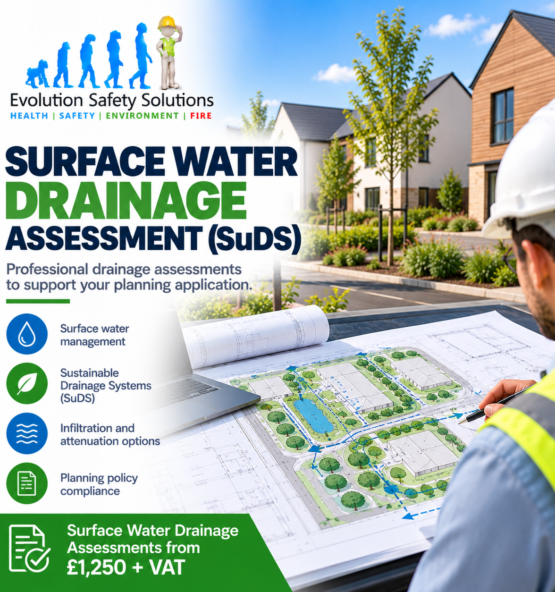
Professional Surface Water Drainage Assessments from £1,250 + VAT

Has your planning officer requested a Surface Water Drainage Assessment, SuDS Report or drainage strategy to support your planning application?

Evolution Safety Solutions Ltd provides professional Surface Water Drainage Assessments (SuDS) for residential, commercial and mixed-use developments throughout the UK.

Our consultants help developers, architects, planning consultants and property owners address surface water management requirements during the planning process.

Whether you are constructing new homes, converting an existing property or developing a commercial site, we can help establish the appropriate drainage assessment requirements.

Furthermore, we can review planning officer comments and identify the information needed to support your application.

Our assessments consider surface water runoff, drainage constraints, infiltration opportunities and sustainable drainage principles.

Surface Water Drainage Assessments from £1,250 + VAT.

REQUEST YOUR SURFACE WATER DRAINAGE ASSESSMENT QUOTATION

What Is a Surface Water Drainage Assessment?

A Surface Water Drainage Assessment examines how a proposed development intends to manage rainwater runoff.

Development can change the way rainwater moves across a site. For example, roofs, roads and hardstanding areas can increase runoff and reduce natural infiltration.

Consequently, planning authorities may require developers to explain how they intend to manage surface water.

A drainage assessment reviews the available site information and identifies appropriate surface water management principles.

Depending on the development, the assessment may consider:

  • Existing site drainage arrangements.
  • Proposed roofs and impermeable surfaces.
  • Surface water runoff pathways.
  • Existing and proposed drainage constraints.
  • Opportunities for infiltration.
  • Sustainable Drainage Systems (SuDS).
  • Surface water discharge options.
  • Potential attenuation requirements.
  • Relevant flood risk considerations.
  • Applicable planning and drainage policies.
  • Further investigations or design requirements.

The report helps establish a suitable planning-stage approach.

However, the level of technical detail depends on the development and the requirements of the relevant authority.

What Are Sustainable Drainage Systems (SuDS)?

Sustainable Drainage Systems (SuDS) manage surface water using methods that aim to reflect natural drainage processes.

Instead of directing all rainfall immediately into conventional pipework, SuDS can help slow, store, filter or infiltrate runoff.

As a result, suitable systems can reduce pressure on drainage infrastructure and help manage surface water flood risk.

SuDS may also provide environmental benefits.

For example, certain features can improve water quality, support biodiversity and create attractive landscaped spaces.

Common SuDS Features

Depending on the site, suitable options may include:

  • Permeable paving.
  • Rain gardens.
  • Swales.
  • Filter drains.
  • Infiltration trenches.
  • Soakaways.
  • Detention basins.
  • Attenuation systems.
  • Green roofs.
  • Rainwater harvesting.

However, not every drainage feature suits every development.

The appropriate solution depends on ground conditions, site layout, available space and the proposed drainage arrangements.

Therefore, we review the available information before identifying potential options.

Why Do You Need a Surface Water Drainage Assessment for Planning Permission?

Planning authorities may require drainage information to establish whether a proposed development can manage surface water appropriately.

For example, a new building may introduce additional impermeable surfaces.

Consequently, the development could increase the volume or rate of runoff unless the design incorporates suitable management measures.

A Surface Water Drainage Assessment helps identify these considerations during the planning process.

Furthermore, it can highlight the need for additional technical investigations before the design progresses.

New Residential Developments

New housing developments can introduce roofs, roads, driveways and other hard surfaces.

Therefore, the drainage assessment may need to consider how the proposed layout affects surface water runoff.

Our consultants review the available information and identify the relevant drainage considerations.

Residential Conversions and Changes of Use

Some conversions introduce new parking areas, extensions or changes to external surfaces.

As a result, the development may affect existing drainage arrangements.

A planning-stage assessment can identify relevant constraints and potential drainage options.

Commercial and Industrial Developments

Commercial premises often include substantial roof areas, access roads and hardstanding.

Consequently, these developments may require more detailed consideration of runoff management.

Our assessment can establish the principal issues and identify where further engineering work is necessary.

Extensions and Refurbishments

Extensions may increase the impermeable area of an existing site.

For example, a new building extension may change the way rainwater reaches existing drainage systems.

We review the proposed works and consider the relevant surface water implications.

Planning Conditions and Council Requests

Sometimes, a planning officer requests additional drainage information during an application.

Alternatively, a planning condition may require a drainage strategy before development progresses.

We can review the exact wording and establish the appropriate assessment scope.

Has your planning authority requested a SuDS Assessment or Surface Water Drainage Report?

Send us the relevant correspondence and development drawings.

We can then review the requirements and provide a quotation.

CONTACT OUR DRAINAGE ASSESSMENT TEAM

What Does Our Surface Water Drainage Assessment Include?

We tailor each assessment to the proposed development and available information.

Our planning-stage service can address the following areas.

1. Site and Development Review

First, we review the existing site and proposed development.

This may include:

  • Site location and surrounding land use.
  • Existing buildings and hardstanding.
  • Proposed development layout.
  • Existing and proposed impermeable areas.
  • Available topographical information.
  • Known drainage infrastructure.
  • Relevant planning correspondence.
  • Available ground investigation information.

This initial review helps establish the principal drainage considerations.

Furthermore, it identifies information gaps that may affect the assessment.

2. Surface Water Runoff Considerations

Next, we consider how the development may influence surface water runoff.

For example, additional roofs and paved areas may reduce the amount of rainfall that infiltrates naturally.

Consequently, the proposed development may need measures to manage runoff.

Where the agreed scope requires calculations, we establish the appropriate assessment methodology and information requirements.

3. Existing Drainage Arrangements

We review the available information about existing drainage systems.

This may include known surface water connections, existing soakaways and drainage infrastructure.

However, a desktop assessment cannot confirm the physical condition, capacity or precise location of buried drainage systems.

Where necessary, we identify the need for drainage surveys or further investigation.

4. Infiltration and Ground Conditions

Ground conditions influence whether infiltration-based drainage solutions are suitable.

For example, some sites may accommodate soakaways or infiltration trenches.

However, other sites may have low-permeability soils, high groundwater levels or other constraints.

We therefore consider available ground information and identify whether further testing is necessary.

5. Sustainable Drainage Options

Our assessment considers potential SuDS measures appropriate to the development.

Depending on the site, this may include:

  • Permeable paving.
  • Rain gardens.
  • Swales.
  • Infiltration systems.
  • Attenuation measures.
  • Rainwater harvesting.
  • Other suitable surface water management features.

We also consider relevant site constraints.

However, the final selection and detailed design of drainage components may require specialist engineering input.

6. Surface Water Discharge Considerations

Where infiltration is unsuitable or insufficient, the project may need an alternative discharge arrangement.

The assessment can consider the available options and relevant constraints.

For example, the design team may need to investigate discharge to a suitable watercourse or surface water sewer.

However, discharge arrangements can require third-party permissions, capacity confirmation or other approvals.

Therefore, we identify these requirements where relevant.

7. Planning Policy and Guidance Review

Finally, we consider the relevant drainage planning requirements.

These may include:

  • Applicable local planning policies.
  • National drainage guidance.
  • Relevant sustainable drainage standards.
  • Local flood risk management requirements.
  • Planning officer comments.
  • Appropriate surface water management principles.

We then explain the relevant considerations within the report.

Surface Water Drainage Assessments in Wales

SuDS Approval Body (SAB) Requirements

Wales has specific statutory requirements for Sustainable Drainage Systems.

Certain developments with drainage implications require approval from the relevant SuDS Approval Body (SAB).

For example, developments involving more than one dwelling or construction areas of 100 m² or more will generally fall within the relevant requirements.

However, the precise position depends on the nature of the proposed works and applicable exemptions.

Importantly, SAB approval is separate from planning permission.

Therefore, obtaining planning permission does not automatically authorise construction of a drainage system that requires SAB approval.

Does Our Standard Assessment Include SAB Approval?

No. A standard planning-stage Surface Water Drainage Assessment does not automatically include a complete SAB application or detailed drainage design.

A full SAB submission may require:

  • Detailed drainage design drawings.
  • Hydraulic calculations.
  • Infiltration testing.
  • Drainage component specifications.
  • Construction details.
  • Maintenance arrangements.
  • Supporting technical information.
  • Relevant application documentation.

Where your development requires SAB approval, we can review the available information and identify the additional work required.

ENQUIRE ABOUT WELSH SuDS AND SAB REQUIREMENTS

Surface Water Drainage Assessments in England

In England, sustainable drainage requirements commonly arise through planning policy, local authority requirements and relevant drainage guidance.

The applicable requirements depend on the development and its location.

For example, a planning authority may request a drainage strategy demonstrating how the proposed site will manage runoff.

The assessment may need to consider discharge arrangements, attenuation, infiltration and long-term maintenance.

Furthermore, some developments require additional hydraulic calculations or detailed drainage drawings.

We review the relevant planning requirements before establishing the appropriate assessment scope.

Do You Need a BRE 365 Infiltration Test?

Understanding Soakaway and Infiltration Testing

A BRE 365 Infiltration Test helps establish the rate at which water infiltrates into the ground.

This information can support the assessment and design of infiltration-based drainage systems.

For example, a proposed soakaway may require infiltration test results to establish whether the ground can accommodate the intended drainage arrangement.

However, a desktop review cannot reliably determine the infiltration rate of the soil.

Therefore, the project may require site testing before the drainage design can progress.

When Might Infiltration Testing Be Necessary?

Testing may be appropriate where:

  • The proposed drainage strategy relies on infiltration.
  • Existing infiltration data is unavailable.
  • The planning authority requests infiltration evidence.
  • Ground conditions remain uncertain.
  • The drainage designer requires site-specific infiltration rates.

Evolution Safety Solutions also provides BRE 365 Infiltration Testing as a separate service.

Where necessary, we can discuss the testing requirements alongside your drainage assessment enquiry.

REQUEST A DRAINAGE ASSESSMENT OR BRE 365 TEST QUOTATION

Surface Water Drainage Assessment vs Flood Risk Assessment

Although these reports are related, they address different technical questions.

Surface Water Drainage Assessment

A Surface Water Drainage Assessment focuses on how the proposed development will manage rainwater runoff.

For example, it may consider infiltration, attenuation and potential discharge arrangements.

Flood Risk Assessment

A Flood Risk Assessment examines the flood risks relevant to the development.

Depending on the site, these may include river flooding, coastal flooding, surface water flooding and other flood sources.

Do You Need Both Reports?

Some developments require both assessments.

For example, a site may need a Flood Risk Assessment because of its location and a separate drainage strategy to explain how the proposed development will manage runoff.

Therefore, we recommend reviewing the planning requirements before commissioning either service.

What Will You Receive?

Following completion of the agreed assessment, we provide a professional Surface Water Drainage Assessment report in PDF format.

The report will typically include:

  • Development details and project description.
  • Purpose and scope of the assessment.
  • Site and development review.
  • Relevant drainage planning requirements.
  • Existing drainage information.
  • Surface water runoff considerations.
  • Infiltration opportunities and constraints.
  • Potential SuDS measures.
  • Surface water discharge considerations.
  • Relevant assumptions and limitations.
  • Further investigation or design requirements.
  • Conclusions and recommendations.

The precise content depends on the agreed scope and available information.

Furthermore, we clearly identify matters that require additional investigation.

Important: Our standard assessment does not automatically include detailed civil engineering design, hydraulic modelling, CAD drainage drawings, BRE 365 infiltration testing, CCTV drainage surveys, SAB approval applications or third-party discharge consents.

Where the development requires these services, we can discuss the necessary additional scope.

How Much Does a Surface Water Drainage Assessment Cost?

Surface Water Drainage Assessments from £1,250 + VAT

Our standard desktop Surface Water Drainage Assessment service starts from £1,250 + VAT.

This starting price applies to relatively straightforward developments where the client provides sufficient drawings and supporting information.

However, more complex sites may require additional technical assessment.

The final fee depends on:

  • Site size and complexity.
  • Proposed development type.
  • Existing drainage arrangements.
  • Proposed impermeable areas.
  • Available topographical information.
  • Ground conditions.
  • Need for infiltration testing.
  • Relevant planning requirements.
  • Extent of hydraulic calculations.
  • Requirement for detailed drainage design.
  • Need for additional site investigations.

We therefore review the project before confirming the fee.

Complex Drainage Assessments

Some developments require detailed calculations, additional testing or specialist drainage engineering.

For example, a large commercial development may need a comprehensive drainage strategy supported by hydraulic modelling.

Similarly, a development requiring SAB approval may need a separate detailed design package.

In these circumstances, we can establish the appropriate scope and provide a tailored quotation.

REQUEST YOUR SURFACE WATER DRAINAGE ASSESSMENT QUOTATION

What Information Do We Need from You?

To provide an accurate quotation, please send us the following information where available.

Development Address

Provide the full site address and postcode.

Description of the Proposed Works

Explain the nature of the proposed development.

For example, you may be constructing new homes, extending a commercial building or creating additional hardstanding.

Architectural and Site Drawings

Please provide existing and proposed site plans, floor plans and relevant elevations.

Topographical Survey

Where available, provide a topographical survey showing site levels and relevant features.

Existing Drainage Information

Please include any available drainage plans, sewer records or information about existing soakaways.

Ground Investigation Information

Where available, provide ground investigation reports or previous infiltration test results.

Planning Application Reference

If you have already submitted an application, please provide the reference number.

Planning Officer Comments

Forward any correspondence requesting a drainage strategy, SuDS Assessment or further surface water information.

Required Completion Date

Finally, advise us of any planning submission or consultation deadlines.

If some information remains unavailable, we can explain what the assessment requires before proceeding.

Our Surface Water Drainage Assessment Process

Step 1 – Submit Your Enquiry

Contact Evolution Safety Solutions with your development details and available drawings.

Step 2 – Initial Technical Review

We review the proposed development and establish the relevant drainage assessment requirements.

Step 3 – Confirm the Scope and Fee

Next, we provide a quotation based on the development and required technical work.

Step 4 – Undertake the Assessment

Our consultants review the site information, drainage constraints and potential surface water management options.

Step 5 – Prepare the Report

We then compile the Surface Water Drainage Assessment and identify relevant findings and recommendations.

Step 6 – Issue Your Completed Report

Finally, we issue the report electronically for your planning submission.

Where the planning authority requests additional information, we can discuss the appropriate further work.

START YOUR SURFACE WATER DRAINAGE ENQUIRY

Why Choose Evolution Safety Solutions?

Professional Environmental and Planning Consultancy

Evolution Safety Solutions provides environmental and development-related consultancy services.

We understand the importance of preparing technical reports that address the relevant planning requirements.

Practical, Proportionate Assessments

We focus on the drainage information your project needs.

Consequently, we can identify where a planning-stage assessment is appropriate and where additional engineering input is necessary.

Clear Technical Reporting

Our reports explain the relevant drainage considerations in a structured format.

Furthermore, we identify assumptions, limitations and outstanding technical requirements.

Supporting Site Investigation Services

In addition to drainage assessments, Evolution Safety Solutions provides BRE 365 infiltration testing.

Therefore, we can discuss relevant ground infiltration investigations where the proposed drainage approach requires them.

Support for Developers and Architects

We work with developers, architects and planning professionals to provide supporting technical information.

Additionally, we can review planning officer comments and identify further assessment requirements.

UK-Wide Consultancy

Based in South Wales, Evolution Safety Solutions provides consultancy services throughout the UK.

We support residential, commercial and mixed-use developments, subject to the applicable project requirements.

Frequently Asked Questions About Surface Water Drainage Assessments

What is a Surface Water Drainage Assessment?

A Surface Water Drainage Assessment examines how a proposed development intends to manage rainwater runoff.

It considers relevant drainage constraints and potential surface water management measures.

What does SuDS stand for?

SuDS stands for Sustainable Drainage Systems.

These systems manage surface water through measures such as infiltration, storage, filtration and controlled discharge.

Do I need a SuDS Assessment for planning permission?

Not every development requires the same documentation.

However, planning authorities may request a drainage strategy or SuDS Assessment depending on the development and relevant policies.

How much does a Surface Water Drainage Assessment cost?

Our standard desktop assessment starts from £1,250 + VAT.

However, complex developments may require additional calculations, investigations or detailed design.

Do I need SAB approval in Wales?

Certain developments with drainage implications require approval from the relevant SuDS Approval Body.

The requirements depend on the nature and scale of the proposed works.

Is SAB approval the same as planning permission?

No. SAB approval is a separate statutory process in Wales.

Therefore, a development may require both planning permission and SAB approval.

Does your assessment include SAB approval?

Not automatically.

A complete SAB submission may require detailed engineering drawings, calculations and other technical information.

We can review the requirements and discuss the appropriate additional scope.

Do I need a BRE 365 infiltration test?

You may need infiltration testing where the proposed drainage strategy relies on soakaways or other infiltration systems.

The requirement depends on the site and available ground information.

Can you assess a residential development?

Yes. We can review residential developments and identify the relevant surface water drainage considerations.

Can you assess commercial and industrial developments?

Yes. We can assess commercial developments within an agreed scope.

However, complex sites may require additional engineering calculations or specialist design input.

Does the report include drainage drawings?

Our standard service does not include detailed CAD drainage drawings.

We review drawings supplied by the client or design team.

Does the assessment include hydraulic calculations?

Not automatically.

Where the project requires detailed runoff, attenuation or hydraulic calculations, we establish these requirements during the initial review.

Can a drainage assessment help discharge a planning condition?

Yes, where the agreed report addresses the requirements of the relevant condition.

However, some conditions require detailed drainage design and supporting calculations rather than a planning-stage assessment.

Is a SuDS Assessment the same as a Flood Risk Assessment?

No. A SuDS Assessment focuses on surface water management.

By contrast, a Flood Risk Assessment considers the flood risks relevant to the development.

Will the report guarantee planning approval?

No. The relevant authority determines whether the submitted information meets its requirements.

Nevertheless, an appropriate drainage assessment can provide supporting technical evidence.

Request Your Surface Water Drainage Assessment Today

Professional SuDS Reports to Support Your Planning Application

Whether you are developing new homes, extending an existing property or responding to planning officer comments, Evolution Safety Solutions can help.

Our Surface Water Drainage Assessment service provides structured technical reporting on surface water management and relevant planning requirements.

Furthermore, we can help identify whether your development requires infiltration testing, additional drainage calculations or more detailed engineering work.

Surface Water Drainage Assessments from £1,250 + VAT.

Send us your development details, available drawings and relevant planning correspondence.

We will then review the requirements and provide an appropriate quotation.

CONTACT EVOLUTION SAFETY SOLUTIONS – REQUEST YOUR SuDS ASSESSMENT QUOTATION

Evolution Safety Solutions Ltd – Professional Surface Water Drainage Assessments, SuDS Reports and Environmental Consultancy Across the UK.