A drainage operative entering a wet well, a maintenance technician working inside a vessel and a supervisor controlling access to a service duct may all be described as confined-space work. They do not, however, require the same competence, equipment or emergency arrangements. The best confined space training courses are those matched to the actual entry, foreseeable hazards and rescue plan, rather than selected solely because a certificate is available at short notice.
For UK duty holders, confined-space training must support safe systems of work under the Confined Spaces Regulations 1997. It should also sit alongside suitable and sufficient risk assessment, RAMS, permit-to-work controls, equipment inspection and maintenance, and arrangements for emergency rescue. A course certificate is evidence of training. It does not by itself demonstrate that an individual is competent for every chamber, tank, sewer, silo or excavation on a site.
What makes a confined space course suitable?
The right course begins with the work activity. A confined space is not defined merely by its size or whether it has a hatch. The legal definition concerns a substantially enclosed place where serious injury may arise from hazardous substances or conditions, including fire, explosion, loss of consciousness, asphyxiation, drowning or heat stress.
A practical training needs analysis should consider the atmosphere, access and egress, isolation requirements, water ingress, mechanical hazards, biological contamination, work duration, communications and the likelihood of needing a casualty recovered. It should also identify whether operatives are entering, acting as a top person, supervising the work or forming part of a rescue team.
The strongest courses combine relevant theory with observed practical performance. Learners should not simply be told about gas detection, breathing apparatus or tripod systems. They should demonstrate correct pre-use checks, understand equipment limitations, communicate effectively and respond to a deteriorating scenario in a controlled manner.
Best confined space training courses by work role
There is no single best qualification for every workforce. In practice, an effective programme normally uses several course levels to reflect different responsibilities.
Confined space awareness training
Awareness training is appropriate for managers, planners, permit issuers, supervisors and personnel who work around confined-space operations without entering. It provides a foundation in legal duties, hazard recognition, entry restrictions, permit controls and emergency planning.
This course is particularly useful where project managers commission specialist entry teams, or where facilities personnel need to identify when a plant room, culvert or chamber may require further assessment. Awareness training should not be used to authorise entry. Nor does it equip a learner to undertake gas monitoring, breathing apparatus use or rescue.
Low-risk entry training
Low-risk courses may suit straightforward entries where hazards are controlled, access is relatively simple and escape is not expected to require specialist rescue equipment. Typical examples can include certain chambers, ducts or large plant spaces, subject to site-specific assessment.
The term low risk can be misleading if it encourages complacency. Conditions can change rapidly through water ingress, adjacent works, cleaning chemicals, process residues or reduced ventilation. Training should therefore cover atmospheric testing, ongoing monitoring where required, communication, access control, entry records and the point at which work must stop.
Medium-risk entry and top-person training
Medium-risk training is commonly required where a vertical entry, more complex access, potential atmospheric hazards or restricted escape routes increase the consequences of an incident. It is often relevant to utilities, civil engineering, water treatment and industrial maintenance activities.
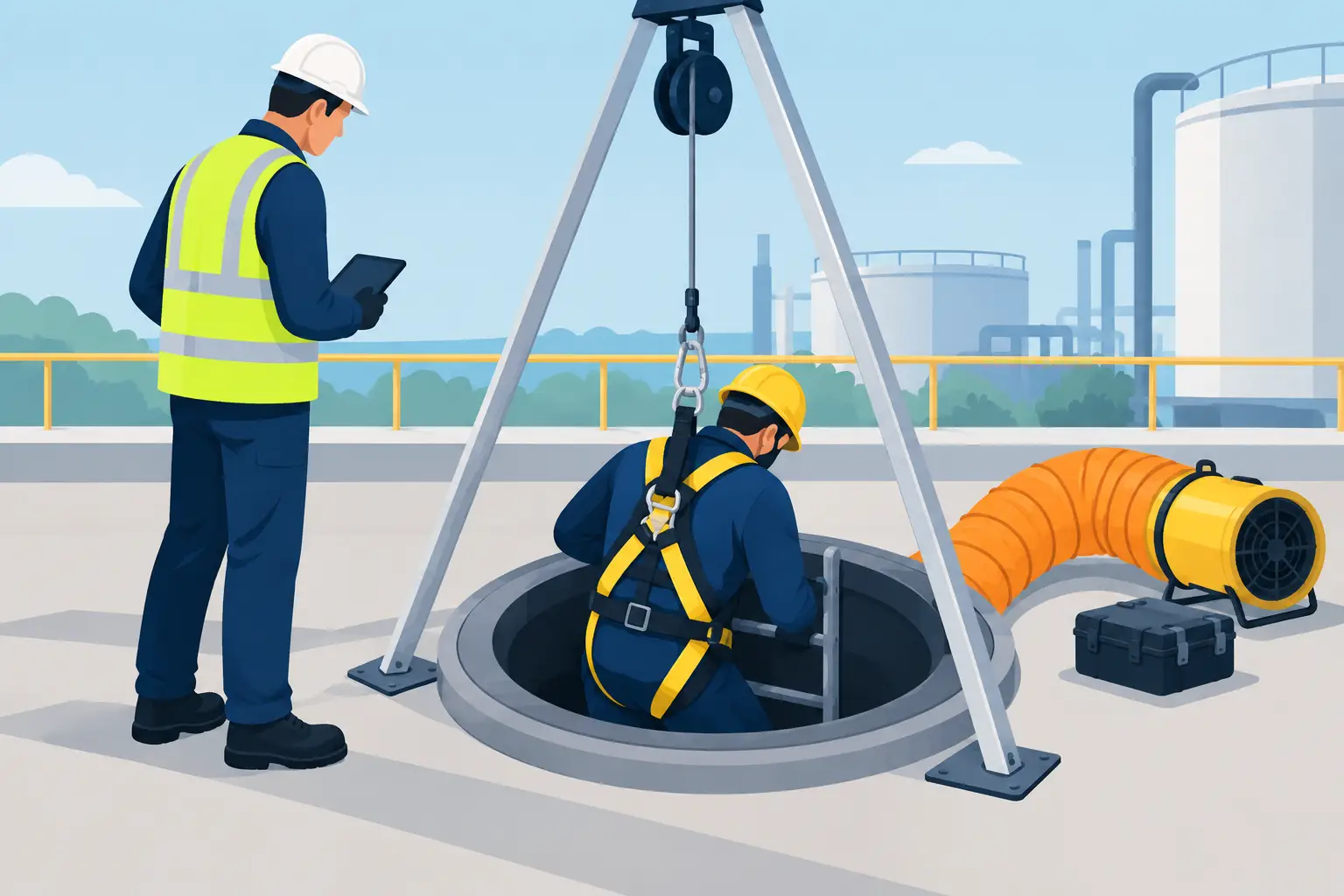
A competent entrant needs to understand the permit conditions, test atmosphere correctly, use suitable harness and retrieval arrangements where specified, and maintain communication with the person controlling the entry. The top person has a distinct role. They manage the entry point, monitor the team, maintain records, prevent unauthorised access and trigger the emergency procedure if conditions deteriorate.
Training should reflect that separation of duties. A site that assigns an inexperienced operative to watch the entrance while carrying out other tasks has not created effective entry control.
High-risk confined-space training
High-risk courses are designed for environments where foreseeable hazards and access arrangements demand a higher level of technical capability. This may include complex vertical entries, difficult extraction routes, significant atmospheric risk, work requiring respiratory protective equipment or conditions in which a casualty cannot be recovered by straightforward retrieval.
For these activities, the course should include realistic practical exercises using the type of equipment the team will deploy. Depending on the task, this may involve escape breathing apparatus, full working breathing apparatus, gas monitors, communications equipment, tripod and winch systems, rescue stretchers and casualty-handling techniques.
High-risk training is not a substitute for a detailed rescue plan. The plan must identify who will rescue, how they will be mobilised, what equipment is available, how access will be maintained and how the casualty will receive medical treatment after extraction. Calling the emergency services without a site-specific provision for immediate rescue is rarely adequate.
Confined-space rescue and breathing apparatus training
Rescue capability deserves separate scrutiny. An entrant may be trained to escape using emergency breathing apparatus but still lack the competence to recover an unconscious colleague. Similarly, a rescue team may be competent in equipment use but unfamiliar with the geometry, hazards and isolation arrangements of a particular site.
Dedicated rescue training should include casualty assessment, team communications, controlled extraction, equipment deployment, contamination controls and post-incident actions. Where breathing apparatus is used, the course must address face-fit requirements, wearer limitations, cylinder management, cleaning and inspection. Medical fitness and practical suitability must also be considered by the employer.
Qualification, accreditation and practical evidence
When comparing providers, procurement teams often focus on course titles. A more useful question is whether the training outcome is recognised by the client, principal contractor, water company or framework that governs the work. Some contracts specify an accredited qualification or a named awarding organisation. Others require demonstrable competence against a defined risk category.
Check the certification period, refresher expectations, assessment method and any prerequisites before booking. A course involving breathing apparatus may require learners to complete a medical declaration, be clean shaven where tight-fitting facepieces are worn and have sufficient physical capability for practical exercises. These are operational controls, not administrative details.
Practical assessment matters because confined-space incidents develop under pressure. A credible course requires learners to apply procedures rather than repeat them. Look for assessment of gas detector bump checks and calibration status, permit interpretation, harness fitting, communications, emergency signals and safe recovery methods. If the task involves a vertical entry, practising only in a classroom does not provide sufficient assurance.
How to specify training for a contract or site
A concise training matrix can prevent both under-training and unnecessary duplication. Map each role against the locations they will access, expected hazards, required equipment and emergency responsibilities. Then verify that the course content and assessment cover those requirements.
For example, a facilities manager who arranges tank inspections may need awareness and permit-control competence, while the contractor’s entrant and top person require task-specific practical training. A water-industry team entering a deep wet well may need medium- or high-risk entry competence, atmospheric monitoring and a rehearsed rescue provision. The classification follows the risk assessment, not the job title.
Training records should be retained with expiry dates, assessment outcomes and equipment-specific familiarisation. Site induction should then address the local conditions that a generic course cannot cover: isolation points, process chemicals, access routes, communications black spots, emergency contacts and ambulance access. Where conditions change, review the RAMS and permit before work resumes.
Evolution Safety Solutions can support this process by aligning confined-space training with site risk assessments, workforce competence records and wider contractor-management controls. This is particularly valuable where confined-space work intersects with excavation safety, DSEAR, water infrastructure, industrial process hazards or principal-contractor duties under CDM 2015.
Questions to ask before booking
Before committing a workforce to a course, establish whether the provider can train for the actual role and risk level, whether practical exercises use suitable equipment, and whether the assessment is independently verified where your client requires it. Ask how many learners are assessed per instructor, whether rescue is included or delivered separately, and what evidence learners receive after successful completion.
Also check the training environment. A well-designed confined-space facility should allow controlled practice of entry, communications, monitoring, retrieval and emergency response. It need not replicate every asset, but it should be sufficiently realistic to test judgement and teamwork. For unusual structures, such as long culverts, restricted process vessels or deep shafts, additional site-based familiarisation and rescue drills may be necessary.
The right course leaves the workforce able to make a sound decision at the access point: enter only when controls are in place, stop when conditions change and act quickly when a colleague needs help. That is the competence standard worth specifying.