An unsupported trench can fail without warning. A strike on a buried gas main, cable or water main can create consequences well beyond the excavation boundary. Knowing how to control excavation risks therefore requires more than issuing generic RAMS: it demands coordinated design information, competent supervision, suitable temporary works arrangements and disciplined site controls throughout the activity.
Excavation work remains a high-risk construction operation under the Construction (Design and Management) Regulations 2015. Principal contractors, contractors and designers must plan the work so that foreseeable hazards are eliminated or controlled so far as is reasonably practicable. The controls must also work in changing ground conditions, around live services and where several trades share a restricted work area.
Start excavation risk control before work reaches site
Effective control starts at pre-construction stage. The client and Principal Designer should ensure that available information on the site, adjacent structures, ground conditions, contamination and existing services is assembled and communicated through the pre-construction information.
For a contractor, this information should inform the construction phase plan, work package planning and task-specific RAMS. It is not sufficient to state that an excavation will be battered back or shored. The method must identify the proposed depth, length, ground type, proximity to structures and plant, service records, access arrangements, spoil location, water management and rescue provisions.
The CDM 2015 hierarchy matters here. Designers should avoid excavation where an alternative solution is reasonably practicable, such as rerouting a service above ground, using trenchless installation methods or redesigning foundations. Where excavation remains necessary, risks should be reduced through design decisions before they become a site problem.
A useful planning review considers whether the excavation may affect neighbouring foundations, roads, retaining walls, underground chambers, railway assets or utilities infrastructure. It should also establish who has authority to alter the excavation sequence or temporary works solution if conditions differ from those anticipated.
Locate and protect underground services
Underground services are one of the most significant excavation hazards. HSE guidance HSG47, Avoiding danger from underground services, provides the established framework: plan the work, obtain service information, locate and identify services, then use safe excavation practices.
Statutory undertaker plans are an essential starting point, but they are not proof of a service’s exact position or depth. Plans can be incomplete, based on historic records or affected by later alterations. They should be reviewed alongside site surveys, visible service indicators, previous construction information and the permit-to-dig process.
Before mechanical excavation begins, competent operatives should use appropriate locating equipment, with the results marked clearly on the ground and understood by the work team. Trial holes should normally be excavated carefully by hand in the identified tolerance zone. The exact method depends on the service owner’s requirements, the utility type, ground conditions and whether safe vacuum excavation is available.
A permit to dig should define the excavation area, identify known services and controls, confirm that detection has been completed, and set its period of validity. It is a controlled authorisation, not a substitute for supervision. If the excavation moves beyond its approved limits, the ground markings become unclear, conditions change or new information is found, work should stop and the permit should be reviewed.
Design the excavation and temporary works properly
Ground can collapse due to over-steep sides, rain, vibration, surcharge loads, changes in strata or water ingress. Even relatively shallow excavations can trap or seriously injure personnel. The selected protective system must suit the actual excavation, not simply the equipment available on site.
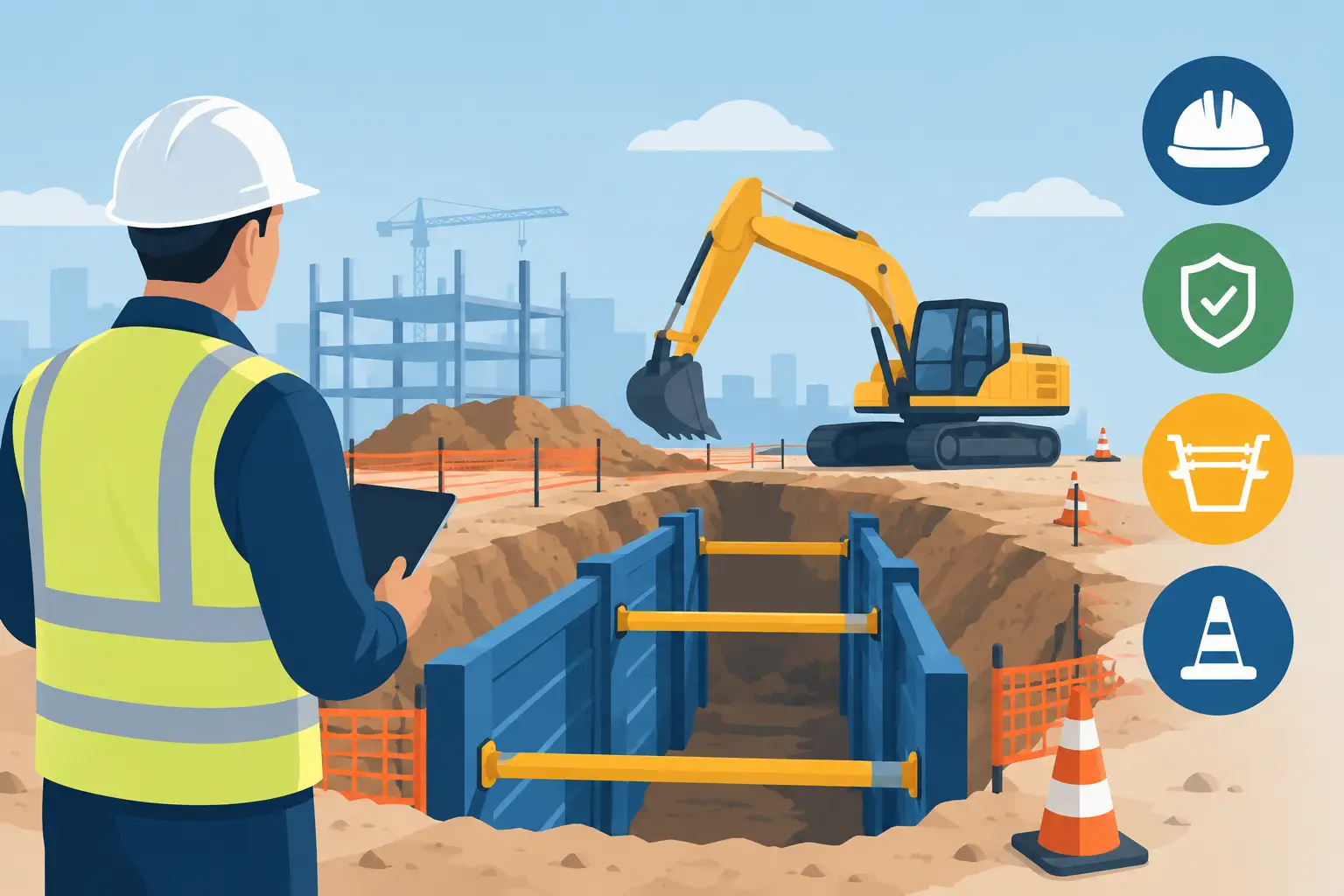
Common control measures include battered or benched sides, trench sheets, hydraulic shoring, proprietary trench boxes and engineered support systems. Each has limitations. Battering requires adequate space and depends heavily on stable ground conditions. A trench box can protect people working inside it, but it does not make unsupported approaches to the box safe or address instability elsewhere in the excavation.
Temporary works must be managed in accordance with a proportionate, defined system. For more complex excavations, this will normally include a Temporary Works Co-ordinator, competent design input, design checks where required, inspection records and formal handover. BS 5975 principles provide a recognised basis for controlling temporary works, particularly where support affects adjacent structures, highways, deep excavations or staged construction.
No person should enter an excavation until the support arrangement has been installed, inspected and accepted for use. Workers must understand the limits of the system, including where they may stand, how materials are placed, and what must happen if a prop, sheet or protective system is disturbed.
Control access, falls and plant interaction
Excavation safety is not limited to collapse. Open edges present a clear fall hazard to workers, visitors and plant operators. Suitable barriers, stop blocks, edge protection, warning signage and lighting should be selected according to the location and the likelihood of public or vehicle access.
Safe access and egress must be provided, maintained and positioned so that workers do not climb unsupported faces or travel excessive distances within a trench. Ladders must be secured and extend sufficiently above the access point. For larger excavations, stair towers or designed access routes may be more appropriate.
Plant movement requires separate planning. Excavators, dumpers and lorries must be kept back from the edge sufficiently to prevent surcharge loading and collapse. The exclusion distance should reflect the temporary works design, soil condition, excavation depth and equipment load. A banksman or vehicle marshal may be necessary where visibility is restricted or vehicles are reversing near the excavation.
Spoil heaps, materials and welfare units can create the same surcharge issue. They should never be placed at the excavation edge simply because space is limited. The work area layout should be agreed before digging starts, with designated locations for spoil, plant, fuel and deliveries.
Inspect conditions, particularly after change
Excavations require formal inspection by a competent person. Under the Construction (Design and Management) Regulations 2015, an excavation must be inspected at the start of each shift before work begins, after any event likely to have affected its strength or stability, and after any accidental fall of material.
Rainfall, freezing conditions, thawing, nearby piling, traffic vibration, dewatering failure and changes to the excavation profile can all affect stability. Inspection is therefore a live operational control, not a paperwork exercise completed in the site office.
Inspection findings should be recorded and communicated to those who need to act on them. Where defects are identified, access must be prevented until the excavation has been made safe. This may mean regrading the slope, removing surcharge loads, pumping out water, installing additional support or obtaining revised temporary works advice.
Water requires particular attention. Pumping may be needed to maintain a safe working area, but uncontrolled dewatering can alter surrounding ground conditions and affect nearby foundations or services. The discharge route should be assessed for environmental compliance, pollution prevention and local drainage capacity.
Make competence and supervision visible on site
People carrying out excavation work need more than a general site induction. Operatives must understand the specific system of work, service drawings and markings, exclusion zones, emergency arrangements and stop-work triggers. Plant operators need clear information about dig limits, safe approach distances and who is directing the operation.
Supervisors should be able to recognise signs of instability, including cracking at the edge, bulging faces, slumping, water seepage, displaced shoring and new ground movement. They must also have the authority to stop work immediately. A culture where operatives can report a concern without pressure to continue is a practical control against serious incidents.
Competence should be evidenced through relevant training, experience and role-specific appointment. This may include plant competence, utility avoidance training, temporary works training and supervisory qualifications. For higher-risk work, an independent review of RAMS, permits, service information and temporary works arrangements can provide valuable assurance before mobilisation.
Prepare for emergencies without relying on rescue from within
An emergency plan should address the realistic scenarios for the excavation: collapse, service strike, flooding, plant incursion, fire, contaminated ground or a medical emergency. The response must identify how the area will be isolated, who will contact emergency services and service owners, and how site access will be maintained.
Workers should not enter an unstable excavation to attempt an improvised rescue. A secondary collapse can turn one casualty into several. Rescue arrangements should instead prioritise stopping work, preventing further entry, making the area safe and obtaining specialist assistance where needed.
For contaminated land, confined-space conditions or work around gas infrastructure, additional controls may be required. Atmospheric monitoring, DSEAR assessment, specialist rescue provision and liaison with the utility owner may be necessary depending on the identified hazard.
A well-controlled excavation is the result of decisions made before digging, verified as conditions change and enforced by competent people at the point of work. When plans, permits, temporary works and supervision align, excavation activity becomes more predictable, defensible and safer for every person on site.