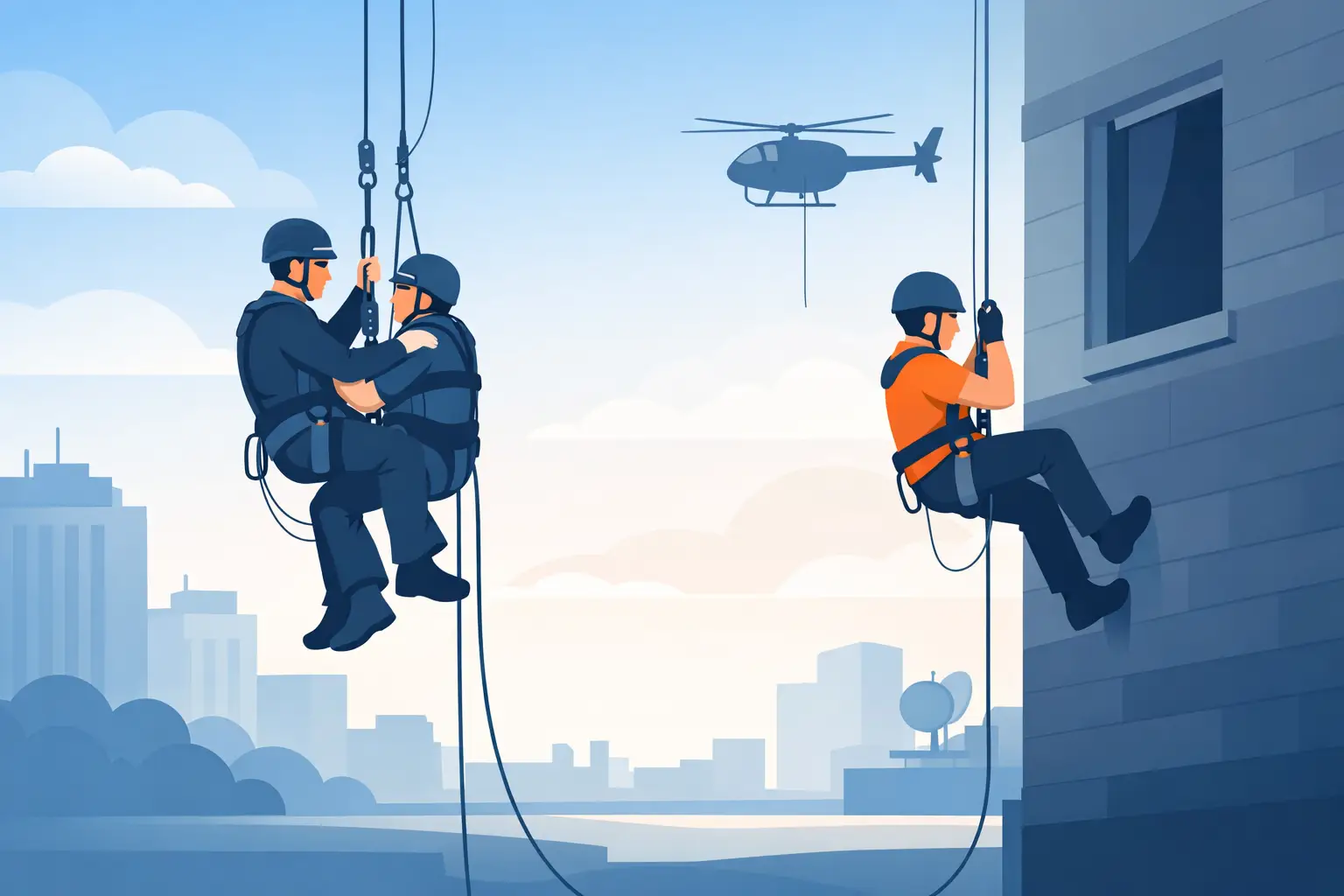
A suspended operative cannot be treated as a routine first-aid scenario. Following a fall arrest event, the worker may be injured, unconscious, unable to self-rescue or at risk of suspension intolerance. Rope rescue and emergency escape from height must therefore be considered before work starts, integrated into the work-at-height plan and tested against the actual structure, access constraints and foreseeable casualty condition.
For principal contractors, facilities managers and duty holders, the key question is not whether a rescue kit is present on site. It is whether a competent team can recover a casualty promptly, without creating a second casualty or relying on an emergency service response that may be delayed by site conditions.
Why a fall arrest plan is not a rescue plan
The Work at Height Regulations 2005 require work at height to be properly planned, appropriately supervised and carried out by competent people. This includes planning for emergencies and rescue. A harness, lanyard and anchor system may arrest a fall, but none of these arrangements alone establishes how a suspended person will be reached, transferred, lowered or recovered to a place where first aid and onward care can be provided.
Generic statements in RAMS such as “call 999” or “use the rescue kit” are rarely sufficient. They do not identify who will undertake the rescue, how they will reach the casualty, whether the selected anchor points are suitable for rescue loading, or what happens if a casualty is hanging beneath a leading edge, within a steel frame, on a telecoms structure or in a confined location.
The rescue arrangement must reflect the work activity. Recovery from a mobile elevated work platform differs materially from a rescue on scaffolding, tower cranes, roof edges, transmission structures, wind energy assets or vertical access systems. The practical options, equipment requirements and competency threshold will change with each environment.
Planning rope rescue and emergency escape from height
A defensible rescue plan starts with the hierarchy of control. Avoid work at height where reasonably practicable. Where it cannot be avoided, prevent falls through collective protection such as compliant scaffolds, edge protection, guardrails and MEWPs. Personal fall protection is normally the final control measure, and its use creates a specific requirement for prompt rescue.
The plan should be developed alongside the task risk assessment and method statement, not added after the lifting plan, access plan or permit-to-work system is complete. It needs to establish credible scenarios rather than simply describe ideal conditions. Consider a worker who has fallen while working alone, a rescuer who cannot access the casualty from above, poor weather affecting rope handling, restricted vehicle access, loss of power, a casualty caught on an obstruction or a rescue taking place outside normal hours.
A site-specific plan should define the rescue method, responsible persons, communications arrangements, equipment location, casualty recovery route, exclusion zones and handover arrangements for emergency services. It should also identify when work must stop. For example, a rescue plan that depends on a trained team being present is not valid if those trained persons leave the work area or are reassigned to another task.
Select a method that suits the site
Common recovery options include assisted self-rescue, lowering or raising with a pre-engineered rescue system, recovery by MEWP, rescue from a fixed access system, or a specialist rope rescue response. There is no universal preferred method. A MEWP may provide the safest recovery method where it can reach the casualty safely and remain available throughout the work. On congested sites, steep structures or locations with difficult ground conditions, that assumption may not hold.
Emergency escape arrangements are different again. They may allow an operative to descend from a height using a controlled descent device when normal access becomes unavailable. Such systems require controlled selection, secure anchorage, suitable descent routes and specific user competence. They are not a substitute for collective protection, nor should they be issued as a general-purpose solution without assessing the workplace and intended users.
Where a plan relies on ropes, anchors, connectors and mechanical devices, equipment compatibility matters. Components that are individually compliant are not automatically safe when assembled as a rescue system. Manufacturers’ instructions, rated loading, rope diameter, descent height, edge risks, device orientation and anticipated rescue configuration all require review by a competent person.
Competence is the critical control
Rope rescue is a specialist activity. A person who is competent to wear a harness or conduct routine work restraint is not necessarily competent to carry out a technical rescue. The rescuer must understand equipment limitations, casualty management, anchor selection, load transfer, lowering and raising principles, communications, dynamic risk assessment and the hazards created by the rescue itself.
Training should match the role. Operatives may need awareness of suspension risks, emergency actions and assisted self-rescue arrangements. Designated rescue personnel require practical, scenario-based training on the equipment and techniques stated in the rescue plan. Supervisors need sufficient knowledge to verify that the plan is available, the team is present, equipment is checked and work does not continue when rescue capability is compromised.
Formal attendance alone is not proof of continued competence. Skills can deteriorate where rescue equipment is rarely used. Refresher training, recorded drills, supervision and reassessment should be proportionate to the complexity and frequency of the work. High-risk sectors such as utilities, construction, energy, rail and industrial maintenance should also consider client standards, site rules and sector-specific competency frameworks.
Equipment management and inspection
Rescue equipment requires the same disciplined control as other safety-critical work equipment. It should be clearly identified, protected from damage and available at the point of work. A rescue kit locked in a distant store, a site vehicle or a supervisor’s office may not be accessible within the time required.
Pre-use checks should cover ropes, harnesses, connectors, pulleys, descenders, anchor slings, rescue stretchers and packaged systems in accordance with manufacturer guidance. Equipment subject to the Lifting Operations and Lifting Equipment Regulations 1998 may require thorough examination by a competent person at prescribed intervals, while other personal protective equipment requires inspection and recorded management under the relevant regulations and guidance.
A kit should not be treated as a sealed box that remains untouched until an incident. Teams must be familiar with its contents and layout. After deployment, equipment may require quarantine, inspection, cleaning or replacement before being returned to service. This process should be documented within the organisation’s equipment register and reflected in site mobilisation checks.
Drills expose weaknesses before an incident
A rescue plan becomes credible when it is rehearsed in realistic conditions. A tabletop exercise can confirm responsibilities, but it will not show whether a casualty can be reached around pipework, whether radio signals work beneath a structure, whether the nominated anchor point is accessible, or whether the team can operate equipment while wearing the PPE required for the task.
Drills should be proportionate and controlled, using a suitable simulated casualty or weighted training load where appropriate. They should test the likely conditions without exposing participants to unnecessary risk. Record the scenario, personnel involved, timings, observations, defects and corrective actions. This provides useful evidence for client assurance, internal audits and incident-prevention reviews.
The objective is not to achieve an unrealistic response-time target. It is to identify where delay or failure could occur and correct it. A drill may reveal that the rescue rope is too short for the location, access is obstructed, the recovery area is not protected from vehicle movements, or the nominated team lacks sufficient personnel to manage both the casualty and the rescue system.
Integrating rescue into wider site controls
Emergency rescue planning should connect with the wider management system. Under CDM 2015, duty holders must ensure that risks are eliminated or controlled through planning, coordination and competent appointment. On complex projects, the rope rescue plan should align with the construction phase plan, logistics plan, lifting operations, temporary works arrangements, permit systems and emergency response procedures.
For occupied buildings and operational assets, coordination is equally important. Facilities teams may need to provide access, isolate plant, manage fire alarm interfaces, secure work areas or direct emergency services. In utilities and industrial settings, DSEAR controls, electrical isolation, confined-space arrangements and process hazards may dictate the rescue approach. A technically sound rope system is not enough if the rescue route passes through an uncontrolled hazardous area.
Evolution Safety Solutions can support organisations in reviewing work-at-height risk controls, developing site-specific rescue arrangements and delivering practical competence training aligned to the work environment. The strongest outcome is an arrangement that can be explained clearly to operatives, demonstrated to clients and used effectively when conditions are at their most demanding.
A rescue plan should give the workforce a practical answer to a difficult question: if someone is left suspended here, right now, who will recover them, with what equipment and by what safe route? If that answer is uncertain, the work is not yet ready to proceed.