A drainage chamber is opened, a worker starts down the ladder and the atmosphere changes before the task has properly begun. This is the operational reality behind many confined space incidents: a routine inspection, cleaning activity, valve operation or repair becomes life-threatening when conditions, controls or rescue arrangements are misunderstood.
For UK dutyholders, confined-space safety cannot be managed through a generic RAMS document and a warning sign at the access point. It requires a task-specific system that establishes whether entry is necessary, controls the hazards that remain, and provides a credible means of recovery if something goes wrong.
Why confined space incidents escalate quickly
A confined space is not defined simply by its size or whether it is underground. Under the Confined Spaces Regulations 1997, it is a place that is substantially enclosed and where serious injury may arise from hazardous substances or conditions within the space or nearby. This can include chambers, tanks, vessels, sewers, culverts, pits, shafts, ducts, silos and some excavations.
The defining issue is the foreseeable risk. A chamber may be safe on one visit and hazardous on the next because of upstream discharge, weather, biological activity, process changes, residual chemicals or work taking place nearby. Oxygen depletion, toxic gas, flammable vapour, engulfment, excessive heat and free-flowing solids can all develop with little warning.
The consequences are often amplified by attempted rescue. Colleagues understandably react when a person collapses, but an unplanned entry by an unprotected rescuer can create multiple casualties. A rescue plan that relies on calling emergency services, without considering access, retrieval, specialist equipment and the nature of the hazard, is not an adequate control measure.
The legal and operational duty
The Confined Spaces Regulations 1997 establish a clear hierarchy. First, avoid entry where reasonably practicable. If entry cannot be avoided, prevent the need for employees to enter a confined space to carry out work. Where entry remains necessary, dutyholders must implement a safe system of work and make suitable arrangements for emergency rescue.
These duties sit alongside the Health and Safety at Work etc. Act 1974 and the Management of Health and Safety at Work Regulations 1999. On construction and infrastructure projects, CDM 2015 also requires clients, designers, principal contractors and contractors to plan, manage and monitor work so it is undertaken without risks to health and safety.
The legal test is not whether paperwork exists. It is whether the assessment, permit, controls and workforce competence are suitable for the actual conditions at the point of work. This distinction matters during investigation, enforcement action and client assurance audits.
Start by removing the need to enter
Avoidance should be actively tested, not treated as a statement on a risk assessment. Remote CCTV surveys, jetting from a safe position, externally operated valves, long-handled tools, isolation changes, remote sampling and redesigned access arrangements may eliminate entry altogether.
There are trade-offs. Remote methods can be slower, may not provide the required quality of inspection and can introduce their own hazards. However, where they achieve the task safely, they are usually preferable to relying on respiratory protection, harnesses and emergency arrangements inside a hazardous environment.
Where entry is unavoidable, the work should be planned around the worst credible conditions, not the best-case assumptions. A confined-space assessment needs to consider the space, the process connected to it, the activity to be undertaken, surrounding work and the people who may be affected.
Build a task-specific safe system of work
A suitable assessment identifies the hazards and specifies the controls required before and during entry. It should not reuse generic wording across tanks, sewers and chambers with fundamentally different risk profiles.
Isolation is central. Mechanical, electrical, hydraulic, pneumatic and process isolations must prevent the introduction of substances, energy, flow or movement into the space. In utilities and process environments, isolation arrangements should be verified by a competent person, with clear communication between operations, the work party and any control room.
Atmospheric testing must be appropriate to the expected hazards. Testing commonly addresses oxygen concentration, flammable gases or vapours, and toxic contaminants such as hydrogen sulphide and carbon monoxide. The order of testing, location of sampling and limitations of the gas monitor matter. For example, gases may stratify, and a single reading from the entrance does not demonstrate that the atmosphere is safe throughout the working area.
Continuous monitoring is often necessary where conditions can change, particularly in sewers, wet wells, tanks connected to live processes and spaces where hot work, cleaning chemicals or equipment emissions are present. Ventilation may control the risk, but it must be selected and positioned so that it reaches the work area without creating a flammable atmosphere or displacing hazards towards others.
What a confined-space permit should control
A permit-to-work system is an active control document, not an administrative form issued at the gate. It should establish the scope and duration of work, the people authorised to enter, and the conditions that require the permit to be suspended or cancelled. In practice, a competent permit issuer should verify:
- the identified space, task and entry team;
- completed isolations, including locks, tags and verification;
- atmospheric test results, monitoring requirements and ventilation arrangements;
- communication, standby cover, access equipment and personal protective equipment; and
- rescue equipment, rescue team availability and emergency communication arrangements.
The permit must be reviewed when the shift changes, the task changes, weather affects the space, monitoring results alter, or another contractor begins adjacent work. A permit that is technically valid but no longer reflects site conditions provides false assurance.
Competence is more than holding a certificate
Confined-space work depends on people understanding their precise role. Entrants need to recognise changing conditions, use equipment correctly and stop work when controls are no longer effective. Top persons or attendants need to maintain communication, prevent unauthorised entry and trigger the emergency response without becoming an additional casualty. Supervisors and permit issuers need the authority and technical judgement to challenge unsafe arrangements.
Training should be matched to the work category and foreseeable rescue needs. A low-risk entry into a clean, isolated chamber is not equivalent to work in a sewer, a space with a specified risk, or a location requiring breathing apparatus. Employers should check that training remains current, practical exercises reflect the work environment, and operatives have been briefed on the site-specific safe system of work.
For contractors, competence assurance should extend to labour-only personnel and specialist subcontractors. Induction alone will not prove that an individual can conduct gas testing, inspect a tripod and winch, use escape breathing apparatus or manage a rescue retrieval.
Make rescue arrangements credible
Rescue planning is where otherwise well-developed systems often fail. The question is not simply who will dial 999. It is how an incapacitated person will be recovered promptly without exposing rescuers to the same atmosphere, engulfment hazard or restricted access.
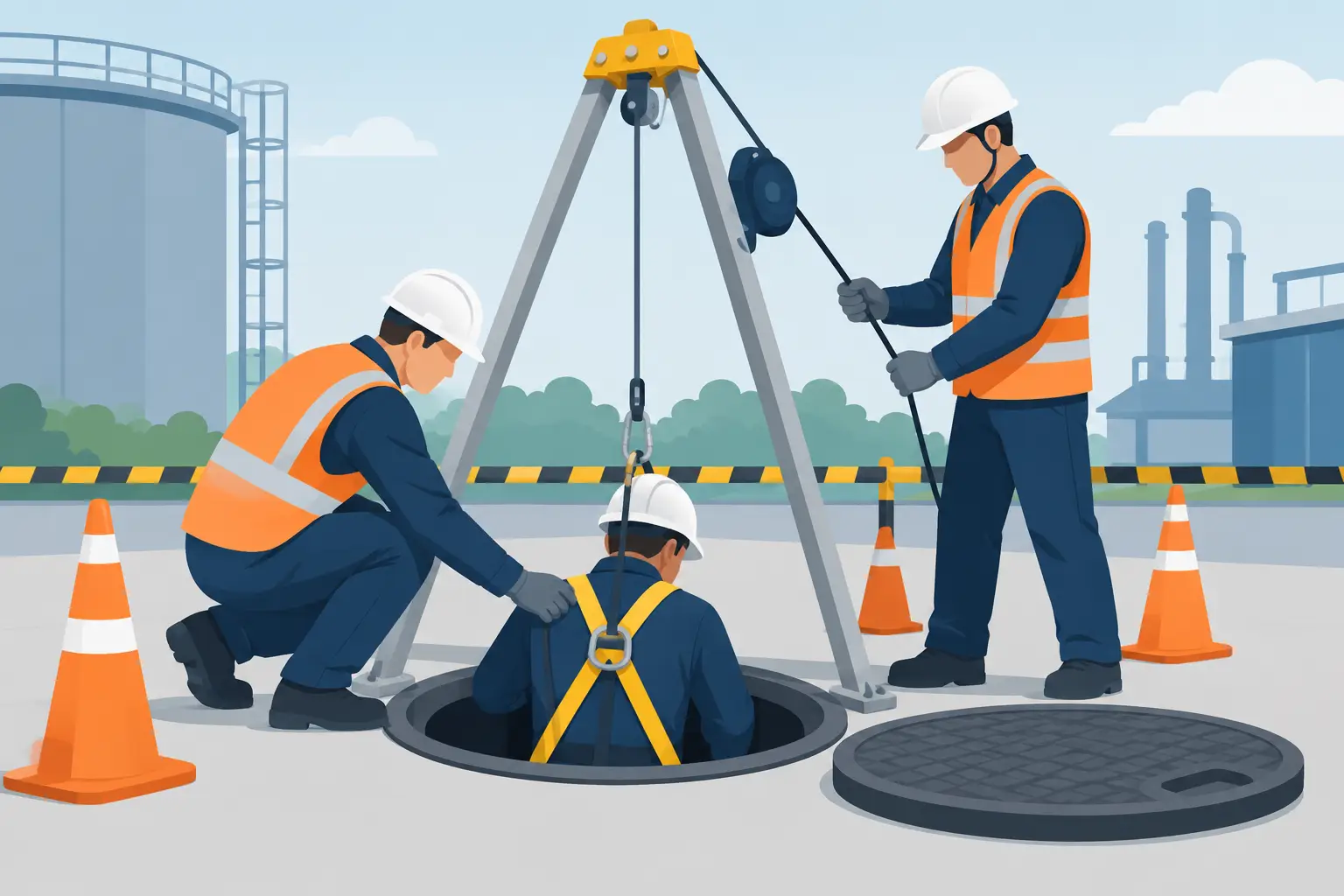
The required response depends on the space and task. Non-entry retrieval using a full-body harness, retrieval line, tripod or davit arm may be suitable in a vertical chamber where the casualty can be lifted without obstruction. It may be unsuitable in a complex vessel, horizontal culvert or sewer where access is restricted, the casualty may snag, or a hazardous atmosphere requires trained breathing-apparatus rescue personnel.
Emergency services remain an essential part of the response, but they should not be the sole rescue provision where immediate recovery is necessary. Arrangements should identify rescue personnel, equipment, access routes, communication methods, casualty handling provisions and how responders will be informed of the hazards and isolations. Drills should test the arrangement under realistic conditions, including poor visibility, limited access and a simulated unconscious casualty.
Assurance that stands up on site
Confined-space controls require inspection and review, particularly on long-running projects or operational sites with changing processes. Gas monitors need calibration, bump testing and traceable maintenance. Harnesses, retrieval systems, breathing apparatus and ventilation equipment require pre-use checks and periodic examination in accordance with manufacturer requirements and relevant inspection regimes.
Supervisory monitoring should test what happens in the field: whether isolations are understood, permits are properly closed out, standbys remain in position and teams act on alarm conditions. Near misses, monitor alarms and permit deviations should be investigated for system weaknesses rather than dismissed as individual error.
Evolution Safety Solutions supports organisations with confined-space risk assessment, safe-system development, operational audits and practical competence training aligned to the hazards faced by construction, utilities and regulated workplaces. The strongest arrangements are those that give teams clear authority to stop entry when conditions change, then provide the technical support to make the work safe before it restarts.