A buried cable strike can stop a civils programme immediately. More seriously, it can expose operatives to fatal electric shock, cause gas release, interrupt critical utility supplies and leave the principal contractor facing investigation, repair costs and programme delay. An HSG47 cable avoidance training course gives those planning and carrying out excavation work the practical knowledge to identify underground-service risk and apply suitable controls before a bucket enters the ground.
HSG47, Avoiding danger from underground services, remains the central Health and Safety Executive guidance for work near buried services. It applies across construction, highways, utilities, maintenance, groundworks, landscaping and demolition. The guidance is not a substitute for competent planning, current utility information or a permit-to-dig system. It is, however, an essential framework for establishing the safe system of work that these controls require.
Why underground-service competence matters
Underground services are rarely as simple as drawings suggest. Asset records can be incomplete, services may have been diverted or abandoned, and depth information is often indicative rather than definitive. Private cables and pipes may not appear on statutory undertaker plans at all. Ground conditions, reinstatement, congested corridors and previous site activity add further uncertainty.
This is why HSG47 promotes a disciplined process: obtain and review plans, survey the work area, mark identified services, use appropriate detection equipment correctly, and excavate using safe techniques. Each stage supports the next. A cable avoidance tool cannot compensate for poor records review, while a well-marked route does not remove the need for careful excavation and ongoing supervision.
For dutyholders, competence is also a compliance issue. Under CDM 2015, those appointing or managing workers must ensure that people have the skills, knowledge, experience and organisational capability appropriate to the work. Training records, equipment checks, RAMS, permits and site briefings should demonstrate that the risk of contact with buried services has been considered and controlled proportionately.
What an HSG47 cable avoidance training course should cover
Effective training must move beyond a classroom explanation of coloured markings and buried-service plans. Operatives and supervisors need to understand what information means in practice, where its limitations lie, and when to stop work and escalate uncertainty.
Planning, records and risk assessment
Before breaking ground, the team should obtain current statutory undertaker information and investigate known private services. The course should explain how to read plans, recognise plan symbols, assess the search area and compare records against the intended excavation, bore, trial hole or driven installation.
Learners should also understand the role of the risk assessment and method statement. Generic wording such as “scan for services” is not enough for a high-risk excavation. The RAMS should identify the work area, known or suspected services, detection method, exclusion requirements, hand-digging arrangements, emergency procedure and responsibilities for authorisation and supervision.
A permit-to-dig system is particularly valuable where multiple activities, changing work fronts or complex service routes increase the potential for error. The permit should not become a paperwork exercise. It needs clear site-specific information, defined validity, competent sign-off and a process for reassessment when conditions change.
Cable avoidance tools and signal generators
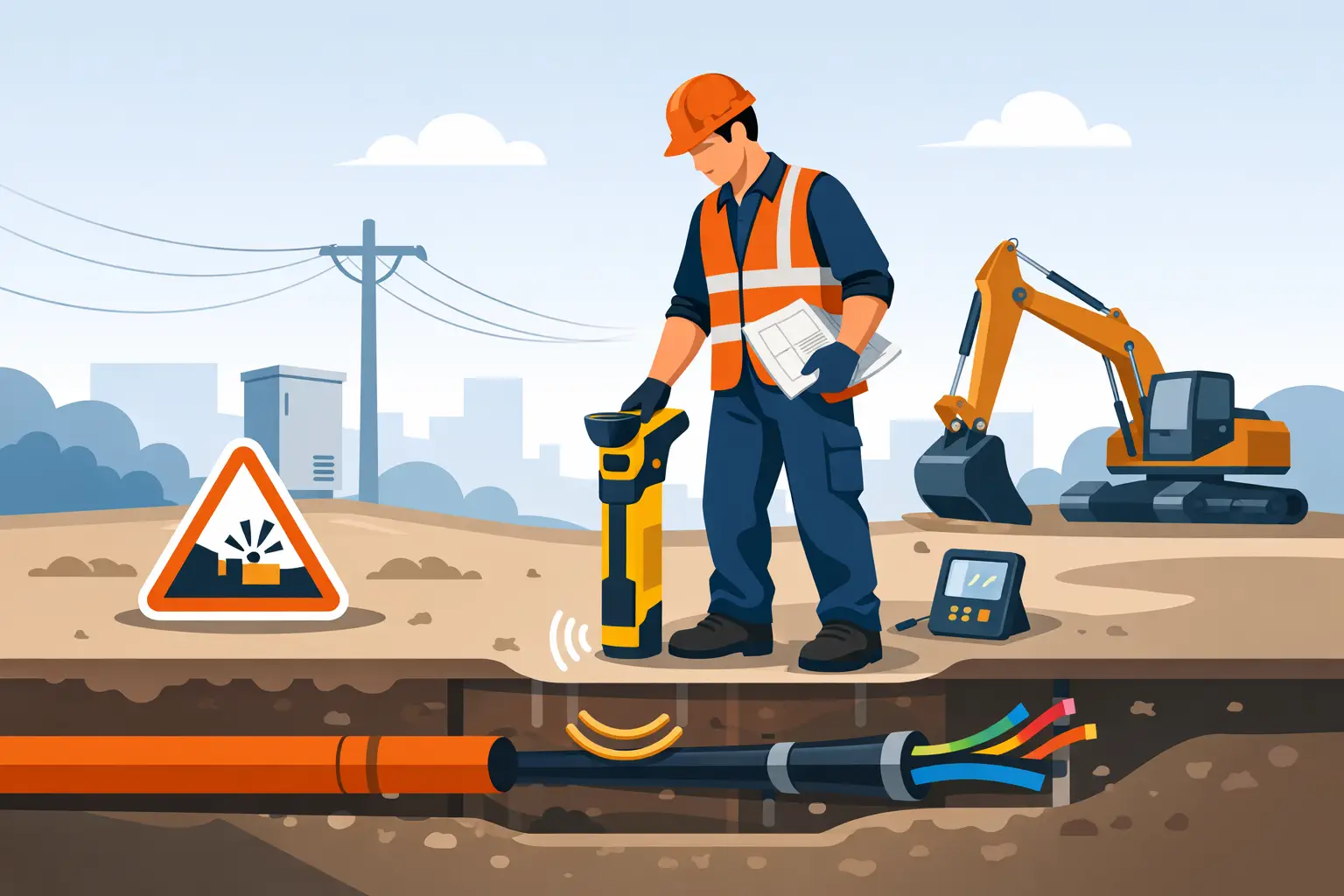
A key part of an HSG47-aligned course is the correct use of cable avoidance tools, commonly called CATs, alongside signal generators or Gennys. Learners should be able to carry out function checks, select the correct operating mode, conduct a systematic survey and interpret the indications they receive.
Training should cover power, radio and generator modes, including the limitations of each. Passive modes may identify live power cables or signals re-radiated from other sources, but they do not locate every buried asset. Generator modes can improve detection where a suitable connection or induction method is possible, yet signal bleed, congested services and poor earth conditions can affect results.
The practical message is clear: a non-detection is not proof that no service exists. When plans, visual evidence or the nature of the site indicate a possible service, the team must treat the area as potentially hazardous until the route and depth have been established by safe means.
Marking out and safe excavation
Once a service has been detected, its route should be marked clearly and protected from disturbance. Markings need to be understandable to the excavation team and maintained as work progresses. On busy sites, paint markings can disappear under spoil, traffic or weather, so supervisors should consider physical barriers, marker boards or repeat surveys where necessary.
The course should address the use of trial holes and safe digging methods around marked services. Mechanical excavation has a place in planned works, but it must be kept outside the defined tolerance zone and controlled by the agreed method statement. Within the zone, hand digging using suitable insulated tools, careful exposure and appropriate support arrangements may be required. The exact approach depends on the asset type, ground conditions, utility owner requirements and work activity.
Operatives also need to recognise that service routes can change direction or depth. A cable found in one trial hole should not be assumed to follow a straight, predictable line. Continued observation and verification are necessary as the work advances.
Who should attend the training?
The course is relevant to anyone whose decisions or actions could affect buried services. This includes groundworkers, machine operatives, drainage teams, highways operatives, utilities crews, fencing installers, arboricultural contractors and maintenance teams undertaking intrusive work.
Supervisors, site managers, temporary works personnel and project managers also benefit because they are often responsible for reviewing RAMS, confirming permits, allocating competent people and intervening where site conditions differ from the plan. For principal contractors, consistent training supports supply-chain control and reduces the variation in working practices between trades.
Training requirements should be matched to role and exposure. An excavator operator needs practical familiarity with the agreed exclusion zones and communication arrangements. A surveyor or permit issuer may need more detailed knowledge of records, detection strategy and the limitations of available information. A one-size-fits-all briefing rarely provides sufficient assurance for all these responsibilities.
Building HSG47 into the site control system
Training is most effective when it is connected to everyday operational controls. A competent operative can still be placed at risk if outdated plans are issued, detection equipment is not maintained, or production pressure encourages shortcuts. Management arrangements need to support the behaviours taught on the course.
This means retaining current service drawings, checking CAT and signal-generator calibration and daily functionality, and ensuring enough time is allowed for surveys and trial holes. It also means making the stop-work authority explicit. If markings conflict with plans, a suspected service is found, or the excavation extends beyond the surveyed area, work should pause until the responsible person reviews the risk.
For larger projects, buried-service controls should be addressed at pre-construction stage and communicated through the construction phase plan. Designers and Principal Designers can help eliminate avoidable excavation, coordinate available utility information and identify residual risks. The principal contractor must then translate that information into workable site arrangements, inductions, task briefings and monitoring.
Selecting suitable course delivery
When selecting an HSG47 cable avoidance training course, employers should look for practical, role-relevant delivery rather than attendance alone. Training should include hands-on use of the equipment types deployed on site, realistic scanning exercises and assessment of the learner’s ability to follow a systematic process.
It is also sensible to confirm how competence will be recorded and refreshed. Equipment interfaces, utility requirements and site procedures can change, while infrequent users may lose confidence in interpreting signals. Refresher training, toolbox talks and supervisor observation can help maintain standards between formal courses.
Evolution Safety Solutions can support organisations that need cable avoidance competence to sit within a wider compliance programme, including RAMS review, CDM 2015 support, workforce training and evidence for contractor assurance. The strongest outcome is not simply a certificate: it is a site team that recognises uncertainty, follows the control system and stops before a routine excavation becomes a serious incident.