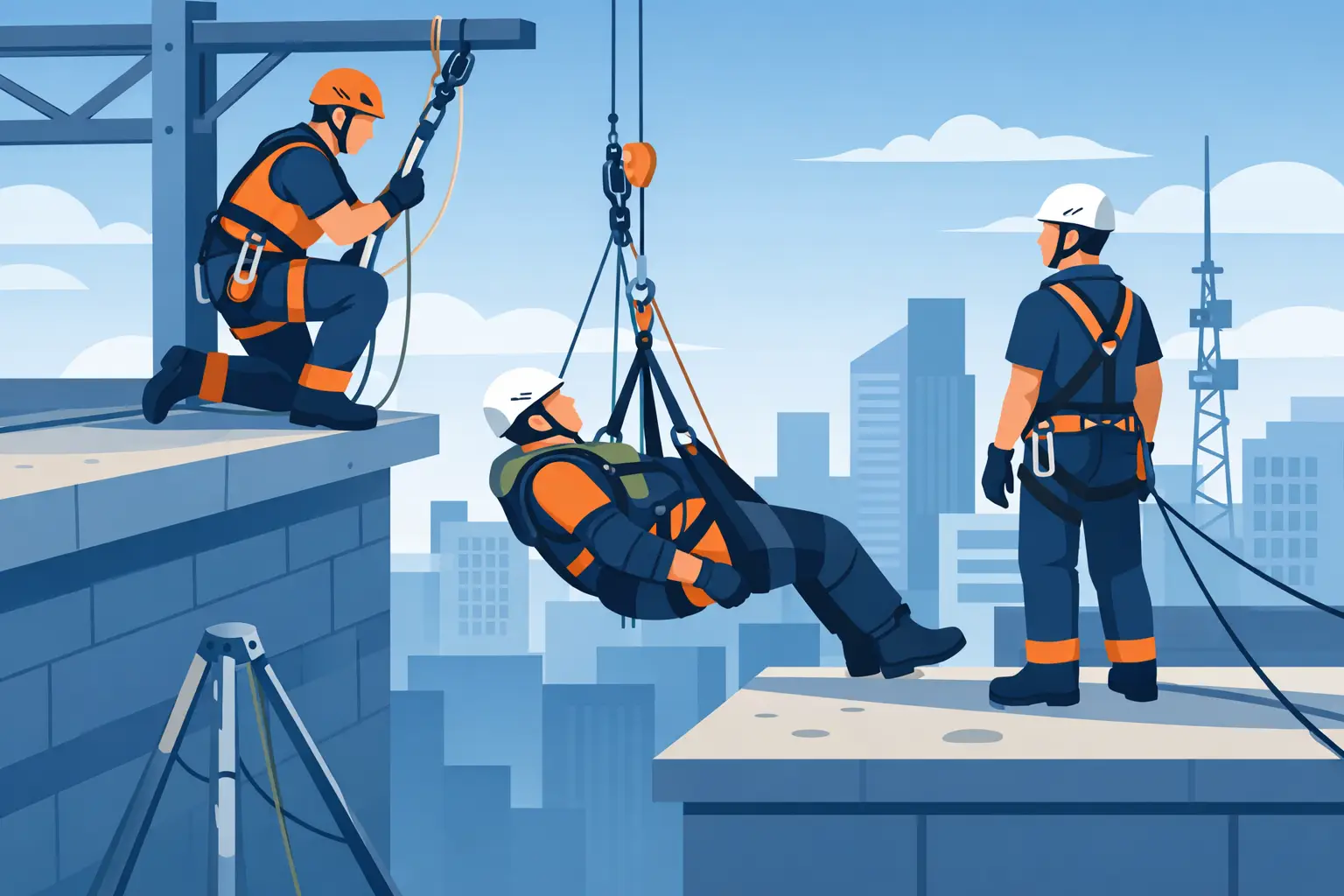
A fall-arrest system can stop a person reaching the ground, but it does not complete the rescue. Gotcha rescue training gives designated personnel the practical competence to recover a suspended casualty promptly, using suitable pre-rigged rescue equipment and a procedure that works for the specific structure, work activity and site conditions.
For principal contractors, facilities managers and work-at-height duty holders, this is a critical distinction. A harness, lanyard and suitable anchor point are only part of the control system. The Work at Height Regulations 2005 require work at height to be properly planned, appropriately supervised and carried out by competent people. That planning must account for foreseeable emergencies, including the recovery of a person after a fall.
Why a fall-arrest plan is not a rescue plan
A common weakness in RAMS is the statement that emergency services will be called following a fall. Calling 999 is necessary where a casualty needs clinical support, but it is not an adequate primary rescue arrangement. Emergency services may face access restrictions, incomplete site information, permit controls, traffic management and the same work-at-height hazards as the workforce. Their arrival time cannot be treated as the rescue timescale.
A casualty left hanging in a harness may be exposed to suspension intolerance. The severity and onset vary with the individual, harness fit, injuries, temperature, exertion and consciousness, so there is no safe universal waiting period. The operational requirement is straightforward: recover the casualty without delay, prevent further harm during recovery and transfer them to an appropriate place of safety for assessment.
A Gotcha rescue kit is commonly used for this purpose because it allows a trained rescuer to reach, attach to and lower or raise a casualty without placing themselves in the same fall hazard. The equipment does not remove the need for planning. It gives a competent team a practical method where its capacity, anchor arrangement and operating limitations match the task.
What Gotcha rescue training should cover
Effective Gotcha rescue training is practical, scenario-led and tied to the type of work being undertaken. Delegates need more than a demonstration of kit contents. They must understand how a rescue sequence changes when a casualty is suspended below a platform, stranded at a ladder, unable to release their own lanyard or positioned near obstructions.
Equipment knowledge and pre-use checks
Training should begin with the rescue kit itself: ropes, descender or lifting mechanism, attachment hardware, pole or reach device where provided, casualty connection elements and storage arrangements. Delegates should be able to identify damaged, contaminated, missing or out-of-date components, check that equipment has been formally inspected at the required interval, and confirm that the kit has not been compromised by poor storage.
The rated capacity of the system is a key control. It must accommodate the casualty, their clothing and equipment, and any applicable rescue configuration. Teams must also understand the consequences of using incompatible connectors, loading a karabiner incorrectly, routing a rope across sharp edges or allowing a descent line to run into a live work area.
Anchor selection and rescue geometry
The selected rescue anchor must be suitable for the anticipated loading direction and the rescue operation, not simply convenient or close to the casualty. This is particularly relevant on steelwork, rooftops, telecoms structures, temporary works, gantries and plant where the fall-arrest anchor may not be suitable for rescue loading.
Delegates should assess clearance below the casualty, potential swing hazards, sharp edges, pinch points and landing areas. A controlled lower may be the preferred outcome, but only where the route is clear and the casualty can be brought to a safe, accessible location. In other circumstances, a short lift may be needed to release the casualty from their original lanyard before lowering begins.
Casualty connection and controlled recovery
Practical drills should cover approaching the casualty safely, connecting the rescue system to an appropriate attachment point, taking the casualty’s weight, releasing or bypassing the original connection where safe, and operating the equipment under control. Rescuers need to communicate clearly, particularly if the casualty is conscious, distressed or unable to assist.
The process must prevent a secondary fall. It must also avoid forcing a rescuer into an unsupported edge position or beneath a suspended load. Depending on the workplace, the recovery may require an exclusion zone, banksman support, isolation of nearby plant, or control of public access below the work area.
Post-rescue care and incident control
Recovery from suspension is not the end of the emergency. The casualty may have injuries that are not immediately obvious. Site arrangements should identify who calls emergency services, who meets them, where first aid equipment is held, how access gates are opened and how relevant information is handed over.
The incident scene should then be controlled. Fall-arrest and rescue equipment involved in the event must be removed from service pending competent examination or manufacturer advice. The work activity should not restart until the cause of the fall, the performance of the rescue plan and any required corrective actions have been reviewed.
Matching the rescue method to the workplace
There is no single Gotcha rescue procedure that is suitable for every work-at-height activity. A team working from a fixed ladder in a water-treatment facility faces different constraints from operatives installing cladding, inspecting bridge structures or undertaking maintenance inside a process plant.
On construction projects, the rescue plan should align with the construction phase plan, work-at-height RAMS, lift plans, temporary works controls and site emergency arrangements. Where activities change frequently, such as during steel erection or façade installation, the rescue method may need review at each workfront rather than being copied across the project.
In utilities and infrastructure environments, access constraints may be more significant. A rescue may need to consider confined spaces, water hazards, remote locations, overhead services, isolation procedures and network owner requirements. EUSR and client-specific access arrangements do not replace rescue competence, but they must be reflected in the response plan.
For facilities and property managers, the issue is often that contractors arrive with their own fall-arrest equipment but no validated means of prompt rescue from the building’s roof, atrium, plant room or access system. Contractor competence checks should therefore include the rescue method, rescue kit inspection status, nominated rescuers and confirmation that site-specific anchors and access routes have been assessed.
Competence, numbers and refresher arrangements
A trained individual is not automatically an available rescuer. Duty holders should identify sufficient trained personnel for each shift, work area and contractor package. The arrangement must remain viable during breaks, holidays, lone working, night work and changing site occupancy. If only one person understands the equipment, the system is vulnerable.
The appropriate level of training depends on the equipment deployed and the foreseeable rescue scenarios. A basic familiarisation session may help a team understand emergency arrangements, but it is not a substitute for hands-on practical instruction where people are expected to operate a Gotcha kit. Delegates should have the opportunity to complete the full sequence under supervision, including connecting to a simulated casualty and controlling a recovery.
Refresher requirements should be set through risk assessment, manufacturer guidance, client requirements, incident findings and evidence of continued use. Annual review is common for work-at-height rescue arrangements, but the right interval depends on exposure and operational change. A team that carries out frequent rescue drills will retain capability differently from a team that uses the kit only as an emergency contingency.
Training records should identify the course content, equipment model, instructor, date, delegates and practical assessment outcome. This evidence supports competence management, tender submissions, client audits and investigation following an incident. It also makes it easier to identify when a change in equipment or work method requires further training.
Integrating rescue into RAMS and emergency planning
A defensible rescue plan should be specific enough for the people on site to use under pressure. It should state the work location, likely casualty position, rescue equipment, nominated rescuers, rescue anchor, recovery route, communications method, first-aid arrangements and escalation process. Generic wording such as “rescue using suitable equipment” offers little operational assurance.
Before work starts, the team should confirm that the rescue kit is present at the point of work, not locked in a distant store or vehicle. They should check that access routes remain open, anchors are available, mobile signal or radio coverage is adequate and the landing area is not obstructed by materials, vehicles or ongoing works. These checks are particularly important when work moves between levels or across large sites.
Evolution Safety Solutions can support employers and contractors with practical work-at-height rescue training alongside RAMS review, competence planning and wider health and safety compliance support. The objective is not simply to hold a rescue kit on site, but to establish a credible capability that can be used when the situation is time-critical.
The most useful test is simple: if a colleague falls now, can the available team explain who will rescue them, from where, with which equipment, and where they will be taken? If the answer is uncertain, the rescue arrangement needs attention before work resumes.