

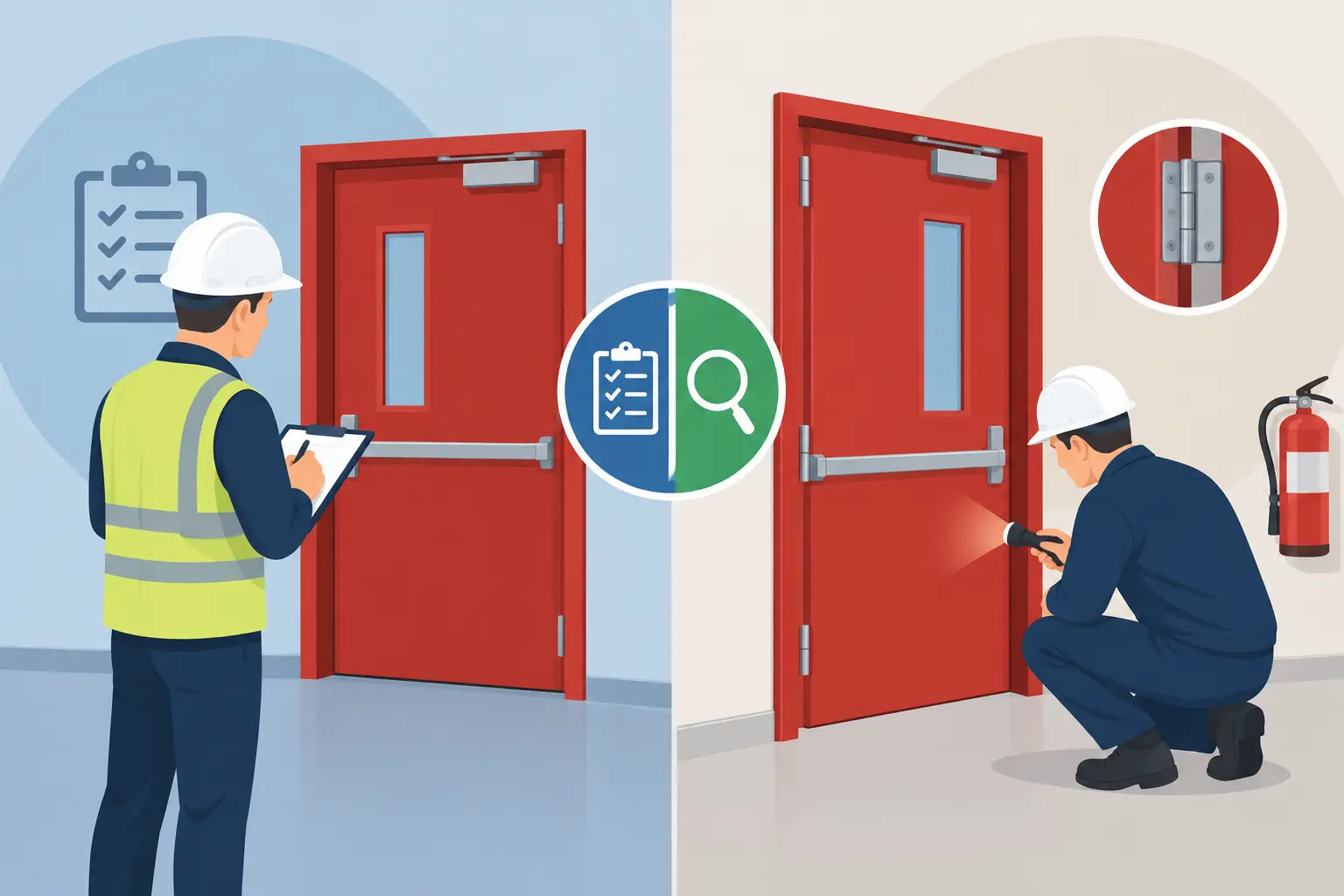
A fire door that closes but does not latch, has damaged intumescent seals, or has been altered around its frame can compromise a compartment line when it is needed most. The distinction between a fire door survey versus inspection matters because each produces different information, serves a different operational purpose, and may be required at different points in a building’s fire-safety management cycle.
For Responsible Persons, facilities managers, principal contractors and building operators, the practical question is not which exercise is better. It is whether the scope of work provides sufficient evidence to identify defects, prioritise remedial works and demonstrate that fire-resisting doors are being managed as part of the wider fire strategy.
What is a fire door survey?
A fire door survey is a structured assessment of a defined population of fire doors. It is commonly commissioned to establish a baseline condition, create or validate a fire-door asset register, support planned maintenance, or determine the scale and cost of remedial work across a site or portfolio.
The surveyor records each door set individually, usually assigning a unique reference and location. The work assesses whether the door assembly appears appropriate for its required function and identifies visible defects or non-conformities affecting fire and smoke performance. Depending on the agreed scope, the survey may also review doors against drawings, the fire strategy, compartmentation layouts or information from the fire risk assessment.
A competent survey will normally consider the relationship between the door leaf, frame, hardware, seals, glazing, signage and surrounding construction. This is critical. A certified door leaf does not, on its own, demonstrate a compliant fire door set. Compatibility of components, correct installation and continuing condition all affect performance.
The output is generally an asset-level report or schedule. It may include door references, photographs, stated ratings where these can be evidenced, defect descriptions, risk categorisation, recommended actions and budgetary information for repairs or replacement. For estates with a legacy of alterations, incomplete records or varying door types, this baseline can be the starting point for a defensible maintenance programme.
What is a fire door inspection?
A fire door inspection is a condition check of individual door sets at a particular point in time. Its principal purpose is to identify faults that could prevent the door from resisting fire and smoke, or from closing correctly in normal use.
Inspections are often repeated at intervals set by the building’s risk profile, fire risk assessment, occupancy, usage levels and maintenance arrangements. High-traffic doors in healthcare, education, residential common parts, industrial premises or public buildings can deteriorate quickly. A door used hundreds of times each day warrants a different level of attention from a low-use plant-room door.
The inspection is focused on present condition and function. Typical observations include excessive perimeter gaps, damaged or missing intumescent and smoke seals, loose hinges, failed self-closing devices, unsuitable hold-open arrangements, damaged glazing, missing signage, excessive leaf damage, unapproved penetrations and doors that fail to close fully onto the latch.
An inspection should result in a clear record of findings, remedial priorities and close-out actions. It is not merely a pass-or-fail exercise. A meaningful inspection record allows the dutyholder to show what was found, what action was taken, who completed it and when the door was rechecked.
Fire door survey versus inspection: the operational difference
The terms are sometimes used interchangeably, but they should not be assumed to mean the same thing. The difference usually lies in scope, objective and deliverable.
A survey is normally broader and more strategic. It answers questions such as: How many fire doors are present? Where are they located? What type of door sets are installed? Which defects are widespread? What remedial programme is required? It is especially useful when taking over a building, preparing a capital works programme, responding to concerns raised in a fire risk assessment, or establishing controls across multiple premises.
An inspection is normally more cyclical and maintenance-led. It asks: Is this door set functioning and in suitable condition today? Has a previous defect been rectified? Has damage occurred since the last check? It supports ongoing assurance after the asset information and remedial priorities are established.
In practice, one commission can include elements of both. For example, an initial survey may assess every door, create the register and identify urgent failures. Subsequent inspections can then be scheduled to maintain the register and verify that defects have been closed. The scope must make this clear. A report described simply as a “fire door check” may not provide the asset data, technical assessment or evidence trail that the client expects.
Where each fits within legal compliance
Under the Regulatory Reform (Fire Safety) Order 2005, the Responsible Person must take general fire precautions so far as is reasonably practicable. Fire doors are part of the measures that protect escape routes, support compartmentation and limit the spread of fire and smoke. Their management should therefore be reflected in the fire risk assessment and the building’s wider maintenance arrangements.
For higher-risk residential buildings and other applicable premises, additional duties and expectations may arise under the Fire Safety Act 2021, the Building Safety Act 2022 and associated fire safety regulations. The precise dutyholder position depends on the premises, its use and the work being undertaken. A survey or inspection does not remove the need to understand those duties.
British Standard guidance, including BS 8214, can inform the installation, inspection and maintenance of fire door assemblies. However, compliance cannot be reduced to a checklist alone. The assessor must understand the door’s role in the building, the likely fire and smoke performance required, the available evidence of specification, and whether alterations have introduced compatibility issues.
A fire risk assessment may identify that a fire door is defective, but an FRA is not normally a substitute for a detailed door survey. Equally, a fire door survey does not replace an FRAEW where one is required, nor does it establish the full condition of compartment walls, service penetrations or cavity barriers. These controls operate together.
Deciding what your site needs
A full survey is usually the appropriate first step where records are absent, the site has undergone refurbishment, door locations are unclear, there is a large or complex estate, or recurring defects suggest systemic issues. It can also support procurement by separating immediate life-safety repairs from planned replacement works.
Routine inspection is more appropriate where a reliable asset register exists, door sets have been surveyed, and the building needs continued condition monitoring. It is particularly valuable following damage, changes in use, contractor works, replacement of ironmongery, or reports that doors are being wedged open or failing to close.
For construction projects, fire-door assurance should begin before handover. Product information, installation records, certification evidence, ironmongery schedules and commissioning checks should be controlled within the project quality process. Under CDM 2015, relevant residual information should also be transferred into the health and safety file so the client can manage the building safely after completion.
What good reporting looks like
Whether the work is described as a survey or inspection, the report should be usable by the person responsible for resolving the findings. Vague wording such as “door requires attention” creates uncertainty for maintenance teams and contractors.
A useful report identifies the location and unique reference, describes the defect, explains the likely implication, assigns an action priority and records the recommended remedial measure. Photographs should support the finding where appropriate. Where the rating, certification or suitability of a door set cannot be verified, the report should say so rather than make assumptions.
Remedial recommendations also need proportion. Replacing a complete door set may be necessary where compatibility or integrity cannot be established, but some defects can be addressed through correctly specified repairs or adjustment by competent personnel. The decision depends on the evidence available, the defect’s severity, the door’s required performance and the proposed repair method.
Competence and close-out matter as much as the survey
The value of a fire door survey or inspection is lost if findings are not controlled through to completion. Urgent defects should be escalated promptly, interim precautions considered where necessary, and remedial work completed by competent providers using suitable components. Completion should then be verified and recorded against the original finding.
Evolution Safety Solutions can support this process through fire-door and compartmentation inspections, fire risk assessment support, compliance reporting and workforce competence development. The objective is not simply to generate a defect list, but to give dutyholders clear evidence, practical priorities and an auditable route to safer premises.
The most effective programme is one that treats fire doors as maintained life-safety systems: surveyed when reliable baseline information is needed, inspected often enough to detect deterioration, and repaired before small defects become failures in a fire.