

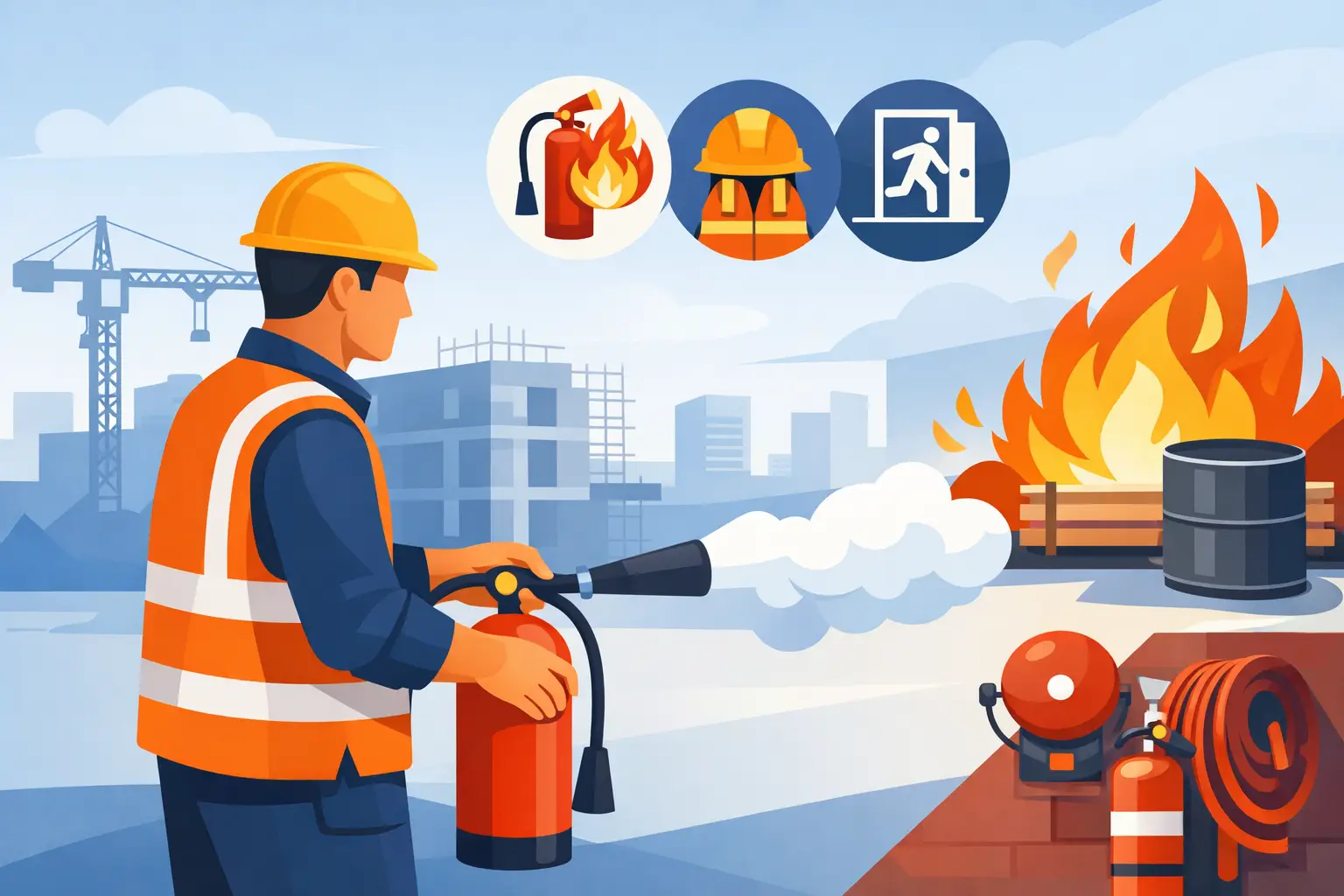
A utility crew may be carrying out hot works near a temporary welfare unit, a cable installation team may be working alongside stored fuels, or an operative may be the first person to identify smoke within a plant room. In each case, EUSR fire safety awareness provides the baseline knowledge needed to recognise the risk, raise the alarm and respond without creating further danger. It is not simply a card requirement: it supports the safe behaviours that prevent small failures becoming site emergencies.
Why EUSR fire safety awareness matters on operational sites
Construction, utilities and infrastructure environments present a changing fire-risk profile. Workfaces move, temporary electrical supplies are introduced, combustible materials accumulate, and contractors may be unfamiliar with local emergency arrangements. A fire strategy that was suitable at mobilisation can become ineffective if access routes, storage areas or site boundaries change without control.
For principal contractors, employers and supervisors, workforce awareness is a practical control within a wider fire-safety management system. People must understand what they are expected to do before an incident occurs, particularly where work is remote, shifts overlap, or emergency services may face restricted access. This is especially relevant on utility projects where excavation, confined spaces, substations, compounds and live operational assets can create hazards beyond those found on a conventional building site.
Where a client, framework or site-access requirement specifies EUSR registration, the correct course and registration route should be confirmed before booking. Requirements can differ between asset owners and projects. Training must also be current, delivered by an approved provider where required, and matched to the operative’s actual duties.
What fire safety awareness training should achieve
A suitable awareness course gives operatives enough knowledge to identify common hazards and follow established controls. It should use recognisable site scenarios rather than treating fire safety as a generic office-based subject. The objective is informed action, not to turn every delegate into a fire-risk assessor or emergency responder.
Training commonly addresses the following areas:
- the fire triangle and the conditions that allow fire to start and spread;
- ignition sources, combustible materials and work activities that increase risk, including hot works and temporary electrics;
- the purpose of good housekeeping, safe storage, fire doors, compartmentation and clear escape routes;
- alarm arrangements, evacuation procedures, assembly points and the need to account for personnel; and
- when it is appropriate to leave immediately, raise the alarm and call for assistance rather than attempt to tackle a fire.
The quality of delivery matters. Operatives need to connect these principles to the site rules in front of them. For example, fire doors must not be wedged open simply because materials are being moved repeatedly, and extinguishers must not be removed from their designated locations to support an unrelated task. Small deviations can weaken the controls relied upon by everyone else on site.
Awareness is not specialist fire competence
EUSR fire safety awareness should sit within a defined competence matrix. It does not replace the duties of a fire marshal, responsible person, fire warden or appointed person under local arrangements. Nor does it qualify a delegate to undertake a fire risk assessment, inspect passive fire protection, design an evacuation strategy or carry out live-fire extinguisher training.
Those responsibilities require role-specific instruction, experience and, where appropriate, formal qualifications. The same distinction applies to managers. A supervisor who has completed awareness training still needs sufficient competence to enforce site rules, challenge unsafe practices and escalate deficiencies through the project management structure.
Connecting training to legal and site controls
Training is one control measure, not evidence that fire risk has been fully managed. Employers and dutyholders must still assess risk, implement proportionate precautions, maintain emergency arrangements and communicate those arrangements to workers. In occupied or operational premises, the Regulatory Reform (Fire Safety) Order 2005 will commonly form part of the compliance framework in England and Wales. Construction activities also require fire risk to be managed through project planning, coordination and supervision under CDM 2015.
The details depend on the environment. A contractor refurbishing an occupied building must manage escape routes, resident or employee interfaces, temporary compartment breaches and fire-door integrity. A civils contractor working from a compound may need controls for fuel storage, generators, battery charging, waste, welding and access for emergency vehicles. On higher-risk sites, DSEAR considerations may also apply where dangerous substances, flammable liquids, gases or explosive atmospheres are present.
The strongest arrangements connect the training record to live site documentation. RAMS should identify the fire precautions relevant to the activity. Inductions should explain alarm signals, muster arrangements and local restrictions. Hot-work permits should set out authorisation, fire watch requirements and post-work inspection periods. Emergency plans should be tested, not merely filed in a project folder.
When awareness training needs to be reinforced
A one-off course cannot account for every change in a project. Supervisors should reinforce fire safety at the point of work when conditions change or controls are being bypassed. This can be done through toolbox talks, start-of-shift briefings, permit reviews and targeted inspections.
Particular attention is needed after site layout changes, during fit-out and commissioning, when temporary works are altered, or when multiple contractors begin working in the same area. Night works and weekend working may require different arrangements because staffing levels, security, access points and response times can change. A simple evacuation drill conducted only during normal daytime hours may not test the arrangements that apply to the highest-risk shift.
Fire safety awareness also has a behavioural dimension. An operative who reports a damaged extinguisher, blocked gangway or compromised fire door early is contributing to preventive control. Organisations should make reporting straightforward, record corrective actions and feed recurring issues into site inspections and management reviews. Repeated housekeeping failures are rarely solved by another poster alone; they usually point to weak storage planning, unclear ownership or insufficient supervision.
Selecting the right EUSR training route
Before arranging training, identify the contractual requirement and the risk profile of the workforce. Some clients require a named EUSR course for access or competence assurance. Others may require fire awareness as part of an induction, with additional training for marshals, hot-work operatives or managers. The course title alone is not enough: check the learning outcomes, delegate eligibility, assessment method and how successful completion is recorded.
Procurement teams should also confirm whether the training provider is authorised to deliver the required EUSR product and whether the expected registration or card process is included. For larger workforces, a training plan should account for inductions, agency labour, refresher needs, shift patterns and evidence retrieval during audit. A register that cannot be reconciled with the people working on site offers limited assurance.
Evolution Safety Solutions can support organisations that need EUSR training alongside fire-risk assessment, fire-door and compartmentation inspection, DSEAR support, RAMS review and broader workforce competence planning. This joined-up approach is useful where project teams need both compliant documentation and practical workforce controls.
Applying the learning at the workface
The value of the course is seen in routine decisions. Before work starts, operatives should know where to find the nearest alarm point, which route they would use to leave the area and where they must report afterwards. They should understand the local smoking policy, battery-charging arrangements, waste controls and restrictions around hot works. If the planned escape route is blocked by materials or plant, the correct action is to stop, report and have the issue resolved – not to accept the obstruction as normal site conditions.
Managers should make these checks visible. Site inspections should examine escape routes, signage, extinguisher provision, fire-door condition, storage controls and temporary electrical installations alongside the more familiar checks on PPE and housekeeping. Findings should be assigned, tracked and closed out with evidence. That creates a defensible trail for clients, auditors and regulators while reducing the likelihood of a preventable incident.
Competence is most credible when it changes how people work. Set clear fire arrangements, verify that the right EUSR fire safety awareness training has been completed, and then keep checking that the controls still work where the work is actually taking place.