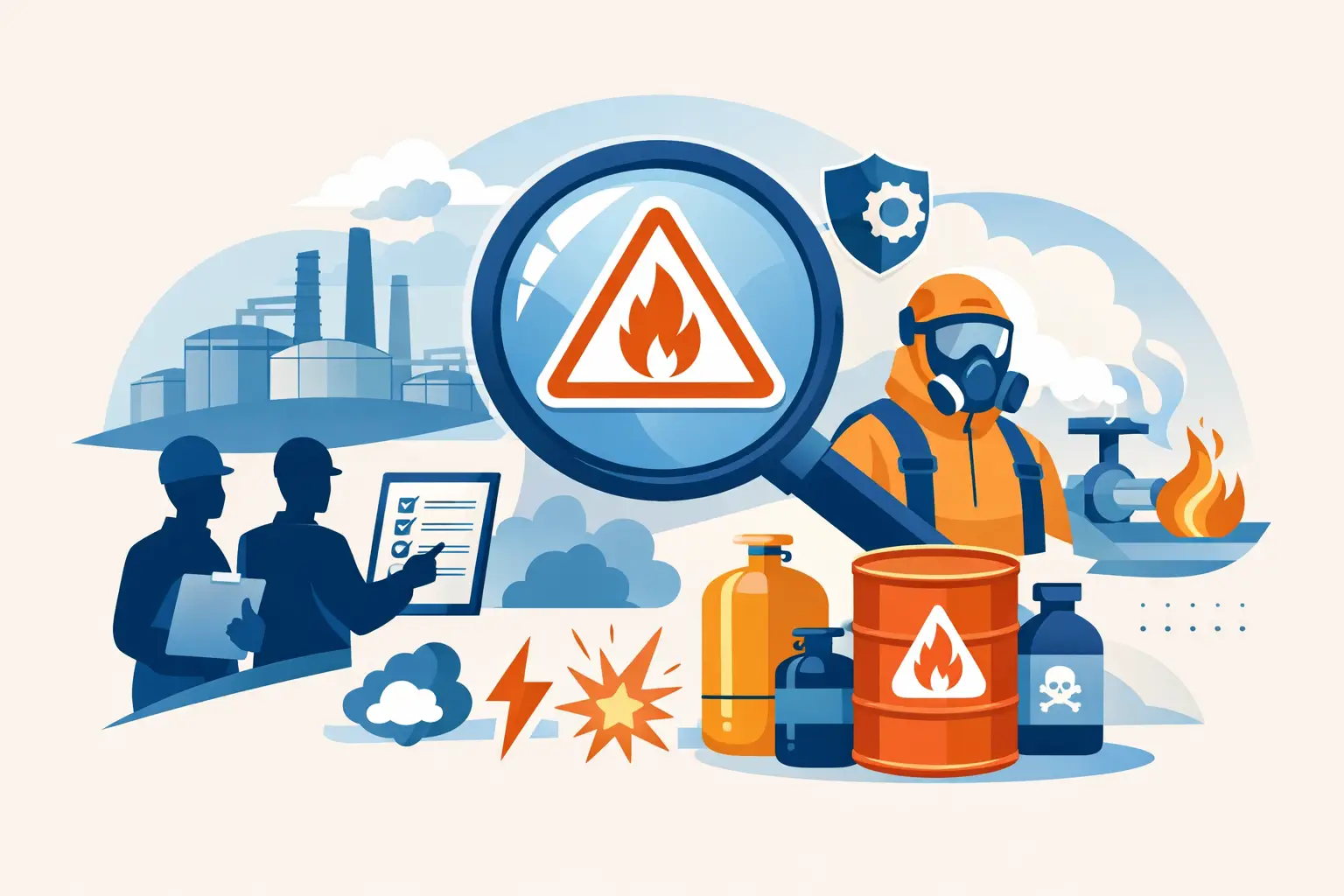
A DSEAR assessment for hazardous substances is not a paperwork exercise to be completed after plant installation or before an audit. It is the process that determines whether flammable gases, vapours, mists, dusts and other dangerous substances can be used, stored, transferred or generated without creating an unacceptable fire or explosion risk. For construction sites, manufacturing facilities, workshops, utilities operations and occupied premises, the assessment must reflect the actual work – not an idealised procedure.
When DSEAR applies
The Dangerous Substances and Explosive Atmospheres Regulations 2002 apply where dangerous substances are present or may be present at work. This can include petrol, diesel, LPG, solvents, paints, adhesives, aerosols, hydrogen, acetylene, biomass dust, flour dust, wood dust and flammable waste. A dangerous substance may be brought onto site, generated by a process, released during maintenance, or arise from a foreseeable loss of containment.
The central question is whether the substance or process could create a fire, explosion or similar energetic event. This makes DSEAR distinct from, but closely connected to, COSHH. A substance may be hazardous to health under COSHH without being a DSEAR concern. Equally, a substance with limited direct health effects may present a serious ignition or explosion hazard. A complete compliance position often requires both assessments to work together.
DSEAR also applies to combustible dusts. This is frequently underestimated where dust extraction is treated solely as an occupational hygiene control. Fine dust from woodworking, food production, plastics processing, metal finishing or biomass handling can form an explosive atmosphere when dispersed in air. Deposited dust can also become fuel for a secondary explosion if an initial event disturbs accumulated layers.
What a DSEAR Assessment for Hazardous Substances Must Establish
A suitable and sufficient assessment examines the substance, the task, the location and the people who may be affected. It should establish how a dangerous atmosphere could form, how it might be ignited, and what would happen if the controls failed.
The assessor will normally begin with a substance and process inventory. Safety data sheets are useful, but they are not a risk assessment. They must be checked against the quantities used, storage arrangements, transfer methods, operating temperatures, pressure conditions, ventilation and the likelihood of release during normal work, cleaning, breakdown and maintenance.
A solvent kept in a sealed container presents a different risk from the same solvent decanted into open containers in a poorly ventilated plant room. Similarly, diesel storage may appear low risk at ambient temperature, but hot work, heated surfaces, leaks onto insulation and poorly managed dispensing activities can materially alter the risk profile. The assessment must therefore follow the task from delivery through use, waste handling and disposal.
The assessment should consider foreseeable ignition sources, including electrical equipment, static discharge, naked flames, hot surfaces, mechanical friction, welding and cutting, vehicle movements, battery charging, smoking, and process-generated heat. This requires operational knowledge. A generic statement that ignition sources are prohibited is inadequate where contractors routinely undertake hot works, fork-lift lorries enter the area, or temporary electrical equipment is introduced during shutdowns.
Where an explosive atmosphere may occur, area classification may be necessary. Gas, vapour and mist hazards can require Zone 0, Zone 1 or Zone 2 classification. Combustible dust hazards can require Zone 20, Zone 21 or Zone 22 classification. The extent and type of zone should be based on the frequency and duration of the hazardous atmosphere, the release source, ventilation effectiveness and process conditions. Equipment installed or used within classified areas must be suitable for the relevant zone and appropriately maintained.
Controlling the Risk at Source
DSEAR follows a clear hierarchy. Elimination is the preferred control. This may mean removing a flammable cleaning agent, changing a process, using pre-mixed materials, or avoiding on-site storage through revised procurement and delivery arrangements.
Where elimination is not reasonably practicable, substitution should be considered. A water-based product may reduce flammability risk, but substitution is not automatic. It must be checked for effects on product performance, worker health, drying times, waste streams and the wider COSHH assessment. Replacing one hazard with another is not a compliant outcome.
If the dangerous substance remains necessary, the assessment should reduce the quantity present and control the release. Examples include closed transfer systems, local exhaust ventilation, bunded storage, flameproof cabinets, gas detection, effective extraction, controlled decanting points and suitable segregation. Ventilation should be assessed as an engineered control, not assumed to be adequate because doors are routinely left open.
Ignition prevention then becomes critical. This can include ATEX-rated equipment in classified areas, bonding and earthing during liquid transfer, permit-to-work systems, hot-work controls, control of portable electrical equipment, exclusion of internal combustion vehicles, and clear management of battery charging. The chosen measures must be proportionate to the risk and capable of being applied during routine work and abnormal conditions.
Mitigation measures are also required where consequences remain credible. Explosion relief, suppression, containment, emergency isolation, fire detection, spill response equipment, escape routes and emergency procedures may all be relevant. Their value depends on design, inspection, testing and workforce competence. A fire extinguisher cannot compensate for unsuitable electrical equipment in a Zone 1 area.
Evidence, Documentation and Competence
The assessment record needs to be detailed enough for managers, supervisors, contractors and auditors to understand the risk and the controls. It should identify the dangerous substances, locations, tasks, possible release scenarios, ignition sources, zoning decisions where applicable, required equipment standards and residual risks. It should also define actions, responsible persons and completion dates.
Drawings, photographs, process flow information, equipment schedules and hazardous area classification plans can be particularly valuable on larger or more complex sites. They turn a written assessment into an operational control document. This is especially relevant where multiple contractors, shift teams or maintenance providers work around the same installation.
Competence is a recurring weakness in DSEAR compliance. Site teams may understand the basic hazards of fuels and gases but be unfamiliar with explosive atmosphere zoning, equipment marking, static control or the implications of modifying ventilation. Contractors can introduce ignition sources or unsuitable equipment unless induction, RAMS review, permit controls and supervision are aligned with the assessment.
Training should be role-specific. Operatives handling flammable substances need clear instruction on storage, transfer, spill response and prohibited activities. Supervisors need to recognise changes that trigger reassessment. Maintenance teams need sufficient knowledge to avoid compromising Ex equipment, extraction systems, earthing arrangements or fire protection measures. Responsible persons need the competence to manage actions and verify that controls remain effective.
Common Failings That Create Exposure
A DSEAR assessment often fails because it describes substances but not the process. Another common issue is reliance on outdated safety data sheets, particularly where products or suppliers have changed. Storage areas may be assessed while decanting, mixing, sampling and waste handling are overlooked.
Other recurring failures include incomplete control of hot work, no documented approach to static electricity, inadequate inspection of hazardous-area equipment, and dust accumulations around extraction plant or elevated surfaces. In occupied buildings, facilities teams can also overlook the interaction between flammable stores, plant-room ventilation, electrical installations and contractor activities.
A further risk arises when a DSEAR assessment is written once and never revisited. The assessment must be reviewed when dangerous substances, quantities, processes, equipment, layout, ventilation, staffing arrangements or incident history change. A near miss, leak, flash fire, dust release or failed extraction system should prompt immediate consideration of whether the risk assessment remains suitable.
A Practical Assessment Process
A defensible assessment generally starts with a site walkover and discussion with the people performing the work. Documentation is then tested against reality: inventories, safety data sheets, COSHH assessments, fire risk assessments, maintenance records, permits, drawings and emergency arrangements should tell a consistent story.
The assessor should observe the points where containment is most likely to fail, such as unloading, hose connection, decanting, mixing, sampling, cleaning, filter changes and waste transfer. This is where procedural controls, engineering measures and human factors need to be examined together. For complex operations, the work may need input from process engineers, electrical specialists, fire safety personnel and operational management.
The output should be an actionable report rather than a generic register. It should distinguish immediate safety issues from planned improvement works, identify any need for hazardous area classification or Ex equipment verification, and set out practical controls that can be embedded in RAMS, permits, maintenance regimes and training. Evolution Safety Solutions can support this through site-specific DSEAR assessments, ATEX-related technical review and workforce competence support.
The most useful DSEAR assessment is one that changes how work is planned before a release, ignition or explosion occurs. Keep it live, test it against real tasks, and ensure every person who can affect the risk understands the controls they are expected to maintain.