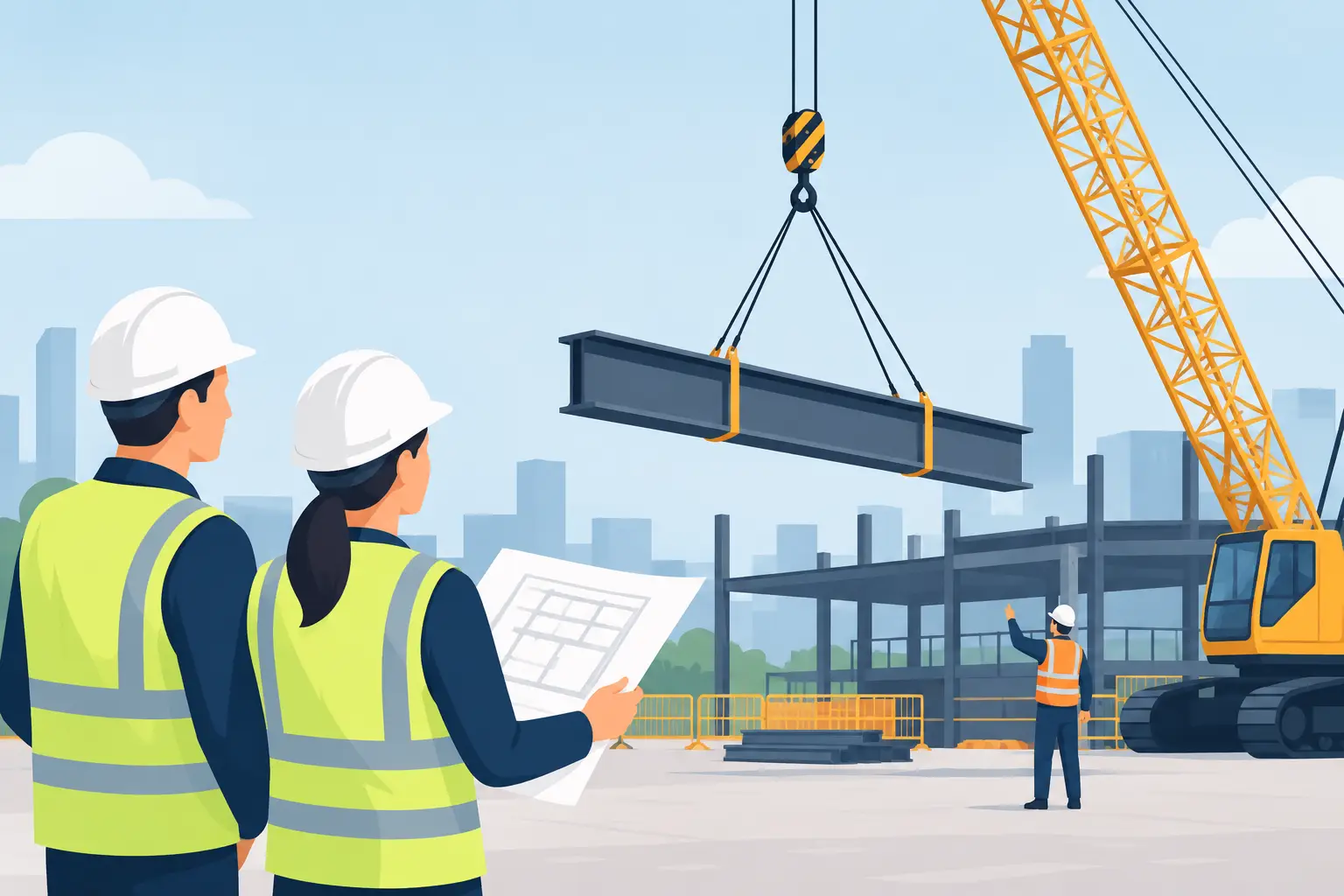
A precast unit arriving before the crane mat is checked, a generator being moved through a congested compound, or a lorry loader working beneath overhead services can turn a routine programme activity into a high-consequence lifting operation. The question is not simply when are lifting plans required, but whether the planned controls are proportionate to the lift, understood by the team and capable of being followed on site.
Under the Lifting Operations and Lifting Equipment Regulations 1998 (LOLER), every lifting operation must be properly planned by a competent person, appropriately supervised and carried out in a safe manner. LOLER does not prescribe a document titled “lifting plan” for every task. However, a written lifting plan is often the clearest and most defensible way to demonstrate that the duty has been met, particularly where the operation is non-routine, technically demanding or exposes people to significant risk.
The legal position on lifting plans
Regulation 8 of LOLER establishes the core duty. Planning must address the lifting operation itself, the equipment and accessories selected, the load, the environment, the people involved and the method of control. The level of planning must reflect the risk.
This means a simple, repetitive lift in a controlled workplace may be managed through a suitable risk assessment, safe system of work and established operating procedure. That does not mean it has not been planned. It means the planning may be contained within existing documented arrangements, provided those arrangements remain suitable for the exact work being undertaken.
A written, lift-specific plan is normally required in practice where generic controls cannot adequately address the hazards or where a change in circumstances could affect the safety of the lift. Principal contractors, clients, insurers and lifting-equipment providers will also commonly require one as part of site assurance arrangements.
LOLER operates alongside the Health and Safety at Work etc. Act 1974, PUWER and, on construction projects, CDM 2015. A lifting plan should therefore not sit in isolation. It must align with the construction phase plan, RAMS, traffic management plan, temporary works arrangements and any permit controls.
When are lifting plans required in practice?
The more complex or less predictable the lift, the stronger the case for a documented lift plan prepared specifically for that operation. A written plan should be expected where a failure of control could cause serious injury, structural damage, service strikes or loss of load control.
Typical triggers include lifting with a mobile crane, tower crane, crawler crane, lorry loader or MEWP where the activity goes beyond standard manufacturer guidance. It is also appropriate for tandem lifts, blind lifts, lifting people, lifting near occupied buildings, and lifts over live work areas or public interfaces.
The need is particularly clear when handling abnormal, heavy, fragile, high-value or awkward loads. Examples include precast concrete, structural steel, transformers, plant, pressure vessels, modular units, large drainage sections and equipment with an uncertain centre of gravity. A load may be within the crane’s headline capacity but still require detailed planning because of radius, boom configuration, outrigger loading, wind area, rigging geometry or restricted landing space.
Environmental and location-specific hazards also drive the requirement. These include overhead power lines, buried services, rail interfaces, waterways, excavations, unstable ground, confined sites, public highways, live process areas and nuclear or other tightly controlled operational environments. Where excavations or underground apparatus are present, the lifting plan should be coordinated with the findings of utility searches, surveys and HSG47 controls.
A plan should also be reviewed when the lift changes. Substituting a crane, altering the lift route, changing the lifting accessories, working from a different set-up position, lifting in higher winds or moving work into a live operational area can invalidate an earlier assessment. Reusing a previous plan without confirming its continued suitability is a common compliance failure.
Routine lifts still require planning
It is a mistake to treat “routine” as a synonym for “low risk”. Repetitive lifts can expose teams to cumulative risk where standards slip, lifting accessories deteriorate or the site layout changes.
For a routine operation, such as palletised materials lifted within a segregated yard using a familiar forklift attachment, the planning may be incorporated in a task risk assessment and operating procedure. The documents should define the equipment permitted, load limits, attachment compatibility, exclusion zone, inspection requirements, competent operators and conditions that require work to stop.
The key test is whether the arrangements provide enough control for the actual task. If a routine lift is moved close to pedestrians, near services, into restricted headroom or onto uneven ground, it may no longer be routine for planning purposes. The controls need to change accordingly.
What a lifting plan should contain
A lift plan is a working control document, not a generic form completed after the decision to lift has already been made. It should give the lifting team sufficient information to set up, communicate and execute the operation safely.
For complex lifting operations, the plan will usually identify the dutyholder, appointed person, crane supervisor, slinger/signaller, operator and any other persons with defined responsibilities. It should state the load weight and dimensions, verified centre of gravity where relevant, lifting points, accessory selection, working load limits and the proposed rigging arrangement.
It should also confirm the selected lifting equipment, configuration, lift radius, capacity at the working radius, ground-bearing requirements, outrigger arrangement, set-up location and travel route where applicable. Site constraints need to be explicit, including exclusion zones, overhead restrictions, proximity hazards, communication methods, weather limits and the landing area.
A suitable plan sets hold points and stop-work criteria. For example, work may not proceed until the crane mat arrangement is verified, the load weight is confirmed, an exclusion zone is established or a banksman has cleared vehicle movements. These controls are more effective when they are discussed during the lift briefing and verified by supervision rather than left as statements in a folder.
For crane operations, BS 7121 provides recognised good-practice guidance for safe use and management. Although British Standards are not legislation, following relevant guidance can help demonstrate a structured approach to planning, competent appointment and operational control.
Competence and responsibility
The person planning the lift must be competent for the complexity of the operation. Competence is more than holding a card or having years on site. It requires suitable training, practical knowledge, experience, authority and an understanding of the equipment, loads and conditions involved.
On significant crane operations, an appointed person is generally responsible for planning and has the authority to provide a safe system of work. The crane supervisor then supervises the lifting operation in accordance with that plan. The slinger/signaller controls the attachment and signalling functions within their role, while the operator remains responsible for operating the machine safely.
These responsibilities must not be blurred. A pressure to recover programme time can lead to informal changes being agreed at the point of lift by people who do not have the authority or information to make them. If the planned method no longer works, the lift should stop and the appointed person or responsible planner should reassess it.
Common gaps found in lifting documentation
Many documents labelled as lift plans are generic RAMS with a crane name inserted. They may lack the information that determines whether the equipment can safely carry out the lift. Common omissions include an unverified load weight, no allowance for lifting accessories, incorrect radius calculations, no ground-pressure assessment and no consideration of the actual exclusion zone.
Another frequent issue is failing to coordinate separate contractors. The crane provider may produce a plan for the machine, while the principal contractor controls access, ground conditions, interfaces and public protection. Neither document alone manages the whole operation. Dutyholders need a coordinated plan that addresses the interface between lifting activity and site management.
Documentation must also be supported by inspection and examination controls. Lifting equipment and accessories require pre-use checks, appropriate maintenance and thorough examination at the intervals required by LOLER. A current thorough examination report does not prove that a lift is safe, but lifting without valid examination evidence may render the operation unlawful and unsafe.
Making lifting plans effective on site
The strongest plans are prepared early enough to influence procurement, logistics and programme decisions. This may mean selecting a different delivery vehicle, reserving adequate crane standing, designing lifting points into fabricated items or scheduling a road closure before the equipment arrives.
Before the lift, the team should confirm that conditions match the plan. Ground conditions, weather, load identity, access, exclusion zones and personnel competence should all be checked. The briefing should focus on the critical controls, not merely obtaining signatures.
Evolution Safety Solutions supports contractors and dutyholders with LOLER-focused lifting risk assessments, lift planning assurance, RAMS review and workforce competence support. Independent review can be particularly valuable where lifting interfaces with complex construction, utilities or operational-site constraints.
A lifting plan earns its value when it gives the team a clear reason to stop before a change becomes an incident. Treat it as an operational control, keep it live, and ensure the people carrying out the lift can use it confidently at the point of work.