Excavation within a substation boundary can expose far more than a single power cable. A shallow trench for fencing, drainage, ducting or a new equipment base may cross high-voltage and low-voltage cables, pilot cables, communications routes and buried earthing conductors. HSG47 CAT & Genny substation use must therefore form part of a controlled excavation process, not a last-minute check immediately before a machine starts work.
For principal contractors, network operators and civil engineering teams, the objective is straightforward: establish what may be present, locate services as reliably as practicable, prove their position by safe exposure where required, and maintain controls until the ground is reinstated. A CAT scan alone cannot demonstrate that ground is clear.
What HSG47 Requires in Practice
HSG47, Avoiding danger from underground services, sets out the established UK approach to planning and controlling work near buried services. It applies to excavation, breaking ground, driven posts, trial pits, drainage runs and any activity capable of penetrating or disturbing the ground.
The guidance is particularly relevant at substations because records may cover several asset owners and several generations of installation work. Historic cable routes can differ from as-built drawings. A cable may have been diverted during previous reinforcement works, and an earthing conductor may not appear on the same drawing set as the operational cable network.
HSG47 should be applied through four connected stages: obtaining and reviewing utility and site information, carrying out a suitable on-site detection survey, marking and protecting suspected routes, then exposing services safely where the work requires certainty. These stages should be reflected in the construction phase plan, RAMS, permit-to-dig arrangements and supervisor briefings.
Plans are an indication of possible service presence, not proof of location, depth, ownership or condition. Equally, an apparently clear CAT reading is not proof that no underground asset exists. The safe system must recognise both limitations.
HSG47 CAT & Genny Substation Use: What Each Tool Can Do
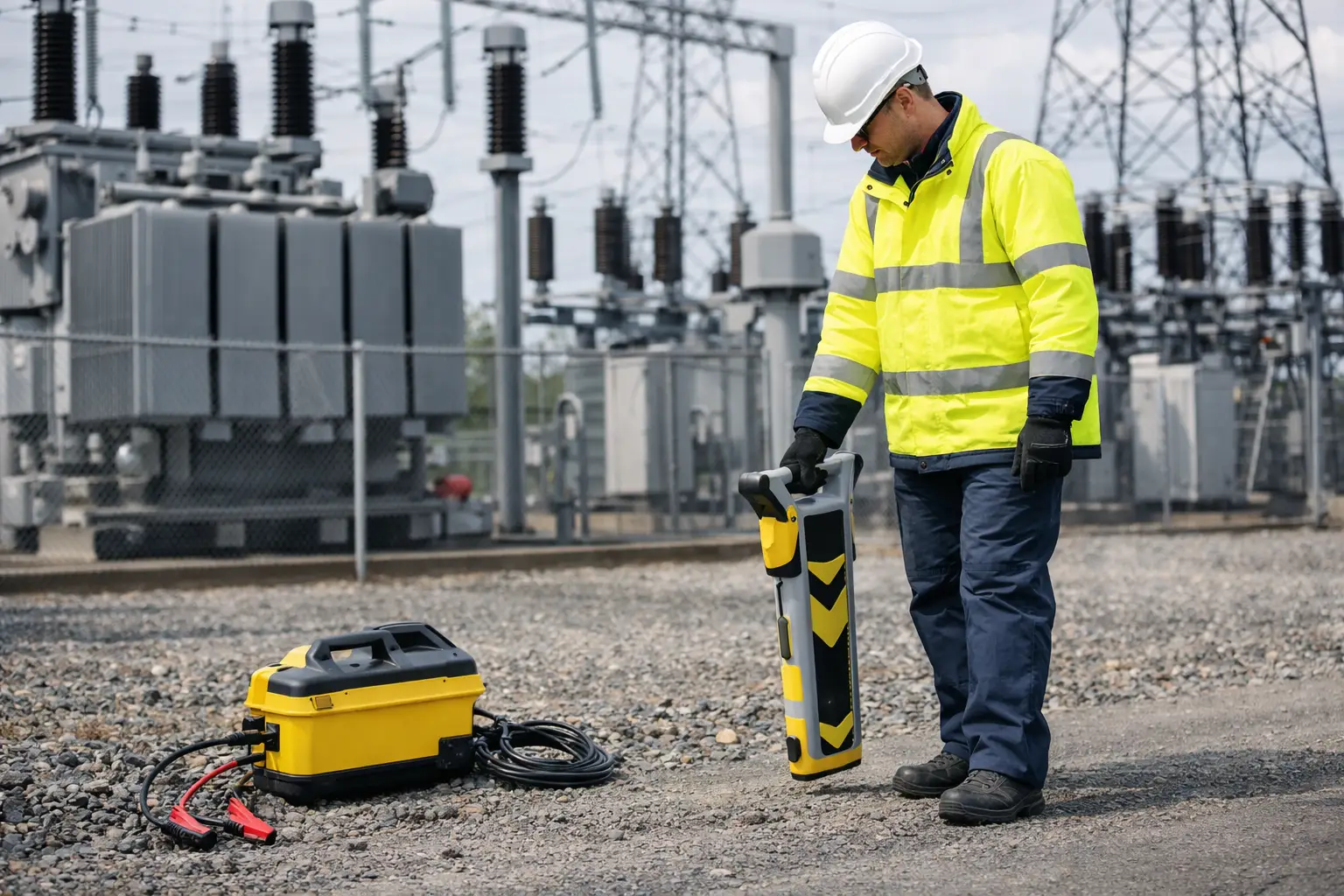
A Cable Avoidance Tool, commonly called a CAT, identifies electromagnetic signals associated with buried conductors. It is normally used in passive power mode, passive radio mode and generator mode. Each mode has a distinct purpose, and using only one mode creates avoidable gaps in the survey.
Passive power mode may identify energised electrical cables carrying a detectable 50 Hz signal. This can be useful in live substation environments, but it may not locate a cable that is isolated, lightly loaded, shielded in a way that reduces the detectable signal, or positioned beyond the practical detection range.
Passive radio mode detects re-radiated radio signals on metallic services. It can assist with locating certain conductors but is not reliable for every cable type or installation condition. It should be treated as a complementary mode rather than a clearance method.
A Genny, or signal generator, applies a traceable signal to a known metallic conductor or induces one onto a route. The CAT is then set to generator mode to trace that signal. In the right conditions, this provides a clearer route than passive detection and can help distinguish a target cable from surrounding services.
However, substation sites introduce complications. Closely spaced power cables, steelwork, cable trays, fences, buried metallic ducts and extensive earthing arrangements can cause signal coupling or distortion. A Genny signal may transfer onto adjacent conductors, creating a response that appears to show a route but does not identify the precise asset. Direct connection to a cable or earth system must only be undertaken under the asset owner’s approved procedure and by personnel authorised to do so. It is not a generic site activity.
The practical rule is that CAT and Genny findings inform the excavation method. They do not replace verified asset information, a permit to dig or safe trial-hole excavation.
Why Substations Need Additional Controls
Substation ground is often congested and operationally sensitive. A strike on an energised HV cable can result in fatal electric shock, arc flash, fire, supply interruption and major asset damage. Damage to a control cable or communications route may not be immediately obvious but can affect protection, interlocking, monitoring or remote operation.
Buried earthing systems require equal attention. Earth tapes, rods and interconnecting conductors support the substation’s fault-current return path and control touch and step voltages. Cutting, displacing or corroding an earth conductor can compromise the earthing design even where no immediate event occurs. Any suspected damage should be reported, assessed and repaired under the network operator’s requirements before reinstatement.
The work area may also contain legacy materials, abandoned ducts, redundant cables and undocumented temporary works. It is unsafe to assume that an unlabelled cable is redundant, de-energised or outside the operational system. Asset status must be confirmed by the duty holder or authorised person.
A Defensible Pre-Excavation Process
Before breaking ground, the responsible contractor should establish a clear, site-specific process. This is not paperwork for its own sake. It provides the evidence needed to make decisions where drawings, detection results and ground conditions do not fully agree.
A suitable process should include the following controls:
- Obtain current drawings, cable schedules, previous survey information and relevant asset-owner constraints for the exact work area.
- Review the proposed excavation footprint, plant access, spoil locations, fencing-post positions and any need for breaking or coring.
- Complete a CAT and Genny survey by a competent operative using equipment that has passed its required functional check and calibration regime.
- Mark detected routes on the ground using an agreed site legend, while recording the survey date, equipment used, modes selected and any areas of uncertainty.
- Issue a permit to dig that defines the approved work limits, exclusion zones, excavation method, supervision requirements and escalation route.
The survey should cover the full work area and a suitable margin around it, rather than the centre line of the proposed trench alone. Operators should sweep methodically in more than one direction. A service running parallel to a single sweep line, or crossing at an oblique angle, can be more difficult to detect. Signal response should be traced beyond the immediate excavation area where this helps establish route direction.
Where marks conflict with drawings, where a response is broad or inconsistent, or where the work approaches a suspected cable corridor, the uncertainty should be resolved before mechanical excavation proceeds. Escalation may involve the client, distribution network operator, independent utility surveyor or the responsible electrical engineer.
Safe Exposure Is the Point of Verification
Once a suspected route is identified, it must be exposed safely before intrusive work enters its tolerance zone. The exact dimensions and method should follow the asset owner’s requirements and site permit conditions. A generic distance copied between projects is not an adequate control.
Hand excavation is not automatically safe. Picks, forks, bars and sharp-pointed tools can damage cable sheaths or earth tapes even where the operative is working carefully. Controlled excavation with suitable hand tools, insulated where specified, or vacuum excavation may be appropriate depending on cable depth, soil type, access and the risk assessment. Insulated tools do not make a cable strike safe and must never be treated as the primary protection measure.
Mechanical plant should remain outside the defined exclusion zone until the service has been positively located and the excavation method has been reassessed. If a cable, duct or earth conductor is found in an unexpected position, work should stop. The route must be identified, protected and incorporated into revised RAMS and permit controls.
Depth readings from a CAT should be treated with caution. They are calculated estimates based on assumptions about signal behaviour and conductor position. At a congested substation, multiple conductors and signal distortion can make those assumptions unreliable. Physical exposure remains the more reliable means of confirmation.
Competence, Records and Supervision
The operative using the CAT and Genny needs more than a certificate issued years ago. Competence includes familiarity with the specific equipment model, understanding detection modes and limitations, correct signal application, interpretation of distorted readings and knowledge of the site’s permit-to-dig process. Supervisors must also understand what the survey can and cannot establish.
Records should be proportionate to the work but sufficient for audit and future planning. Retain drawings used, survey results, marked-up photographs where appropriate, equipment identification, calibration or service status, permits, briefings and changes made after trial holes. For larger schemes, the confirmed locations should feed into revised utility information and the handover file.
This is particularly valuable where a project involves repeated excavations. The first verified trial holes can reduce uncertainty for later phases, provided the findings are accurately recorded and protected from being treated as assumptions beyond the area actually proved.
Evolution Safety Solutions can support contractors with HSG47-focused training, excavation-risk assessments, RAMS review and competence arrangements where substation or utility works require a more defensible control framework.
The safest decision is often to pause when the evidence does not align. At a substation, a short delay to verify an uncertain response is a proportionate control against consequences that can affect personnel, network reliability and the wider project programme.