

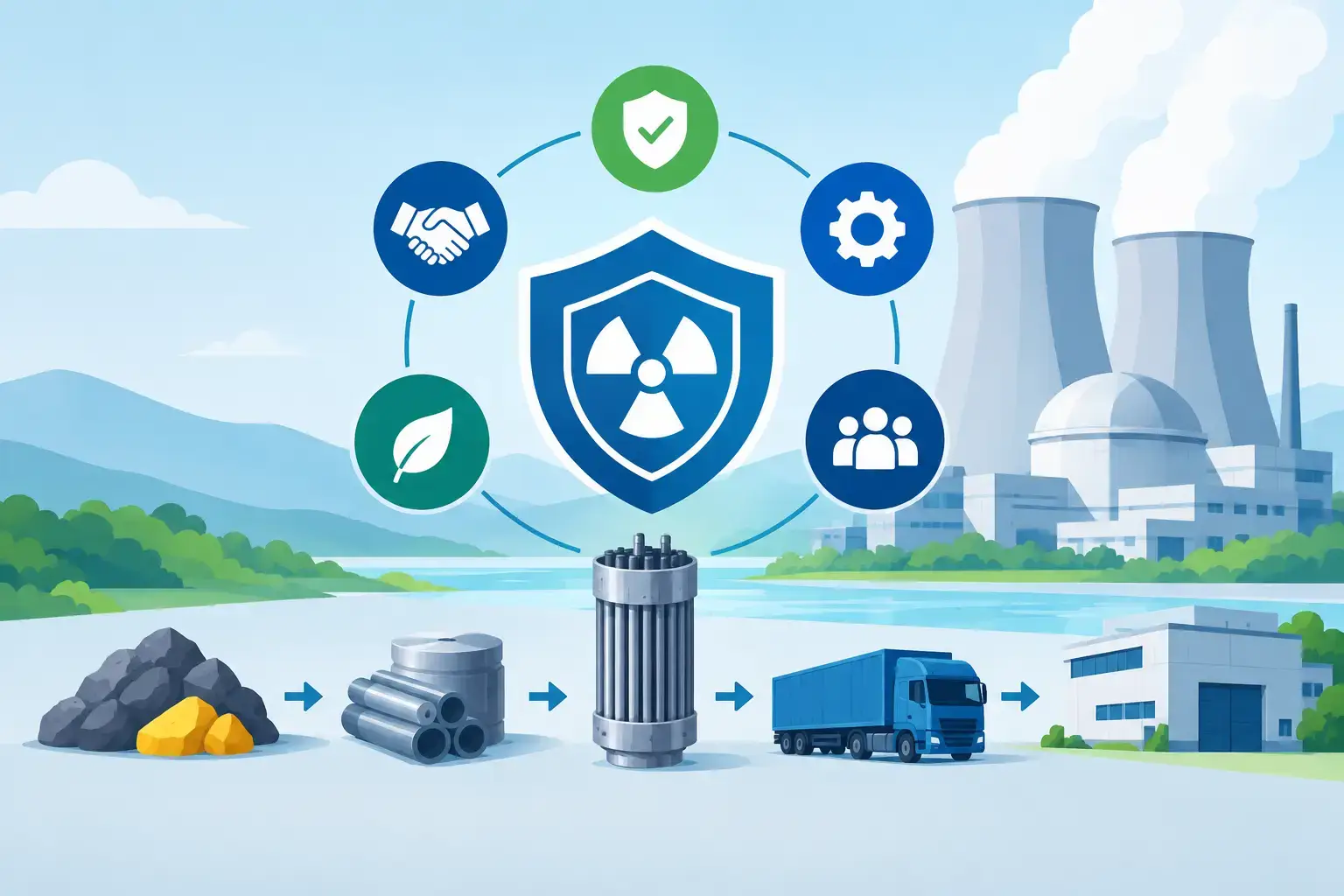
A nuclear supply-chain audit rarely fails because a business cannot describe its product or service. It fails because the organisation cannot demonstrate consistent control: who approved the work, how a safety-significant requirement was identified, where traceability was maintained, and what happened when a non-conformance arose. The practical ISO 19443 benefits for suppliers sit in this evidence trail. The standard gives organisations a structured way to manage quality where failure could affect nuclear safety.
ISO 19443 builds on ISO 9001, but it is not simply ISO 9001 with a nuclear label. It introduces requirements relevant to products and services important to nuclear safety, often referred to as ITNS. For UK businesses supporting nuclear new build, decommissioning, waste management, fuel-cycle activities or nuclear infrastructure, it can provide a recognised framework for meeting increasingly detailed customer and supply-chain expectations.
What ISO 19443 is designed to achieve
ISO 19443 specifies quality management system requirements for organisations in the nuclear supply chain that provide products or services important to nuclear safety. Its central purpose is to ensure that quality decisions are made with appropriate regard for nuclear safety, rather than being driven only by cost, programme pressure or conventional customer satisfaction measures.
The standard applies to a wide range of activities. A precision manufacturer, civil engineering contractor, design consultancy, inspection provider, electrical installer, laboratory, logistics provider or training organisation may all have a role in a nuclear project supply chain. The relevant question is not whether the organisation works inside a licensed nuclear site. It is whether its output could be classified by a customer as important to nuclear safety.
This distinction matters when setting the management system scope. Not every product, project or business process will necessarily fall within an ISO 19443 scope. A clear, defensible scope prevents both under-control of safety-significant work and unnecessary administration around work that is not nuclear related.
ISO 19443 benefits for suppliers and contractors
The commercial value of ISO 19443 is closely tied to operational discipline. Buyers want confidence that suppliers understand the difference between routine quality control and work where an error, substitution, missed requirement or weak record could have wider safety consequences.
Stronger nuclear safety culture
ISO 19443 requires organisations to promote a nuclear safety culture. In practical terms, this means people are expected to raise concerns, stop and escalate work when necessary, challenge unclear requirements, and report errors without fear of inappropriate blame.
For senior management, this moves nuclear safety from a statement in a policy document into visible leadership behaviour. Directors and managers need to set priorities, provide adequate resources, and ensure that commercial targets do not weaken safety-significant controls. For supervisors and operatives, it means understanding when a deviation must be reported rather than informally corrected on site.
A positive reporting culture does not remove accountability. It makes it more likely that weaknesses are identified early, investigated properly and prevented from recurring.
Better control of ITNS requirements
One of the most significant ISO 19443 benefits is the formal identification and control of ITNS requirements. These requirements must flow from the customer through quotations, contracts, purchasing documentation, work instructions, inspection plans and final records.
Without this flow-down, safety requirements can be lost between commercial teams, designers, buyers, subcontractors and site personnel. A supplier may manufacture to an approved drawing but still fail to apply a required hold point, material traceability requirement, competence condition or notification arrangement.
ISO 19443 encourages organisations to review requirements before accepting work and to identify ambiguities early. This can reduce late-stage technical queries, rejected documentation packs and costly rework. It also gives project managers a clearer basis for planning resources, inspection and test activity, and specialist competence.
More reliable traceability and records
For nuclear work, evidence is often as important as the physical output. Inspection certificates, calibration records, weld documentation, material certificates, competence records, concession approvals, non-conformance reports and release documentation may all form part of the quality record.
ISO 19443 strengthens the control of documented information and traceability. The benefit is not creating paperwork for its own sake. It is ensuring that a completed item, installed system or delivered service can be shown to meet the applicable requirements years after the original work was undertaken.
The depth of traceability should be proportionate to the safety significance and contractual requirements. Applying the highest level of control to every low-risk activity can create delay and obscure critical information. Applying too little control to ITNS work creates a serious assurance gap. A graded approach is therefore essential.
Improved supplier and subcontractor assurance
Many nuclear supply-chain organisations depend on specialist subcontractors, material suppliers, testing houses and labour providers. ISO 19443 places greater emphasis on controlling externally provided processes, products and services, including the communication of nuclear safety requirements through the supply chain.
This supports more effective supplier approval, procurement review and surveillance. It also helps businesses establish when a subcontractor requires a full quality assurance assessment, when focused verification is sufficient, and when source inspection or customer notification is needed.
For principal contractors and package managers, this creates a more structured basis for evaluating supply-chain risk. It can be particularly valuable where a subcontractor carries out safety-related fabrication, design verification, non-destructive testing, lifting activities, commissioning support or controlled installation work.
Increased audit and tender readiness
Nuclear clients commonly assess suppliers through prequalification, technical evaluation, supplier audits and project-specific quality reviews. ISO 19443 does not guarantee contract award, and certification is not always a stated requirement. However, an effectively implemented system provides a recognisable framework against which an organisation can present its controls.
A business that can evidence its scope, process maps, ITNS arrangements, internal audit programme, management review outputs, competence controls and corrective action process is better positioned to answer detailed assurance questions. It can also respond more consistently when different clients use different audit protocols.
The strongest tender benefit comes where the management system reflects actual operations. Generic procedures that are not understood by buyers, workshop personnel or project teams are quickly exposed during an audit. Clear records, competent personnel and demonstrable implementation carry far more weight than a certificate alone.
Where ISO 19443 requires additional effort
The standard brings obligations as well as benefits. Businesses moving from ISO 9001 should expect to strengthen their treatment of safety culture, graded application, configuration and change control, supply-chain oversight, competence, and management of counterfeit, fraudulent or suspect items where relevant.
Implementation can also expose weaknesses that were previously tolerated. A company may find that contract reviews are inconsistent, approved supplier lists are outdated, calibration arrangements lack clear recall controls, or work instructions do not identify required verification points. Addressing these issues requires management time and, in some cases, investment in systems, training or technical assurance support.
The right level of implementation depends on the organisation’s activities, contractual position and the safety classification applied by its customer. A small specialist supplier should not copy the bureaucracy of a large nuclear tier-one contractor. Equally, a lean business cannot use its size as a reason to omit essential control of ITNS work.
Building a credible ISO 19443 management system
A practical implementation normally begins with a gap analysis against the organisation’s existing ISO 9001 arrangements and nuclear customer requirements. This should review the real delivery process from enquiry and tender through procurement, production or service delivery, inspection, release and post-project learning.
The resulting plan should identify specific deliverables rather than broad intentions. These may include an ISO 19443 scope statement, nuclear safety culture policy and objectives, ITNS identification process, contract review checklist, procurement flow-down wording, supplier evaluation criteria, quality plan templates, non-conformance and corrective action arrangements, and internal auditor competence.
Training is central to adoption. Senior leaders need to understand their accountabilities for nuclear safety culture and resource decisions. Commercial and procurement teams need to recognise which requirements must be flowed down. Supervisors, quality personnel and operatives need instructions that relate directly to the activities they control. Training should be proportionate, role-specific and supported by records of competence.
Internal audits should test operational effectiveness rather than merely confirm that procedures exist. Auditors should sample completed records, observe work, interview personnel and follow a requirement through the supply chain. Management review can then use audit findings, customer feedback, non-conformances, supplier performance and process measures to direct improvement.
For organisations that need external support, Evolution Safety Solutions can assist with ISO 19443 gap analysis, management system development, internal audit programmes, documented information, workforce awareness and implementation planning aligned to the organisation’s nuclear supply-chain role.
Making the standard work under project pressure
The greatest test of an ISO 19443 system is not certification audit day. It is the point at which a delivery date is at risk, a material certificate is incomplete, a drawing changes, or an operative identifies a discrepancy after work has started. The system must give people a clear route to pause, assess, obtain authorisation and retain the decision record.
That discipline protects both nuclear safety and commercial performance. It reduces the chance that an unresolved issue becomes an expensive site rejection, contractual dispute or loss of client confidence. For suppliers seeking long-term nuclear work, ISO 19443 is most valuable when it becomes the normal way the organisation plans, controls and proves safety-significant delivery.