

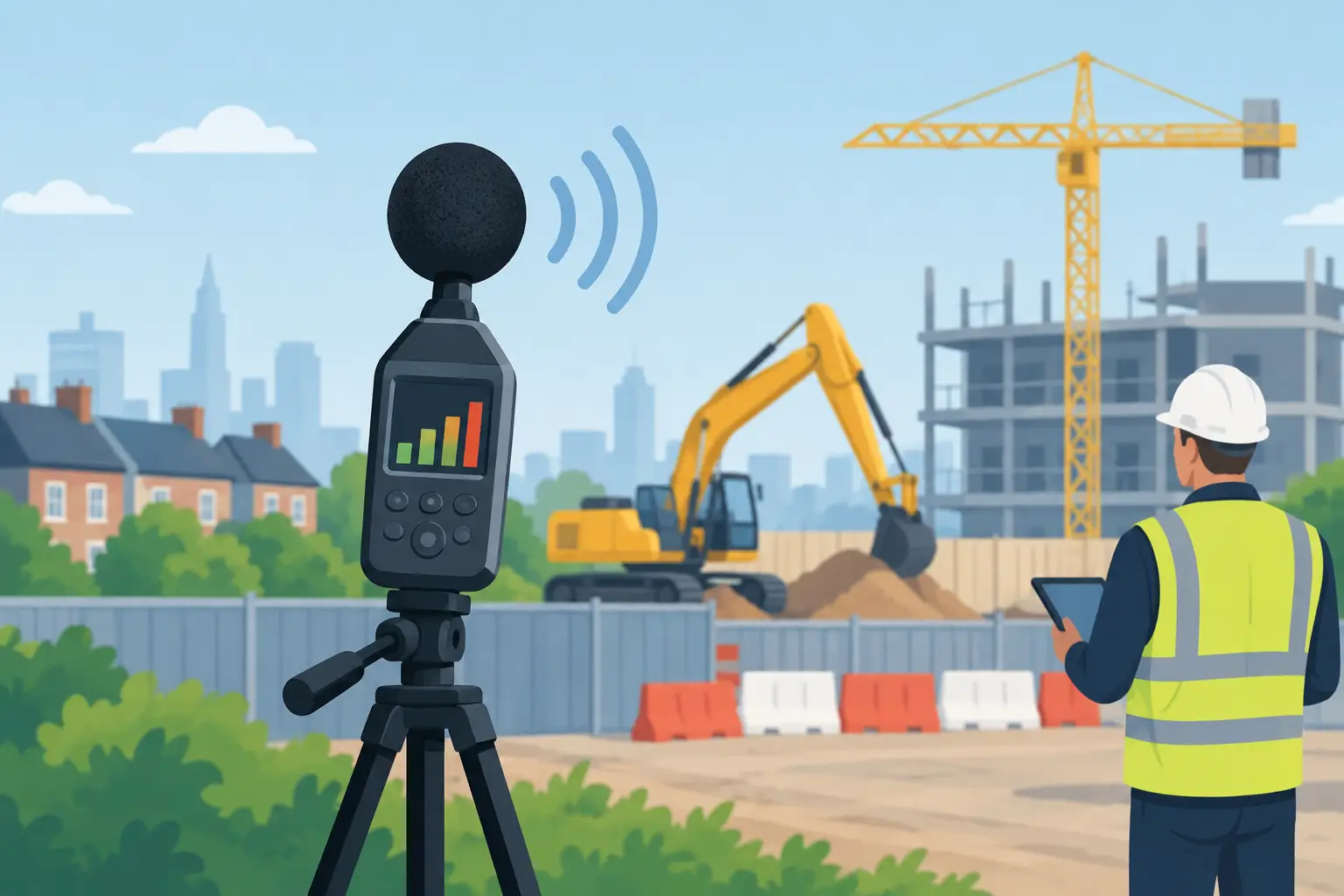
A worker using a cut-off saw, breaker or impact wrench can exceed an exposure action value long before a supervisor identifies a problem by ear. Equally, a fixed plant item that appears routine can generate complaints at a neighbouring property when operating conditions change. Knowing how to conduct noise monitoring properly gives dutyholders evidence on which to base controls, health surveillance decisions, procurement choices and communications with regulators or neighbours.
Noise monitoring is not simply a matter of taking a decibel reading. The survey method must reflect the source, the people exposed, the duration of the activity and the applicable legal or planning requirement. Occupational exposure monitoring and environmental noise assessment use related acoustic principles, but their objectives, metrics and reporting requirements are different.
Start by defining the monitoring objective
Before selecting an instrument, establish why the assessment is required. Under the Control of Noise at Work Regulations 2005, employers must assess the risk where workers are likely to be exposed to noise at or above the lower exposure action values. The assessment must be suitable and sufficient, identify employees at risk, and support a planned control programme.
For workplace exposure, the key values are 80 dB(A) daily or weekly personal noise exposure, LEP,d or LEP,w, for the lower exposure action value; 85 dB(A) for the upper exposure action value; and 87 dB(A) for the exposure limit value, taking account of hearing protection attenuation. Peak sound pressure action values are 135 dB(C) and 137 dB(C), with a 140 dB(C) peak limit value.
Construction and infrastructure projects may also need environmental monitoring. This can be required by planning conditions, a Section 61 consent, client specifications, stakeholder commitments or a complaint investigation. In these cases, the assessment may consider construction noise in accordance with BS 5228, or the rating of industrial and commercial sound under BS 4142. A measurement intended to assess a worker’s daily exposure cannot automatically be used to demonstrate compliance at a residential receptor.
Define the purpose in the survey brief. Record the activities, personnel groups, plant, work areas, receptors, operating hours and site constraints. For a contractor, this should align with the RAMS, construction phase plan and programme of works. For an occupied facility, include shift patterns, maintenance activities and any foreseeable abnormal operations.
Select suitable equipment and measurement parameters
The instrument must be appropriate for the decision it will support. A compliant sound level meter should meet the relevant requirements of BS EN IEC 61672, typically using a Class 1 instrument where higher accuracy or environmental assessment is required. Personal noise dosemeters are often more effective for mobile operatives, variable tasks or work involving multiple noise sources across a shift.
A sound level meter is useful for identifying source levels, mapping noise across a workplace and measuring at fixed environmental locations. A dosimeter measures an individual’s cumulative exposure during representative work, making it particularly valuable for groundworkers, fitters, maintenance teams, operatives moving between workfaces and drivers undertaking mixed duties.
Set parameters to suit the assessment. Occupational measurements commonly require A-weighted equivalent continuous sound level, LAeq,T, and C-weighted peak sound pressure, LCpeak. Environmental surveys may require LAeq,T alongside statistical indices such as LA90,T for background sound, depending on the standard and purpose of the assessment.
Use an acoustic calibrator compatible with the instrument. Calibrate immediately before and after the monitoring period, recording both values. A significant drift may invalidate the results and should trigger investigation. Maintain current calibration certificates and ensure instrument serial numbers are retained within the survey record. A phone application, consumer sound meter or unverified handheld device may assist with informal screening, but it is not appropriate for a defensible compliance assessment.
Plan representative monitoring
The most common weakness in noise surveys is measuring an unrepresentative period. A five-minute reading during a quiet interval says little about a task that includes intermittent impact noise, reversing alarms, loading activity or short-duration use of high-noise plant.
Observe the work before monitoring. Identify the noisiest tasks, task frequencies, the usual number of repetitions, operator positions and whether doors, acoustic enclosures or barriers are normally in place. Confirm whether the day being monitored represents normal conditions. If it does not, record the reason and plan further measurement where necessary.
For personal exposure, determine how much time employees spend on each activity. Exposure is based on both level and duration. A worker exposed to 94 dB(A) for a short operation may have a lower daily exposure than someone exposed to 83 dB(A) throughout a full shift, although both scenarios may require control measures. Where weekly exposure is being considered, this must be justified and should not be used to avoid implementing reasonably practicable daily controls.
For environmental monitoring, document the measurement location, microphone height, distance from reflective surfaces, weather conditions and any extraneous events. Rain, high winds, aircraft, traffic and unrelated site activity can materially affect the data. Select monitoring periods that capture the relevant source operation and, where baseline sound is needed, periods without the source present.
How to conduct noise monitoring in the field
During the survey, record more than numbers. The observation log gives meaning to the acoustic data and is often decisive when results are reviewed during an audit, incident investigation or complaint response.
At a minimum, the field record should identify the date, time, exact location, instrument and calibration details, personnel or job role, activity being undertaken, plant involved, duration of the task, readings obtained and unusual events. Photographs of the work area, source arrangement and measurement position can strengthen the report where site rules permit.
Position the microphone correctly. For a fixed workplace measurement intended to indicate exposure at a work position, measure close to the worker’s ear zone without creating a hazard or interfering with the task. For dosimetry, fit the microphone on the shoulder close to the ear, secure the cable and brief the wearer not to tamper with the equipment. Check periodically that it remains in place and that the work pattern has not changed substantially.
Do not assume hearing protection resolves the issue. At the upper exposure action value, employers must establish and implement a programme of technical and organisational noise controls. Hearing protection is necessary where residual risk remains, but it should not be the first or only control. Over-protection can also create communication and warning-signal risks, particularly around mobile plant, lifting operations and utilities work.
Interpret results against the correct standard
Translate readings into practical exposure information. For occupational surveys, calculate or obtain the daily personal noise exposure for each representative role or task group, identify peak exposures and compare results with the action and limit values. Consider workers who may have additional vulnerability, those who work extended shifts and agency personnel whose exposure may be split across employers or locations.
Where lower action values are reached or exceeded, provide suitable information, instruction and training, and make hearing protection available. At or above the upper action values, designate hearing protection zones where appropriate, ensure hearing protection is worn, implement a noise-control programme and provide health surveillance to employees regularly exposed above the upper action values or otherwise at risk.
Environmental results require more context. Compare the measured or predicted level with the relevant consent condition, project criterion or assessment methodology. A complaint is not automatically evidence of a breach, but it should be investigated promptly, especially where the source is tonal, impulsive, intermittent or operating outside agreed hours. Source character can affect the level of impact even where average sound levels appear moderate.
Specify controls that reduce risk at source
A noise survey should lead to action, not sit as a stand-alone report. Apply the hierarchy of control by considering elimination, substitution, engineering measures, administrative controls and personal protective equipment.
For example, replace a high-noise method with a lower-noise process where practicable, select quieter plant during procurement, maintain silencers and guards, isolate vibrating equipment, use acoustic screens or enclosures, and separate workers from the source. On construction sites, sequencing can prevent several high-noise activities occurring in the same area. Limiting time at source may help, but it is less reliable than engineering control and must be managed through supervision.
Review the controls after implementation. A new enclosure may reduce airborne noise but create overheating, access or maintenance issues. A quieter machine may be commercially justified over its life cycle but unsuitable if it cannot meet the required output. Effective compliance requires a control package that works in actual operating conditions.
Produce a defensible noise monitoring report
The report should allow a competent reviewer to understand what was measured, why it was measured, how results were derived and what action is required. Include the scope, legal framework, methodology, equipment details, calibration records, survey observations, raw and calculated results, assumptions, limitations, conclusions and prioritised recommendations.
Where results are close to an action value, explain uncertainty and whether further monitoring is advisable. Set a review trigger, such as new plant, a change in process, altered working hours, a complaint, an occupational health concern or a material change to the workforce’s exposure pattern.
For complex sites, Evolution Safety Solutions can integrate noise monitoring findings into wider occupational hygiene, environmental compliance and workforce competence arrangements. The value lies in converting measurements into controls that supervisors can implement and management teams can demonstrate.
The most useful noise monitoring programme is one that remains connected to the work: observe the task, measure representative exposure, document the evidence and verify that the chosen controls genuinely reduce risk.