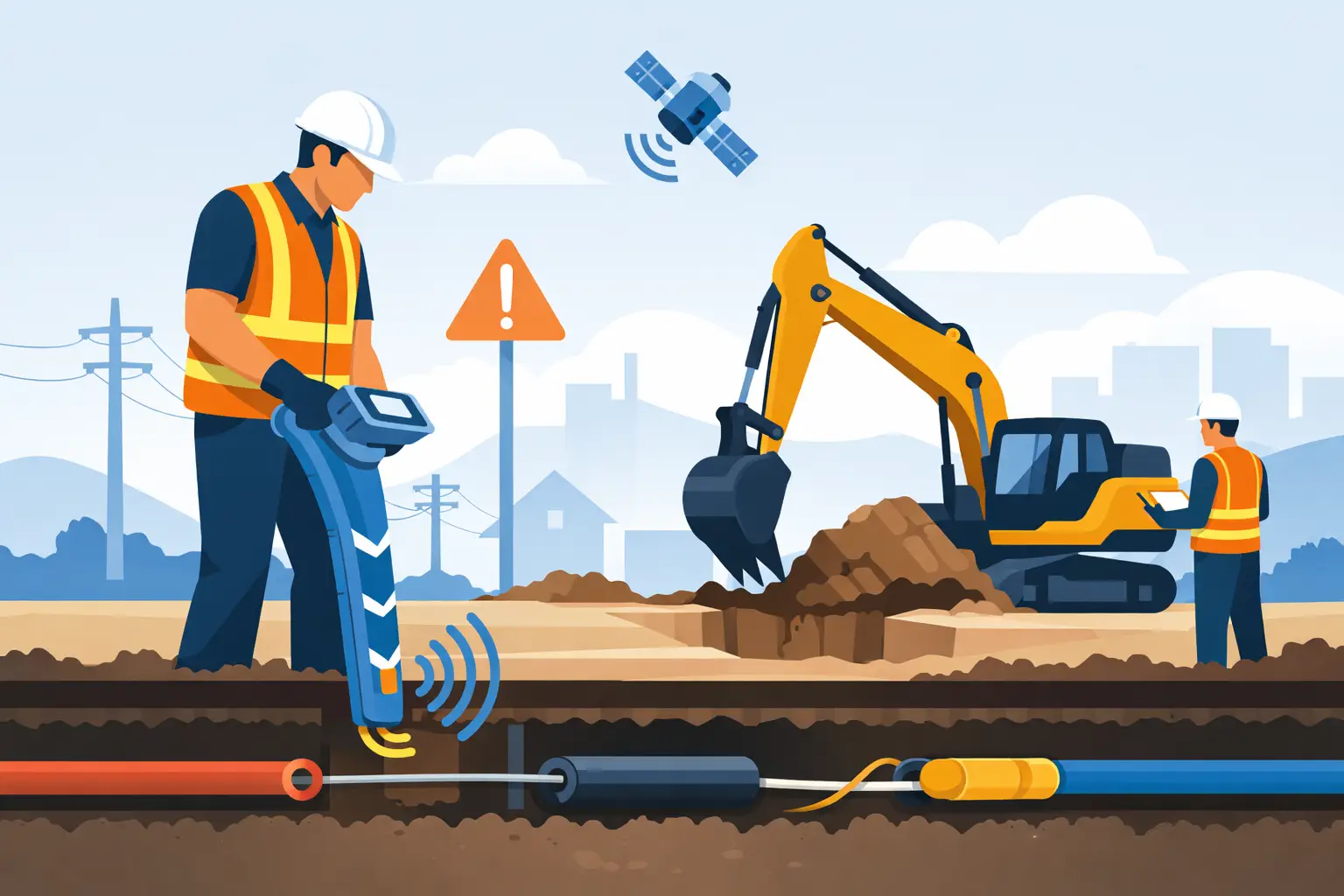
An excavator bucket does not need to strike a service directly to create a serious incident. A near miss, damaged coating, stretched cable or compromised gas main can stop a project, expose operatives to harm and trigger costly investigation. EUSR RD8200 Series training provides the practical locating competence needed to use Radiodetection equipment methodically before breaking ground, rather than treating a cable avoidance tool as a simple pass-or-fail check.
For principal contractors, utilities teams and civil engineering businesses, the course sits within a wider safe system of work. It supports the survey, planning, detection, marking and excavation controls expected under HSG47, alongside accurate utility information, suitable permits, RAMS, supervision and ongoing site verification.
Why RD8200 competence matters on live sites
The RD8200 range is widely used to locate buried conductive services, including electricity cables, metallic gas and water pipes, telecommunications cables and associated infrastructure. It can detect passive signals already present on a line and active signals applied with a transmitter. However, the presence of a locator does not guarantee that every buried asset has been identified.
This is the central operational issue. Some services may be non-conductive, poorly mapped, deeply buried, congested with other utilities, disconnected from the network or unable to carry a usable signal. Signal distortion, nearby metallic structures, overhead lines, poor transmitter connection and incorrect receiver settings can also produce misleading results. A competent operator understands these limitations and knows when to escalate rather than making assumptions.
EUSR RD8200 Series training should therefore be viewed as competence development for controlled excavation work. It is not a substitute for statutory undertaker records, utility searches, ground penetrating radar where justified, trial holes or safe digging practices. The correct control depends on the service risk, ground conditions, available records and planned work activity.
What EUSR RD8200 Series training covers
Effective training combines the theory of underground service avoidance with supervised, hands-on use of the RD8200 receiver and transmitter. Learners need to understand what the equipment is detecting, not simply which button to press.
Understanding the locating system
Training introduces the function of the receiver, transmitter, connection leads, earth stake and clamps. Delegates learn the difference between passive power mode, passive radio mode and active frequency locating. Each mode has a purpose, but none should be relied upon in isolation where the consequences of a strike are significant.
Passive detection can identify signals that are naturally present, yet it may not detect an inactive or non-energised service. Active locating allows a signal to be applied directly or induced onto a line, creating a more controlled search. Direct connection may provide the strongest and clearest result where a suitable access point is available, while induction can be useful where no direct connection can be made. It can also energise nearby conductors, so the search method must be selected carefully.
Conducting a structured site search
A reliable locating process begins before the equipment is switched on. Delegates should review available utility drawings, survey information, work boundaries, proposed excavation depths and known changes to the site. Records establish an expected picture of the underground environment, but they must be treated as indicative unless verified.
The practical element should cover a systematic sweep of the intended work area, using more than one detection mode and appropriate receiver sensitivity. Operators learn to trace suspected services across the work zone, identify changes in direction and assess the quality of the returned signal. They should also recognise when a response is uncertain, inconsistent or affected by signal bleed.
The objective is to build a defensible process. On a busy urban project or utility corridor, an operative may find several responses at different depths and alignments. Recording the result, applying appropriate site markings and notifying the supervisor of anomalies is safer than selecting the most convenient interpretation.
Estimating depth and position
The RD8200 can provide depth estimates when used correctly, but depth must never be treated as an exact measurement or permission to excavate mechanically. The result is affected by signal quality, line orientation, soil conditions, nearby services and the accuracy of the applied signal.
Training should reinforce the distinction between locating a signal and proving the physical position of an asset. Once a service route has been marked, safe excavation methods remain essential. This may require hand digging, vacuum excavation, insulated tools, exclusion zones and trial holes in accordance with the approved RAMS and site rules.
Marking, recording and communicating findings
A locator survey only improves safety if the findings reach the people carrying out the work. Delegates should understand the site marking conventions used by the project, including line route, service type where known, direction of travel and any identified depth indication. Markings need to remain legible and protected from plant movements, weather and subsequent site activities.
The training should also establish clear reporting expectations. Unidentified responses, discrepancies against drawings, missing records and suspected high-risk services should be reported before excavation proceeds. This provides project managers with evidence that underground service risk has been assessed and allows controls to be revised where necessary.
Linking locator training to HSG47 controls
HSG47, Avoiding danger from underground services, remains a key reference for organisations planning excavation, drilling, piling, fencing, kerbing, drainage or other ground-disturbance work. Its principles apply well beyond major civil engineering schemes. A minor installation can have the same potential to damage a cable or gas pipe if planning and supervision are weak.
RD8200 training supports the detection stage, but HSG47-aligned arrangements should include several connected controls:
- obtaining and reviewing current utility plans before work starts;
- carrying out a suitable site survey and identifying discrepancies;
- selecting excavation methods appropriate to the known or suspected service risk;
- briefing the workforce through task-specific RAMS and permits to dig;
- supervising changes to the work area, scope or ground conditions; and
- stopping work when unexpected services, markers or detector responses are found.
For clients and contractors, this joined-up approach is easier to defend during an investigation, client audit or regulatory inspection. It demonstrates that plant operators and groundworkers have not been left to make critical decisions without information, equipment or competent supervision.
Who should attend RD8200 locator training?
The course is particularly relevant to operatives and supervisors involved in excavation, reinstatement, cable installation, drainage, highways, street works, fencing, landscaping, surveying and utility maintenance. It is also valuable for project managers and temporary works or site managers who need to understand the limits of a locating survey before authorising work.
Training requirements vary by duty and work activity. A dedicated locator operative may require more frequent practical use and formal assessment than a supervisor who only reviews findings. Equally, a workforce carrying out hand excavation near identified services needs a different level of instruction from the person operating the RD8200. Competence matrices should reflect these distinctions rather than assigning the same training indiscriminately.
Businesses should also consider refresher arrangements. Refresher frequency may be influenced by client rules, network operator requirements, changes in equipment, incident learning, audit findings and how regularly individuals use the device. A card or training record does not remove the need for ongoing monitoring of practical performance.
Selecting a course that supports operational assurance
When arranging EUSR RD8200 Series training, procurement teams should confirm the course scope, equipment model, practical assessment method and evidence supplied on completion. A course based solely on classroom slides is unlikely to demonstrate that a learner can trace, interpret and mark services in realistic conditions.
The best training provision uses practical scenarios that reflect the learner’s environment, whether that involves highways works, utility networks, construction compounds or industrial sites. It should test the decisions that matter: selecting a search mode, applying a transmitter signal, responding to distorted readings, identifying uncertainty and communicating restrictions to the excavation team.
Evolution Safety Solutions can support organisations that need training to sit within broader compliance arrangements, including competence management, RAMS review, safe systems of work and workforce development. This is particularly useful where multiple contractors share responsibility for service avoidance across a programme of works.
Turning training into safer digging practice
The value of EUSR RD8200 Series training is realised at the point of work. Before each excavation, ensure records are current, the equipment is serviceable, the operator understands the task boundary and the locating findings are communicated to every relevant member of the team. If the ground tells a different story from the drawings, stop and investigate.
That discipline protects people, critical infrastructure and programme certainty. It also gives site teams a practical standard to work to: detect carefully, mark clearly, excavate cautiously and never allow production pressure to override uncertainty underground.