A rescue plan that consists of calling 999 is not a confined-space rescue plan. Where workers enter a chamber, tank, vessel, culvert, manhole or similar enclosed area, confined space rescue training requirements must be considered before the permit is issued and before anyone crosses the point of entry. The critical question is whether a trained, equipped rescue capability can recover a casualty quickly enough without placing rescuers at the same risk.
For UK dutyholders, this is a practical compliance issue as much as a training one. A suitable rescue arrangement needs to reflect the hazards identified in the confined-space risk assessment, the method of entry, the work activity, the likely emergency scenarios and the condition of the people undertaking the work.
What the law requires
The Confined Spaces Regulations 1997 require employers to prevent entry into confined spaces where reasonably practicable. Where entry cannot be avoided, work must be carried out under a safe system of work. Regulation 5 requires suitable and sufficient arrangements for the rescue of persons in the event of an emergency.
The regulations do not prescribe one mandatory course title, duration or certificate for every operative. Instead, the legal test is competence. Employers must provide the information, instruction, training and supervision necessary for employees to work safely. In practice, this means training must be proportionate to the confined-space category, the hazards and the rescue role assigned.
A generic awareness course may help a manager recognise confined-space risk. It does not qualify that person to enter, act as top person, use breathing apparatus or perform rescue. Equally, an entrant qualification does not automatically demonstrate competence to lead a technical rescue from a deep vertical entry with an irrespirable atmosphere.
Confined space rescue training requirements by role
A defensible training matrix separates the responsibilities of entrants, top persons or attendants, supervisors and rescue personnel. Each role requires specific competence, and records should show who is authorised to undertake it.
Entrants and top persons
Entrants need to understand the permit-to-work system, atmospheric testing, communications, access and egress, equipment checks, emergency alarms and the limits of their authority. They should know when to stop work and leave the space, including when gas-monitor readings, ventilation performance or physical conditions change.
The top person or attendant remains outside the confined space and is central to the rescue plan. Their duties commonly include maintaining communications, controlling entry, monitoring the work party, preventing unauthorised access and initiating the emergency procedure. They must not abandon the entry point to attempt an unplanned rescue.
Training should cover the particular communications method used on site, such as radio, hard-wire communication, line signals or visual contact. It must also address shift handovers, lone-worker controls and escalation where the attendant suspects an entrant is distressed but cannot communicate.
Supervisors and permit issuers
Supervisors need sufficient technical knowledge to establish whether the work can be avoided, whether the proposed controls are suitable and whether the rescue provision is ready before authorising entry. This includes checking the scope and limitations of permits, RAMS, isolation certificates, gas-test records, ventilation arrangements and rescue equipment inspections.
They should understand the difference between a normal evacuation and a rescue. A conscious entrant climbing out under their own ability is not evidence that a rescue plan is suitable for an unconscious casualty, an injured worker or a person wearing respiratory protective equipment.
Rescue team members
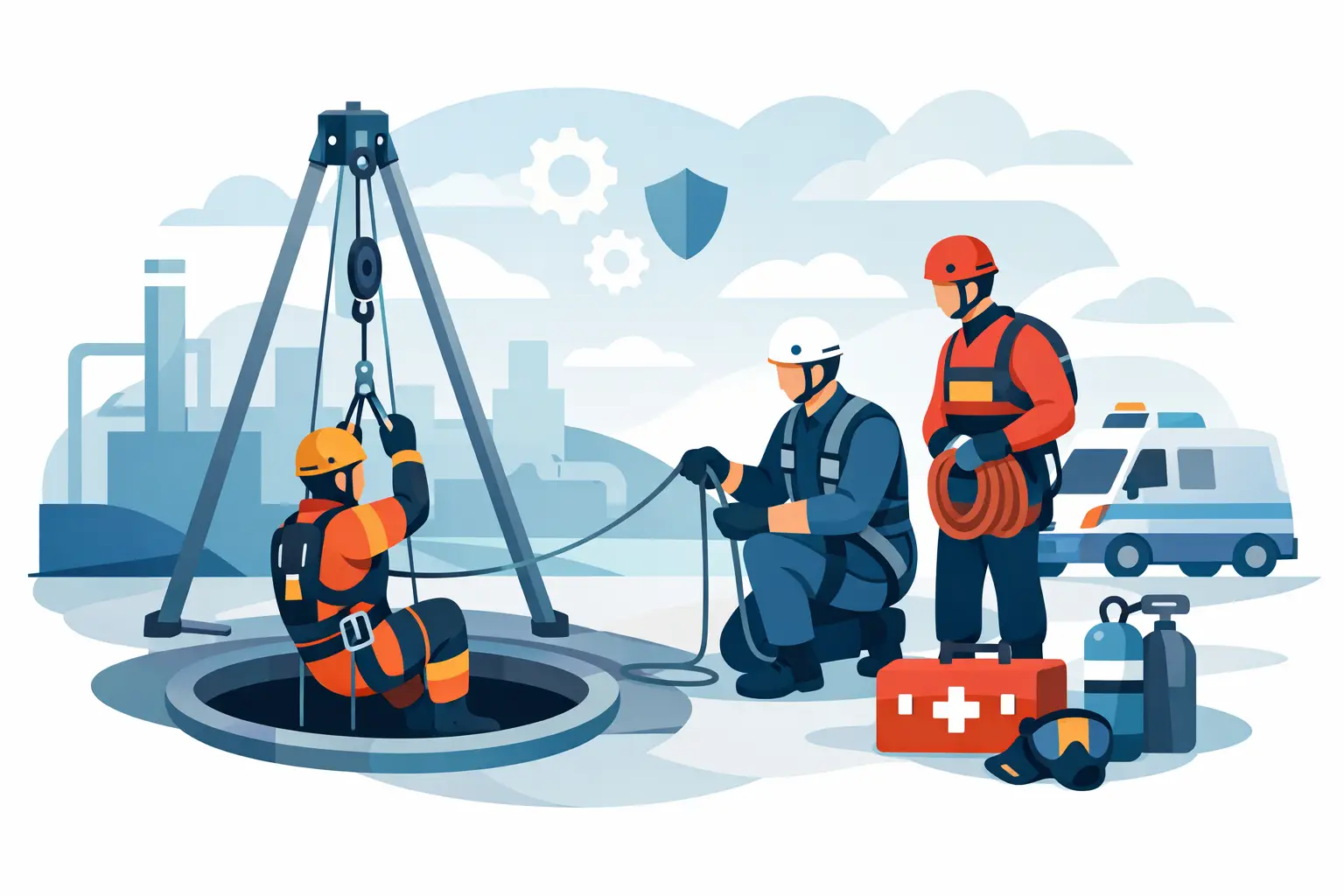
Rescue personnel require practical, scenario-based training for the actual recovery method. Depending on the risk assessment, this may include using a rescue tripod, winch, fall-arrest retrieval device, stretcher, harness, lowering and hauling system, resuscitation equipment, escape breathing apparatus or working breathing apparatus.
Where breathing apparatus is part of the rescue strategy, training must go beyond putting on a set. Rescuers need competence in pre-use checks, cylinder duration, communications, emergency procedures, casualty handling, hygiene, storage and maintenance arrangements. They also require sufficient physical capability for the task. Medical fitness and face-fit testing may be necessary where tight-fitting respiratory protective equipment is specified.
For higher-risk works, rescue teams should be trained and assessed in realistic vertical and horizontal retrieval scenarios. A rescue from a wet well, for example, may involve contaminated water, restricted headroom, an awkward ladder, a difficult casualty transfer and a potentially toxic atmosphere. The recovery method has to work in those conditions, not only during a demonstration in an open training area.
Training must follow the rescue plan
The most common weakness is buying a course first and designing the rescue plan afterwards. The correct sequence begins with assessment and control of the risk.
The risk assessment should identify foreseeable emergencies, including oxygen deficiency, toxic gas exposure, fire or explosion, flooding, engulfment, heat stress, loss of consciousness, falls, entrapment and failure of communications. It should consider the space’s geometry, access route, depth, distance from the entry point, internal obstructions, work equipment, simultaneous operations and the time needed for recovery.
These factors determine the training and equipment needed. A shallow chamber with a clear entrance and stable atmosphere may require a straightforward retrieval arrangement. A sewer network, process vessel or underground utility structure may demand a dedicated rescue team, specialist equipment and a more stringent level of operational control.
Emergency services remain vital, but they should not be the primary rescue provision where immediate action is needed. Fire and rescue services may not have site-specific knowledge, access equipment or immediate availability. The employer’s plan must enable prompt initial rescue and casualty recovery while emergency responders are mobilised.
Equipment alone does not create rescue capability
Tripods, retrieval winches, gas monitors and breathing apparatus are only effective when selected, inspected, maintained and used by competent people. A retrieval winch may be unsuitable if the casualty cannot pass the opening, if the line will foul on internal structures or if the entrant’s harness attachment point is inaccessible.
Rescue equipment should be identified in the safe system of work and checked before entry. This normally includes the condition, compatibility and certification status of harnesses, ropes, connectors, lifting devices, stretchers, communications equipment, atmospheric monitors and respiratory protective equipment. Site teams also need clear arrangements for quarantine and replacement of defective equipment.
Training should include equipment limitations. For example, a personal gas monitor does not remove the need for appropriate pre-entry testing, ongoing monitoring or forced ventilation where required. Likewise, a fall-arrest harness is not necessarily a suitable rescue harness for suspension, lifting or a complex casualty transfer.
Proving and maintaining competence
Certificates are useful evidence, but they are not the full competence record. Dutyholders should retain training certificates, practical assessment records, equipment familiarisation records, fitness evidence where applicable, face-fit records, rescue drills, toolbox talks and authorisation records. This creates an auditable trail for clients, principal contractors and regulators.
Refresher intervals should be set according to the task, the risk level, the amount of hands-on exposure and the training provider’s requirements. Retraining is also appropriate after an incident, a near miss, a long period without performing the role, changes to equipment or a significant change in the confined-space work activity.
Rescue drills are particularly valuable because they test the system rather than the paperwork. A drill can expose issues with site access, delayed communications, unclear responsibilities, insufficient rescue-team numbers or incompatible equipment. Drills should be recorded, debriefed and used to improve the plan, rather than treated as a pass-or-fail exercise.
Selecting suitable training for your operation
Training provision should match the risk profile rather than follow the lowest-cost option. Lower-risk entries may need awareness, entry control and basic emergency arrangements. Medium- and high-risk work may require formal entrant, top person, supervisor and rescue qualifications, alongside breathing-apparatus competence and practical rescue exercises.
For contractors working across utilities, civil engineering, manufacturing and construction sites, the training matrix also needs to align with client rules, permit systems and sector schemes such as EUSR where applicable. The principal contractor should verify competence before mobilisation, while the employer remains responsible for ensuring workers are trained for the actual work they will perform.
Evolution Safety Solutions can support organisations with confined-space training, competence mapping, rescue-plan review and practical assessment of site arrangements. The strongest control is not the certificate on file. It is a team that can identify an emergency early, recover a casualty safely and demonstrate that its arrangements will work under real site conditions.