A service strike can turn a routine drainage run, trial hole or foundation excavation into a life-changing event within seconds. EUSR combined Cat 1 & Cat 2 excavation safety training addresses the decisions that must be made before mechanical excavation starts and the controls that need to remain effective as conditions change on site. For contractors working around buried utilities, competence must be visible in the planning, the permit controls, the briefing record and the behaviour of the excavation team.
What EUSR Combined Cat 1 & Cat 2 Excavation Safety Covers
The combined category route is designed for operatives and supervisors whose work involves identifying buried services and managing safe excavation activity in their vicinity. It gives a structured understanding of the risks associated with underground apparatus and the practical controls expected by utility asset owners, principal contractors and clients.
Category 1 focuses on the principles of avoiding damage to underground services. This includes recognising why service records are not definitive, reviewing plans, identifying site indicators, and understanding the role and limitations of cable avoidance tools. It also considers the consequences of striking electricity, gas, water, telecommunications and other underground assets.
Category 2 applies those principles to excavation activity. Learners consider how safe systems of work are established, communicated and monitored where excavation takes place near known or suspected services. The course should reinforce the need for appropriate excavation methods, exclusion arrangements, trial holes, supervision and escalation where the available information does not match site conditions.
The practical value of combined training is not simply that personnel hold an EUSR record. It is that the team understands the sequence: obtain current information, assess uncertainty, locate and mark services, expose them safely where required, then control the excavation as work progresses. Skipping any part of that sequence creates an avoidable reliance on assumption.
Why Buried-Service Risk Requires More Than Plans
Utility plans are a critical planning input, but they are not a permit to excavate. Records can be incomplete, scaled differently from the proposed work area, based on historic surveys or affected by later alterations. Apparatus may have been diverted, abandoned, installed at an unexpected depth or poorly recorded.
HSG47, Avoiding danger from underground services, remains a central reference point for UK excavation controls. Its principles require dutyholders to plan the work, obtain and interpret service information, use detection methods appropriately, excavate carefully and maintain effective supervision. These requirements should be translated into project-specific RAMS rather than copied as generic wording.
A competent workforce is needed to challenge discrepancies. If detection results, drawings, visual evidence and ground conditions do not align, the correct response is to stop, reassess and seek clarification. Pressing on to protect a programme is not a defensible control measure.
The consequences vary by service, but all can be significant. Damage to an electrical cable may cause fatal injury, arc flash or widespread outage. A gas strike can introduce fire, explosion and evacuation risks. Water-main damage can undermine ground, flood excavations and disrupt public supply. A telecommunications strike may affect emergency communications, rail operations, businesses or critical infrastructure.
Who Should Complete the Combined Course?
EUSR combined Cat 1 and Cat 2 excavation safety is relevant to individuals who plan, supervise or undertake ground-breaking work near buried apparatus. This commonly includes civil engineering operatives, groundworkers, utility teams, highways contractors, drainage and fencing crews, machine operators, site supervisors and project managers.
The appropriate training route depends on the person’s role and the client or asset-owner specification. An operative using hand tools for trial holes needs practical understanding of the site controls and the limits of their authority. A supervisor needs a wider view: reviewing RAMS, checking drawings and scan results, confirming competence, arranging permits and ensuring changes are managed. A manager may not undertake detection or excavation personally, but still needs sufficient knowledge to resource and challenge the system.
Training does not replace role-specific authorisation. Organisations should define who is permitted to review utility plans, use locating equipment, issue excavation permits, alter exclusion zones or authorise mechanical excavation close to identified apparatus. These arrangements need to be clear before the shift starts, particularly where several subcontractors are working within one excavation zone.
Turning Training Into a Site Control System
A certificate alone cannot control excavation risk. The employer must integrate learning into its construction phase plan, RAMS, permit-to-dig procedure and supervisory checks. This is where training becomes operational assurance rather than an isolated compliance record.
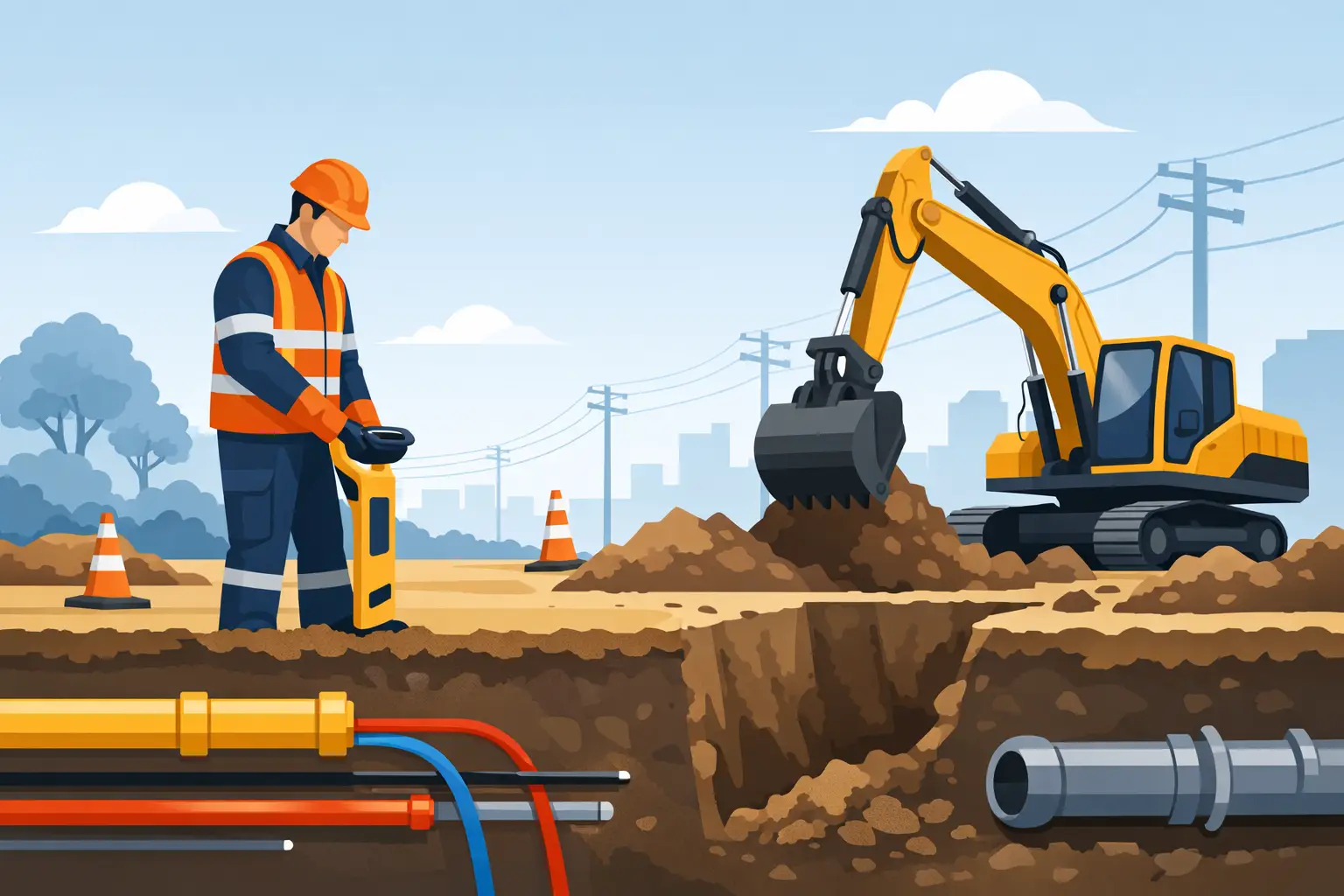
Before works begin, the responsible team should establish the scope of the excavation, identify relevant statutory undertakers and asset owners, obtain current plans, and review previous ground investigation information. The work area should then be walked over. Signs such as marker posts, chambers, cabinets, overhead connections entering the ground, reinstatement lines and changes in surface finish can all indicate the presence of buried services.
Detection should be undertaken by a competent person using suitable equipment and an agreed method. Cable avoidance tools provide valuable information, but they have limitations. They may not detect all materials or all services, and signal strength can be affected by depth, congestion, orientation and operating mode. A clear scan result should never be interpreted as proof that no apparatus exists.
Where services are identified or suspected, their locations should be marked clearly and protected from disturbance. The required safe approach distances, hand-digging methods and permit conditions must reflect the asset owner’s requirements and the task-specific risk assessment. Trial holes may be needed to confirm line and depth before mechanical plant is permitted to work nearby.
Conditions then need monitoring. Rain, standing water, plant movement, changing work fronts, newly discovered ducts and revisions to design information can all affect the adequacy of the original controls. Supervisors should treat a changed condition as a reason to pause and brief the team again, not as an administrative inconvenience.
The Interface With CDM 2015 and Principal Contractor Duties
Under CDM 2015, excavation hazards must be planned, managed and monitored through the project arrangements. Designers should provide relevant information about existing services and consider whether the proposed design reduces the need for high-risk excavation. The principal contractor must coordinate site controls, including induction content, traffic management, permits, welfare arrangements and workforce supervision.
For smaller projects, the same fundamentals apply even where roles are less formal. A contractor cannot rely on the absence of a principal contractor to justify weak planning. If the work involves excavation, the duty to assess risk and provide competent supervision remains.
Documentation needs to demonstrate more than intention. A defensible file may include utility plans, correspondence with asset owners, marked-up drawings, survey or scan records, permits, briefings, photographs of service markings, training evidence and inspection records. The exact format will depend on the client system and project scale, but the evidence should show how the team made decisions and controlled uncertainty.
Common Failings That Training Should Prevent
Many service strikes stem from predictable gaps rather than unusual technical problems. Plans are obtained but not issued to the workforce. A scan is completed but no clear markings are maintained. A trial hole exposes one service and personnel assume the corridor is clear. A permit is signed at the start of the week but the excavation location changes. Plant operators are briefed verbally but do not understand the agreed stand-off limits.
Another common weakness is poor coordination between excavation and other activities. A lifting operation, delivery route or temporary works installation can disturb marked ground or force a change to the planned work sequence. The excavation team must be able to stop work and obtain revised controls without being penalised for raising a concern.
Competence is also weakened when training is treated as a one-off event. Refresher requirements, client expectations, changes in equipment, lessons from near misses and site observation findings should inform ongoing supervision and toolbox talks. EUSR training supports the competence framework, but the employer remains responsible for maintaining capability in the field.
Selecting Training That Supports Audit Readiness
When arranging combined Cat 1 and Cat 2 training, confirm that the course meets the specification set by the client, principal contractor or utility network. Check the learner eligibility requirements, expected assessment method, EUSR registration arrangements and any prerequisite knowledge needed for the role.
Training records should sit alongside the organisation’s competence matrix, not in a disconnected folder. Managers should be able to identify who has completed the required learning, when renewal is due, which roles they are authorised to perform and where additional mentoring or supervision is necessary. This is especially relevant for contractors mobilising across multiple utility, infrastructure and civil engineering projects.
Evolution Safety Solutions can support organisations requiring EUSR-aligned excavation safety training alongside RAMS review, CDM 2015 support and wider competence-management arrangements. The strongest result is a workforce that can recognise buried-service risk early, apply the agreed controls consistently and stop work confidently when the information no longer supports a safe excavation.