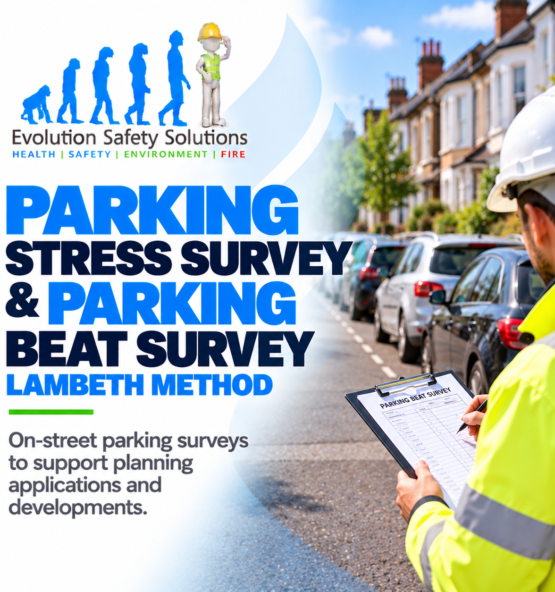
Assess parking demand and improve urban planning with our comprehensive Parking Stress Survey using the Lambeth Method, providing data-driven insights for effective parking management.
Turnaround is 14 to 21 days.
Call for a chat on 0333 339 9037
Availability:In Stock
Need a Parking Stress Survey or Parking Beat Survey to support a planning application, residential conversion, HMO or property development?
Evolution Safety Solutions Ltd provides professional Parking Stress Surveys, Parking Beat Surveys and Lambeth Method Parking Assessments throughout the UK.
Our surveys help developers, architects, planning consultants, landlords and property owners establish existing on-street parking demand, available parking capacity and the potential implications of additional parking demand.
When a proposed development has limited or no dedicated parking, local planning authorities may require supporting evidence to demonstrate whether surrounding streets can accommodate additional vehicles.
We provide practical parking investigations, measured vehicle occupancy data, parking capacity calculations and professional reports to support planning applications and development proposals.
Whether you are responding to a planning officer’s request, preparing a change-of-use application or addressing objections about parking congestion, we can help.
Parking Stress Surveys and Parking Beat Surveys from £1,250 + VAT.
Typical turnaround: 14–21 days, subject to survey scheduling and project requirements.
REQUEST YOUR PARKING SURVEY QUOTATION
A Parking Stress Survey assesses how heavily on-street parking is used within a defined area surrounding a proposed development.
It compares the number of vehicles parked with the practical parking capacity available on nearby streets.
The findings are expressed as a percentage, commonly referred to as parking stress.
For example, where 80 vehicles are recorded within an area containing 100 available parking spaces, the parking stress is 80%.
This information helps planning authorities and developers understand existing parking conditions and whether there may be sufficient capacity to accommodate additional demand.
A professional parking assessment provides measured evidence rather than relying on assumptions about local parking availability.
A Parking Beat Survey is an observational parking survey in which surveyors record vehicles parked within a defined area at specified times.
Each observation is commonly referred to as a parking beat.
Parking beat surveys can establish how parking occupancy changes throughout the day or night, depending on the agreed survey requirements.
They may be used to investigate:
Depending on the agreed scope, parking beat surveys may involve one or more observation periods.
Where required, the recorded information can be used alongside a parking capacity assessment to calculate parking stress.
Although the terms are frequently used together, they describe related aspects of parking assessment.
Parking Beat Survey: Records the number and location of parked vehicles during specified observation periods.
Parking Stress Survey: Assesses the recorded parking occupancy against the available parking capacity to calculate the level of parking stress.
Lambeth Method Parking Survey: Uses a recognised approach to defining parking capacity, observing occupancy and calculating parking stress, subject to relevant local authority requirements.
Our service can combine these activities to provide a comprehensive parking assessment for your development.
CONTACT US ABOUT YOUR PARKING BEAT SURVEY REQUIREMENTS
The Lambeth Method is a recognised approach to assessing on-street parking capacity and occupancy, originating from guidance associated with the London Borough of Lambeth.
It is commonly referenced in planning applications where a proposed development may increase demand for surrounding parking spaces.
The assessment generally considers:
The appropriate survey radius, observation times and assessment criteria depend on the local planning authority’s requirements.
Not every council applies identical methodology or parking stress thresholds.
We therefore review the relevant planning requirements before confirming the survey scope.
Parking availability can be an important consideration when determining planning applications.
A local authority may request parking evidence where a proposed development introduces additional residents, visitors or vehicle movements without providing sufficient dedicated parking.
Our parking surveys can support the following types of development.
New housing developments may increase demand for surrounding on-street parking.
A Parking Stress Survey can establish existing parking occupancy and available capacity to inform the planning assessment.
Converting a single property into several flats can create additional parking demand.
A Parking Beat Survey provides recorded evidence of parking occupancy during agreed observation periods.
The results can then inform the parking stress assessment.
HMO planning applications can attract concerns about parking congestion and the number of vehicles associated with additional occupants.
Our surveys assess existing parking demand and provide supporting evidence for the proposed development.
Developments proposing limited or no dedicated parking may require evidence about existing on-street parking conditions.
A parking assessment can help establish whether spare capacity exists, alongside consideration of local parking policies and transport accessibility.
Changing the use of a building may alter parking demand.
A Parking Beat Survey or Parking Stress Assessment can provide evidence of existing parking conditions where the proposed use raises parking concerns.
Where parking availability is disputed, a professional survey can provide recorded evidence of actual parking conditions.
This information may support planning representations or appeals.
Some planning permissions require parking surveys or additional parking evidence before development proceeds.
Our reports can provide supporting information where the agreed survey scope meets the relevant condition.
Has your planning officer requested a Parking Beat Survey, Parking Stress Survey or Lambeth Method assessment?
Send us the relevant planning comments or application details, and we can review the requirements.
REQUEST A PARKING SURVEY QUOTATION
We provide structured parking investigations tailored to the proposed development and the relevant planning requirements.
We begin by reviewing the development proposal and identifying the purpose of the parking assessment.
Where available, we consider:
This information helps establish the appropriate survey methodology.
We identify the surrounding roads to be included within the agreed survey area.
The assessment may use a defined walking-distance catchment, depending on the relevant planning requirements.
The extent of the survey is confirmed before attendance.
Where parking stress calculations are required, we establish the practical on-street parking capacity within the agreed survey area.
This includes considering restrictions and physical constraints such as:
The objective is to identify the available parking capacity rather than simply measuring the total length of the surrounding roads.
Our surveyors undertake parking beats during the agreed observation periods.
During each parking beat, we record parked vehicles within the defined survey area.
Depending on the requirements, the observations may include:
Residential parking beat surveys are commonly undertaken during overnight periods, when residents are more likely to have returned home.
However, different development types may require daytime, evening or multiple observation periods.
The appropriate survey dates and times are agreed in advance.
Where required, we calculate parking stress by comparing observed parking occupancy against available parking capacity.
Parking Stress (%) = Observed Parked Vehicles ÷ Available Parking Capacity × 100
For example:
The calculations provide a measurable indication of parking demand relative to available capacity.
The significance of the findings depends on the applicable local planning criteria.
Following completion of the agreed survey, we prepare a structured report.
The report explains the methodology, survey observations, calculations and findings.
It can then be provided to your planning consultant, architect or local planning authority.
Our professional Parking Stress Survey or Parking Beat Survey report will typically include:
The report provides structured evidence to support the planning and development process.
Please note: Our standard service does not automatically include a full Transport Statement, Transport Assessment, highway design or planning appeal representation.
Any additional work would require a separately agreed scope.
Our Parking Stress Survey and Parking Beat Survey service starts from £1,250 + VAT.
The final fee depends on the location, survey area and specific requirements.
Factors influencing the cost may include:
Larger survey areas or multiple observation periods may require additional survey time.
We confirm the scope and agreed fee before proceeding.
Planning submissions, appeals and planning committee dates can create time pressures.
We aim to accommodate project programmes wherever practicable.
However, parking surveys must be scheduled for appropriate dates and times to produce representative observations.
School holidays, public holidays, major local events and other unusual circumstances may affect survey suitability.
Typical turnaround: 14–21 days, subject to survey scheduling and agreed scope.
GET A QUOTATION FOR YOUR PARKING SURVEY
To provide an accurate quotation, please send us the following information where available.
1. Development Address
The full address and postcode of the proposed development.
2. Description of the Proposed Development
For example, a house conversion, HMO, new residential development or change of use.
3. Planning Application Reference
If an application has already been submitted, please provide the reference number.
4. Planning Officer’s Comments
If the local authority has requested a Parking Beat Survey or Parking Stress Survey, please forward the relevant correspondence.
5. Proposed Parking Arrangements
Details of any existing or proposed off-street parking spaces.
6. Development Plans
A site location plan or proposed development drawings, where available.
7. Required Completion Date
Please advise us of any planning submission or appeal deadlines.
If you do not have all the information available, we can explain what is required before confirming the survey scope.
Contact Evolution Safety Solutions with your development details, site address and relevant planning correspondence.
We review the planning requirements and establish the appropriate survey methodology.
We provide a quotation based on the agreed survey area, number of parking beats and reporting requirements.
We schedule the required observations for suitable dates and times.
Our team records vehicle occupancy, assesses parking capacity where required and calculates parking stress.
We prepare the report for your planning consultant, architect or local planning authority.
CONTACT US TO ARRANGE YOUR PARKING SURVEY
We provide structured parking investigations using recorded observations and clearly documented calculations.
Our assessments are designed to provide relevant technical information for planning and development projects.
We can undertake parking occupancy observations and associated parking stress calculations within an agreed scope.
This allows clients to obtain the parking information required for their development without commissioning unnecessary additional services.
Our reports present the methodology, recorded data, calculations and findings in a logical format.
We identify relevant assumptions and limitations so that the results can be interpreted appropriately.
We explain the survey scope and associated costs before undertaking the work.
Where additional parking beats or specialist requirements are necessary, these are identified during the quotation process.
Evolution Safety Solutions is based in South Wales and provides consultancy services throughout the UK.
We can support developments in London, Wales, the South East, the Midlands and other locations, subject to availability and agreed arrangements.
We also provide environmental and development-related consultancy services.
Where a project requires additional supporting assessments, our team can discuss the relevant requirements.
A Parking Stress Survey assesses the level of on-street parking demand compared with the available parking capacity within a defined area.
A Parking Beat Survey involves recording parked vehicles within a defined area at specified times.
The observations can provide evidence of parking occupancy and may be used to calculate parking stress.
A parking beat records vehicle occupancy during a particular observation period.
A parking stress assessment compares occupancy with available capacity to calculate the percentage of parking spaces being used.
The Lambeth Method is a recognised approach to assessing on-street parking capacity and occupancy for planning purposes.
It is commonly associated with residential developments where additional parking demand may arise.
Our parking survey service starts from £1,250 + VAT.
The final cost depends on the survey area, number of observation periods and reporting requirements.
Not every development requires one.
However, a local planning authority may request parking occupancy evidence where a development could increase parking demand or where proposed parking provision is limited.
Yes. A parking beat survey can provide evidence of existing parking occupancy around a proposed HMO.
Where required, the findings can inform a parking stress assessment.
Residential parking surveys are commonly undertaken overnight, when residents are more likely to be at home.
Other development types may require different observation periods.
The number of observations depends on the relevant local authority requirements and the agreed survey methodology.
Some assessments require multiple observations across different dates or times.
The survey area depends on the applicable methodology and planning requirements.
We establish the appropriate walking distance and surrounding streets before undertaking the survey.
High parking stress indicates that a substantial proportion of available parking capacity is occupied.
The threshold considered significant varies between planning authorities and assessment methodologies.
No. The survey provides supporting evidence, but the planning authority determines the outcome of the application.
Our typical turnaround is 14–21 days, subject to survey scheduling, the number of required observations and reporting requirements.
Yes. We provide UK-wide parking survey services, subject to location and availability.
Yes. We can provide parking occupancy and capacity evidence that may support planning appeal submissions.
Any wider appeal representation or specialist transport planning advice would require a separately agreed scope.
If your development requires a Parking Stress Survey, Parking Beat Survey or Lambeth Method Parking Assessment, Evolution Safety Solutions can help.
We provide professional on-street parking surveys, vehicle occupancy observations, parking capacity calculations and structured reports for planning applications throughout the UK.
Whether you are converting a property into flats, developing an HMO, constructing new housing or responding to a planning officer’s request, our team can help you obtain the relevant parking evidence.
Parking Surveys from £1,250 + VAT.
Typical turnaround: 14–21 days.
REQUEST YOUR PARKING STRESS SURVEY OR PARKING BEAT SURVEY QUOTATION
Evolution Safety Solutions Ltd – Professional Parking Stress Surveys, Parking Beat Surveys and Lambeth Method Parking Assessments Across the UK.