Schedule Meeting

Workplace Noise Assessments | HSE Noise Surveys & Monitoring

workplace-noise-assessments-occupational-noise-surveys-uk

Workplace Noise Assessments | HSE Noise Surveys & Monitoring

From £750.00 Excl Vat

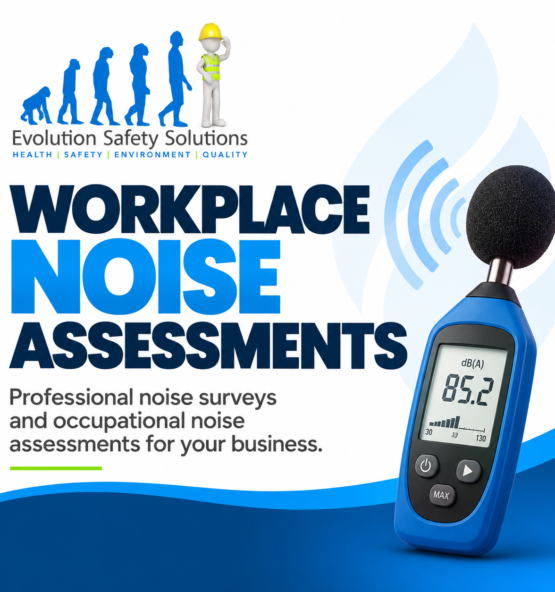
We will come to your site, carry out a full Noise assessment inspection and provide you with a written report of the findings with any action points as maybe required. Cost is from £750+vat
Call 03333 399 037

Workplace Noise Assessments – Professional HSE Noise Surveys and Occupational Noise Monitoring

Protect Your Employees’ Hearing and Meet Your Legal Noise Exposure Obligations

Professional workplace noise assessments and occupational noise exposure surveys throughout the UK.

Is your business exposing employees to potentially harmful levels of workplace noise?

Excessive noise can cause permanent hearing damage, increase workplace risks and expose employers to enforcement action where suitable precautions have not been taken.

At Evolution Safety Solutions Ltd, our qualified health and safety consultants provide professional workplace noise assessments to help businesses identify noise hazards, evaluate employee exposure and establish effective control measures.

Our services support employers in meeting their duties under the Control of Noise at Work Regulations 2005.

Whether you operate a manufacturing facility, engineering workshop, construction site, warehouse or industrial premises, we can help you understand and manage occupational noise exposure.

Protect your workforce. Understand your noise exposure. Take control of workplace risks.

Call 03333 399 037 or request your workplace noise assessment quotation.

What Is a Workplace Noise Assessment?

A workplace noise assessment evaluates the risks associated with employees’ exposure to noise during their working activities.

It considers the noise generated by machinery, equipment, processes and the working environment.

However, measuring the sound level at one location does not necessarily establish an employee’s actual exposure.

A suitable assessment must consider how noise levels vary, how long employees spend undertaking different activities and whether they are exposed to significant peak sound pressures.

Our consultants assess these factors to help determine whether employees are exposed to potentially harmful noise levels.

Where appropriate, we measure workplace sound levels and calculate or estimate daily or weekly personal noise exposure.

We then identify suitable precautions and provide practical recommendations.

Why Does Your Business Need a Workplace Noise Assessment?

Under Regulation 5 of the Control of Noise at Work Regulations 2005, employers must make a suitable and sufficient assessment of the risk from noise where employees are likely to be exposed at or above the lower exposure action values.

The purpose is to identify employees who may be at risk and determine the measures necessary to comply with the Regulations.

Prolonged exposure to excessive workplace noise can contribute to:

  • Permanent noise-induced hearing loss.
  • Tinnitus and other hearing-related symptoms.
  • Difficulties communicating in noisy environments.
  • Reduced awareness of warning signals.
  • Increased risk of workplace accidents.
  • Long-term occupational health problems.

A professional noise assessment helps your organisation understand these risks and implement proportionate controls.

It can also support your wider occupational health and safety management arrangements.

Do You Know Whether Your Employees Are Exposed to Excessive Noise?

If your employees regularly need to raise their voices to communicate at close range, or work around noisy machinery, a more detailed assessment may be necessary.

Speak to our workplace noise consultants or telephone 03333 399 037.

HSE Workplace Noise Exposure Limits and Action Values

The Control of Noise at Work Regulations 2005 establish exposure action values and exposure limit values.

These values help employers determine when additional precautions are required.

Noise exposure thresholdDaily or weekly personal exposurePeak sound pressure
Lower exposure action value80 dB(A)135 dB(C)
Upper exposure action value85 dB(A)137 dB(C)
Exposure limit value87 dB(A)140 dB(C)

The daily or weekly exposure values are expressed as personal noise exposure levels, rather than simply the sound pressure measured at a particular machine.

Lower Exposure Action Value – 80 dB(A)

At or above the lower exposure action values, employers must take specified steps, including providing appropriate information and training.

Suitable hearing protection must also be made available where required.

Upper Exposure Action Value – 85 dB(A)

At or above the upper exposure action values, employers must establish and implement a programme of technical or organisational measures to reduce noise exposure.

They must also ensure suitable hearing protection is used where required and designate hearing protection zones where appropriate.

Exposure Limit Value – 87 dB(A)

Employees must not be exposed above the exposure limit values.

For the purpose of assessing compliance with exposure limit values, the attenuation provided by suitable hearing protection is taken into account.

However, hearing protection is not deducted when determining whether the lower or upper exposure action values have been reached.

Our occupational noise assessments help employers understand these thresholds and their implications.

Our Professional Workplace Noise Assessment Services

Evolution Safety Solutions provides occupational noise assessment services tailored to your workplace, equipment and operational activities.

1. Initial Workplace Noise Review

We begin by understanding your operations and identifying activities that may expose employees to significant noise.

This includes reviewing:

  • Machinery and equipment.
  • Work processes and operating conditions.
  • Employee roles and working patterns.
  • Duration and frequency of noisy activities.
  • Existing noise controls.
  • Hearing protection arrangements.
  • Previous noise surveys or monitoring results.

This initial review helps establish an appropriate measurement and assessment strategy.

2. Workplace Noise Measurements

Our consultants undertake sound level measurements using appropriate noise measurement equipment.

Depending on the assessment requirements, measurements may include:

  • A-weighted equivalent continuous sound pressure levels.
  • C-weighted peak sound pressure levels.
  • Noise measurements associated with individual activities.
  • Measurements near relevant machinery and workstations.
  • Representative operating conditions.
  • Variations in noise exposure during different tasks.

Measurements are undertaken using appropriate methods and equipment for the agreed scope.

Where necessary, we can discuss more detailed personal exposure monitoring or specialist occupational hygiene services.

3. Employee Noise Exposure Assessment

Employee exposure depends on both the sound level and the duration of exposure.

Our consultants consider the tasks employees undertake and the time spent in different noise environments.

Where sufficient information is available, we calculate or estimate personal daily noise exposure.

For example, an employee who operates noisy equipment for a short period may have a different exposure from someone working near moderately noisy machinery throughout an entire shift.

We can also consider weekly exposure where the regulatory criteria for using that approach are satisfied.

This provides a more meaningful assessment than relying on isolated sound level readings.

4. Comparison Against HSE Action Values

We compare the assessment findings against the relevant exposure action values and limit values.

This helps identify:

  • Employees who may require additional protection.
  • Activities that contribute significantly to exposure.
  • Areas where noise reduction measures are necessary.
  • Requirements for information and training.
  • Potential hearing protection arrangements.
  • Whether further investigation or monitoring is appropriate.

The findings provide a basis for proportionate management decisions.

5. Assessment of Existing Noise Controls

Our consultants review the measures already used to manage workplace noise.

These may include:

  • Quieter machinery and equipment.
  • Engineering noise controls.
  • Acoustic enclosures and barriers.
  • Machinery maintenance.
  • Isolation of noisy processes.
  • Changes to working methods.
  • Reducing time spent in noisy environments.
  • Hearing protection selection and use.
  • Employee information and supervision.

Where improvements are necessary, we identify suitable options based on the assessment findings.

6. Workplace Noise Assessment Report

Following the assessment, we prepare a professional report setting out the findings and relevant recommendations.

Depending on the agreed scope, the report may include:

  • Description of the premises and activities.
  • Relevant legislation and assessment criteria.
  • Measurement methodology.
  • Equipment information.
  • Recorded sound levels.
  • Employee exposure calculations or estimates.
  • Comparison against regulatory action values.
  • Existing noise control measures.
  • Identification of employees or activities at risk.
  • Recommended improvements.
  • Relevant management actions.

Our objective is to provide clear information that your business can use to manage workplace noise effectively.

Workplace Noise Assessments for Different Industries

Manufacturing and Production Facilities

Manufacturing environments frequently contain machinery that generates significant noise.

Examples include presses, compressors, cutting equipment, conveyors and production lines.

Our consultants can assess employee exposure during representative production activities and identify appropriate control measures.

Engineering and Fabrication Workshops

Engineering activities such as grinding, cutting, drilling, welding preparation and fabrication can create significant occupational noise.

We assess relevant tasks and working patterns to help employers understand exposure risks.

Construction Sites

Construction workers may encounter noise from breakers, saws, drills, generators, compressors and other equipment.

Our assessments can consider specific activities, work areas and employee exposure patterns.

Warehousing and Distribution

Noise may arise from mechanical handling equipment, conveyors, loading activities and industrial processes.

We can assess relevant exposure conditions and provide practical recommendations.

Utilities and Infrastructure

Utilities and infrastructure operations may involve pumps, generators, compressors, treatment equipment and maintenance activities.

Our consultants can assess workplace noise risks associated with these operations.

Commercial and Specialist Workplaces

Some commercial premises, workshops, leisure facilities and specialist operations also generate potentially harmful workplace noise.

Where employee exposure is the primary concern, an occupational noise assessment may be appropriate.

What Is the Difference Between a Workplace Noise Assessment and an Environmental Noise Survey?

Workplace noise assessments and environmental noise surveys address different questions.

A workplace noise assessment focuses on the potential harm caused to employees by occupational noise exposure.

An environmental noise survey considers sound affecting neighbouring properties, communities or other noise-sensitive locations.

Workplace noise assessmentEnvironmental noise assessment
Focuses on employee exposureFocuses on noise affecting external receptors
Primarily addresses the Control of Noise at Work RegulationsMay address planning or statutory nuisance considerations
Considers personal exposure over working periodsConsiders environmental sound levels and characteristics
Supports occupational hearing protection and noise controlSupports environmental noise management and planning decisions

Evolution Safety Solutions can discuss both occupational and environmental noise requirements.

However, the appropriate methodology and scope must be established before work begins.

Not sure which type of noise assessment your business needs?

Contact our consultants and explain your circumstances.

When Should a Workplace Noise Assessment Be Reviewed?

A noise risk assessment must be reviewed regularly and immediately where there is reason to suspect it is no longer valid or there has been a significant change in the work.

Relevant changes may include:

  • Installation of new machinery.
  • Changes to production processes.
  • Increased operating hours.
  • Changes in employee working patterns.
  • Introduction of noisier equipment.
  • Changes to existing noise controls.
  • Findings from health surveillance.
  • Evidence that previous exposure estimates are no longer representative.

The review should reflect the nature of the risks and any relevant changes in workplace conditions.

A new measurement survey is not necessarily required every time an assessment is reviewed. However, further measurements may be appropriate where existing information is insufficient.

What Information Do We Need for Your Noise Assessment?

To establish the appropriate scope and provide a quotation, we will normally ask for:

  1. The address and nature of your workplace.
  2. A description of the noisy machinery or processes.
  3. The approximate number of employees potentially exposed.
  4. Normal operating hours and shift patterns.
  5. Details of the activities requiring assessment.
  6. Any previous noise survey reports.
  7. Information about existing noise controls and hearing protection.

We may also request a site layout, equipment list or other relevant operational information.

Where possible, measurements should reflect representative working conditions.

Consequently, we may need to arrange attendance while the relevant machinery and processes are operating.

How Our Workplace Noise Assessment Service Works

Step 1 – Contact Our Consultancy Team

Tell us about your workplace, the activities involved and your concerns about noise exposure.

Step 2 – We Establish the Assessment Scope

We review your requirements and identify the appropriate measurement strategy.

This includes considering the premises, operating activities and employees who may be exposed.

Step 3 – We Confirm the Fee and Attendance Arrangements

We provide a quotation based on the agreed scope.

We also arrange a suitable time to undertake the necessary measurements.

Step 4 – We Undertake the Noise Assessment

Our consultant attends the workplace, gathers relevant information and undertakes the agreed noise measurements.

Where appropriate, we assess representative employee activities and exposure durations.

Step 5 – We Prepare Your Professional Report

We analyse the results, compare the findings against relevant regulatory criteria and prepare the assessment report.

The report identifies relevant risks and recommends appropriate management actions.

Request a workplace noise assessment quotation.

Why Choose Evolution Safety Solutions?

Experienced Health and Safety Consultants

Our consultants have extensive experience across engineering, manufacturing, construction, utilities and other operational environments.

We understand the practical challenges of managing occupational risks while maintaining productive operations.

OSHCR-Registered Professional Expertise

Our senior team includes consultants registered on the Occupational Safety and Health Consultants Register.

This supports our commitment to professional health and safety consultancy.

Certified Management Systems

Evolution Safety Solutions operates certified management systems covering:

  • ISO 9001 – Quality Management.
  • ISO 14001 – Environmental Management.
  • ISO 45001 – Occupational Health and Safety Management.

Practical Recommendations

We aim to provide realistic noise control recommendations that reflect your workplace and operational circumstances.

Our assessments focus on identifying relevant exposure risks and suitable precautions.

Wider Health and Safety Consultancy

We also provide COSHH assessments, DSEAR consultancy, workplace risk assessments, fire safety services and retained health and safety support.

This allows businesses to access complementary consultancy services where necessary.

UK-Wide Coverage

Based in South Wales, Evolution Safety Solutions provides professional consultancy services throughout the UK.

We can arrange workplace noise assessments at commercial and industrial premises across England, Wales, Scotland and other UK locations.

Frequently Asked Questions About Workplace Noise Assessments

Is a workplace noise assessment a legal requirement?

Where employees are likely to be exposed at or above the lower exposure action values, employers must carry out a suitable and sufficient noise risk assessment under the Control of Noise at Work Regulations 2005.

At what noise level is a workplace noise assessment required?

The lower exposure action value is 80 dB(A) for daily or weekly personal noise exposure, or 135 dB(C) for peak sound pressure.

These are exposure criteria rather than a simple threshold for every individual sound level measurement.

What is the 85 dB rule?

The upper exposure action value is 85 dB(A) for daily or weekly personal exposure.

At or above this level, employers must implement additional noise reduction measures and ensure appropriate hearing protection is used where required.

Can you measure noise from machinery?

Yes. We can measure sound levels associated with machinery and equipment as part of an agreed workplace noise assessment.

Does the assessment include personal noise exposure calculations?

Where the scope and available information permit, we can calculate or estimate daily personal noise exposure using relevant sound level and exposure duration data.

Do you provide workplace noise assessments for construction sites?

Yes. We can assess occupational noise exposure associated with relevant construction activities and equipment.

How long does a workplace noise assessment take?

The duration depends on the size of the premises, number of processes, working patterns and complexity of the assessment.

We will discuss the anticipated attendance requirements when preparing your quotation.

Does a noise assessment include hearing protection recommendations?

Yes. Where appropriate, we can recommend suitable hearing protection arrangements and identify circumstances requiring additional control measures.

Do you provide noise assessments throughout the UK?

Yes. We provide workplace noise assessment services to businesses across the UK.

Can you assess noise complaints from neighbouring properties?

We can discuss environmental or nuisance noise concerns. However, these require a different assessment scope and methodology from occupational noise exposure surveys.

How much does a workplace noise assessment cost?

The cost depends on the size of the workplace, number of activities, complexity of employee exposure and measurement requirements.

Contact our team for a quotation based on your premises and operations.

Book Your Workplace Noise Assessment Today

Protect Your Employees’ Hearing and Take Control of Occupational Noise Exposure

Excessive workplace noise can cause permanent hearing damage.

Understanding your employees’ exposure is an important first step towards establishing effective precautions and meeting your legal responsibilities.

At Evolution Safety Solutions, we provide professional workplace noise assessments that help employers identify risks, evaluate exposure and improve noise management arrangements.

Whether you operate a small engineering workshop or a large industrial facility, our consultants can discuss your requirements.

Call our team today on 03333 399 037.

ENQUIRE NOW – REQUEST YOUR WORKPLACE NOISE ASSESSMENT

Evolution Safety Solutions Ltd – Professional Workplace Noise Assessments, Occupational Noise Monitoring and Health and Safety Consultancy Throughout the UK.